AWS Is Raising GPU Rental Prices 20% on July 1, Its Second Hike This Year
TL;DR
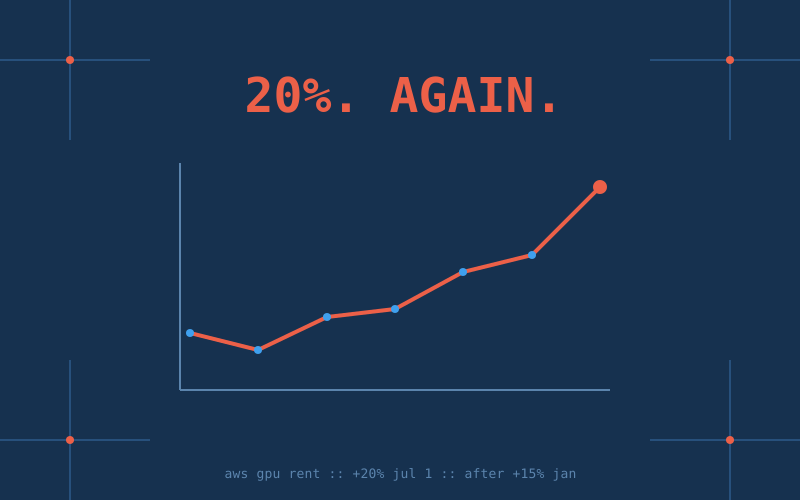
Amazon Web Services updated the published rates for EC2 Capacity Blocks for ML, the product you use to reserve a block of Nvidia GPUs for a fixed window. The new rates take effect July 1, 2026, and across the affected instance families they are about 20% higher. This is the second increase of the year: AWS already raised the same product roughly 15% in January. For an H100-class block that got hit by both, the compounded effect is about 38% more than you paid at the start of 2026. No new chips, no new features, same silicon, higher bill. If your inference or training budget rides on rented Capacity Blocks, this lands in five days.
What actually changed
Capacity Blocks are AWS's answer to the GPU shortage: instead of hoping an on-demand p5.48xlarge is free when you need it, you reserve a guaranteed block of accelerators for a set window, days or weeks, and pay up front. The convenience is that the GPUs are definitely there. The catch is that the price is not fixed policy, it floats. AWS's own line is that "reservation prices are updated periodically based on supply and demand," which is a polite way of saying the meter moves when demand is hot.
Think of it like surge pricing for a rental car at an airport during a holiday rush, except the holiday is "the entire AI industry trying to train at once" and it does not end in January. The new per-accelerator hourly rates that kick in July 1 are concrete: $14.04 for a Blackwell Ultra P6-B300 GPU, $12.36 for a P6-B200, $6.87 for an H100 on P5en, $5.97 for an H200 on P5e, $5.19 for an H100 on P5, and $2.21 for an older A100 on P4de. AWS's Trainium accelerators, Trn1 and Trn2, are in the adjustment too, so this is not strictly an Nvidia tax.
Those are per-GPU numbers. A standard P5 node packs eight of them, so a single p5.48xlarge reservation runs north of $41 an hour at the new H100 rate. Hold that block continuously for a month and you are looking at roughly $30,000 for one eight-GPU box, before storage, egress, or the inevitable second box.
This is the second hike, and that is the real story
One price bump is noise. Two in six months is a trend, and the trend is the point. AWS raised Capacity Block prices about 15% back in January, hitting P5 and P5e (H100 and H200) instances, with the same supply-and-demand explanation. Now another roughly 20% lands in July, this time reaching the newer Blackwell P6 instances as well. The increases compound: 1.15 times 1.20 is 1.38, so an H100 block that got both adjustments now costs about 38% more than it did in December 2025.
The direction is the opposite of what most of us were trained to expect from cloud. The old gospel was that compute gets cheaper every year, you ride the curve down, and last year's instance is this year's bargain. GPU scarcity broke that. Demand for accelerators is outrunning supply badly enough that AWS can raise the price on hardware that has been in the catalog for a year and watch it sell out anyway. AWS revenue grew 28% year over year to $37.6 billion in Q1 2026, so the customers are clearly still paying.
Why this should change how you plan
If you are a builder, the lesson is not "AWS is greedy," it is "rented GPU pricing is now a variable you cannot model as flat." A few concrete adjustments:
- Lock in before July 1 if you can. A Capacity Block reserved at the current rate holds that rate for its window. Five days of lead time is worth real money on a multi-week training run.
- Re-run your build-versus-rent math. At about $5.19 per H100-hour, a single GPU rented continuously is roughly $3,800 a month. That number used to make owning hardware look like a hobbyist indulgence. At a second hike in six months, the payback window on a local rig keeps shrinking.
- Right-size the chip to the job. An A100 on P4de is $2.21 an hour against $5.19 for an H100. Plenty of inference and fine-tuning workloads do not need Hopper, let alone Blackwell, and the old silicon took a smaller hit.
- Treat multi-cloud and spot as a hedge, not a religion. When one provider's reserved price ratchets up twice a year, having a fallback that is already wired and tested is leverage, even if you never pull the trigger.
The homelab angle
This is the kind of news that quietly validates everyone running inference on a box in their basement. The whole pitch of self-hosting was insulation from exactly this: a vendor moving your unit economics 38% in six months with a pricing-page edit and zero notice. You trade the cloud's elasticity for a fixed, known, depreciating capital cost and a power bill you control. For steady, predictable workloads, that trade looks better with every hike. For bursty or frontier-scale training, the cloud's "the GPUs are definitely there" guarantee is still worth paying for, just be honest that the toll keeps going up.
Key Takeaways
- AWS raised EC2 Capacity Blocks for ML reserved GPU rates about 20%, effective July 1, 2026, announced June 26.
- New per-accelerator hourly rates include $14.04 (P6-B300), $12.36 (P6-B200), $6.87 (H100 on P5en), and $5.19 (H100 on P5); Trainium Trn1 and Trn2 are affected too.
- It is the second 2026 hike after a roughly 15% increase in January, compounding to about 38% more for H100-class instances since December 2025.
- AWS attributes the move to supply and demand; GPU scarcity has inverted the usual "cloud gets cheaper" curve.
- Reserve before July 1 to hold the current rate, re-check your build-versus-rent math, and match the chip to the workload instead of defaulting to the newest GPU.
Sources: AWS EC2 Capacity Blocks pricing, Investing.com, Seeking Alpha, Network World, InfoQ