Deezer Survey: 80% Want AI Music Labeled as UMG Reports 68% Want a Kill Switch
On this page 7 sections
TL;DR
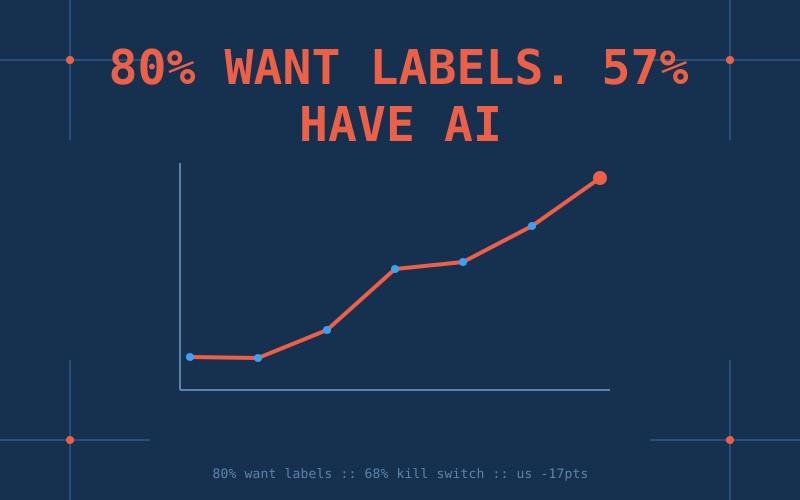
Deezer published the second edition of its AI x Music barometer on November 17: Ipsos surveyed 9,000 adults in eight countries, and 80% want every AI-related track, fully generated or merely AI-assisted, clearly labeled. The self-knowledge gap is the sharper finding: 74% of streaming users believe their playlists hold no fully AI music, while 57% of the 53,000-plus people who joined Deezer in October already carried at least one such track. US attitudes swung against AI across the board in a single year, and a day after the survey landed, Universal Music Group's digital chief told an investor conference that 68% of listeners want what UMG calls a kill switch.
What the barometer measured
Ipsos fielded the survey online from October 9 to 14: 9,000 adults across the US, Canada, Brazil, the UK, France, the Netherlands, Germany and Japan, 2,000 of them in the US, and 6,672 of the total use a streaming service. It is the second annual run, so year-over-year movement is in the data, with the Ipsos scorecards published alongside. Deezer sells the detection technology this argument runs on, and it is now licensing that tech to the wider industry. The fieldwork is Ipsos's; keep the buyer in mind anyway.
The demand side is close to a consensus. Beyond the 80% for labeling, 72% of streaming users want to know when their platform recommends fully AI music, and 60% say fully AI songs should stay off the main charts, up eight points in a year. Only 7% think fully AI tracks deserve equal chart treatment. Curiosity outruns appetite: 61% would try a fully AI track once, and 43% say they would skip one without listening.
The filter number deserves care. This year 41% of streaming users said they want to filter fully AI music out of their service. Last year 45% said yes to the same idea, and Ipsos says the two are not comparable because the answer options changed. Treat the trend as flat, and high.
The playlist blind spot
Seventy-four percent of streaming users believe their playlists contain no fully AI music. Deezer scanned the libraries of the more than 53,000 subscribers who joined from other services in October, and 57% already had at least one fully AI track. Listeners are wrong about their own libraries, and last year's edition showed why nobody catches it by ear: 97% of respondents failed to tell fully AI music from human-made music in a blind test, per Music Business Worldwide.
The supply side explains the blind spot. Deezer now receives nearly 90,000 fully AI tracks a day, more than half of all music delivered on peak days, and it tagged 13.4 million of them in 2025. Those tracks draw 1-3% of streams, and up to 85% of the streams they did draw in 2025 were fraudulent, manipulated rather than listened to. The most prolific artist on the platform has no heartbeat.
The US turned in a year
Every general-attitude question moved against AI in the US, the only market where reported listening of fully AI music also fell, from 52% to 45%. The share calling AI a valuable tool for musicians dropped from 54% to 37%; those expecting AI to play a significant role in music creation fell from 62% to 51%; belief that fully AI music will become popular fell from 60% to 41%. Trust in AI among US respondents who had heard of it fell from 32% to 21%. Ipsos's summary of the US findings, quoted by MBW: "perceptions have shifted from enthusiasm to caution versus last year."
The spread across countries is wide enough to plan a launch around. France wants labels most, 88% for fully AI music and 90% for AI-assisted, and 76% there worry AI costs music its creativity. Brazil is the friendly market: 61% call AI a valuable tool against 35% globally. Japan reports the least exposure, with 46% saying they have never listened to fully AI music, down six points in a year, so even that wall is eroding.
Two numbers, one direction
On November 18 in Barcelona, at the Morgan Stanley European Technology, Media and Telecom conference, UMG executive vice president and chief digital officer Michael Nash put a bigger number on the same demand: "The vast majority of consumers demand transparency. They want the [AI-generated] content identified. They want the content labeled. An increasing percentage are looking for what we call a kill switch," as Music Ally reported. UMG's own research puts kill-switch demand at 68%, against Deezer's 41% for filtering.
The 27-point spread is a methodology story. Deezer's number comes from 6,672 streaming users with published questionnaires; UMG has not released the wording, sample size or countries behind its figure. The phrasing gap matters too: wanting an option is an easier yes than saying you would use it, the way wanting a fire escape installed beats claiming you would have climbed down it last night. Either way, somewhere between four and seven listeners in ten want a way to switch fully AI music off, and one of the two numbers came with its homework attached.
The industry is already building for it. Deezer announced in October a toggle that hides fully AI tracks, albums and artists from search, reaching all its markets before the end of 2026. The RIAA and IFPI proposed a two-tag system in July, "AI-generated" and "AI-assisted". Spotify has hidden 50 million slop tracks from recommendations and YouTube Music labels AI tracks on the player page, per The AI Musicpreneur; both decide for you instead of handing you the switch, which is exactly the gap Deezer is marketing into.
What it means if you build
- Provenance disclosure is the default expectation now, and 80% is consensus territory. If your product emits content, label how it was made before a platform or a regulator does it for you.
- The label is step one, the filter is step two. Deezer ships the first listener-facing one this year, and detection itself has become a product line: licensed to partners, backed by two published patents, and justified with survey data the company commissions annually.
- Measure your own perception gap. Deezer turned "users think they get X, actually get Y" into a press cycle; inside your product the same gap is trust debt with a countdown on it.
- US sentiment on AI content cooled sharply in twelve months, which matters for launch markets. Brazil is the friendly market in this dataset; France demands the most disclosure.
- When you publish research, show the sample. UMG's 68% is carrying headlines with no published methodology behind it, and the comparison turned awkward within a day.
Key Takeaways
- Deezer's second annual Ipsos barometer (9,000 adults, 8 countries, fielded October 9-14) finds 80% want both fully AI and AI-assisted music labeled, 72% of streaming users want recommendation flags, and 60% would keep fully AI music off the main charts, with only 7% for equal treatment.
- 74% of streaming users believe their playlists hold no fully AI music, but 57% of the 53,000-plus subscribers who joined Deezer in October already carried at least one such track; in the 2025 edition, 97% failed to distinguish fully AI music by ear.
- US attitudes moved sharply in a year: 54% to 37% on AI as a valuable tool for musicians, 62% to 51% on AI playing a significant role in creation, 60% to 41% on fully AI music becoming popular, and trust down from 32% to 21%.
- Scale underneath: nearly 90,000 fully AI tracks delivered to Deezer daily, more than half of deliveries on peak days, 13.4 million tagged in 2025, 1-3% of streams, and up to 85% of those streams were fraudulent.
- A day after the survey, UMG's Michael Nash cited UMG research that 68% of listeners want a kill switch, against Deezer's 41% filter figure; UMG has not published its survey, and asking about an option invites more yes answers.
- Tags and filters are converging across the industry: Deezer's search toggle lands in all markets by the end of 2026, the RIAA and IFPI have a two-tag proposal out since July, Spotify hides slop upstream, YouTube Music labels on the player page.
Sources: Deezer newsroom, Nov 17, 2026, Ipsos scorecards (PDF), Music Business Worldwide, Nov 17, 2026, Music Ally, Nov 19, 2026, Music Week, The AI Musicpreneur, MBW on the Deezer toggle, MBW on the RIAA/IFPI proposal, MBW on the 2025 edition