Etched Raised $300M for a Chip That Refuses to Run Anything but Transformers
TL;DR
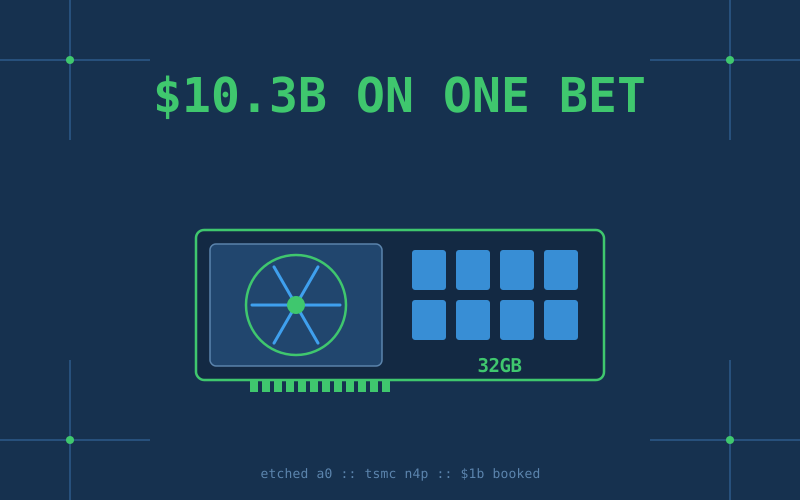
On July 23, transformer-chip startup Etched closed a $300 million Series C at a $10.3 billion valuation, led by Sequoia with Andreessen Horowitz, Jane Street, SK Hynix, and Diffusion. That roughly doubles the $5 billion the company was worth in December, and pushes total money raised past $1 billion. The thesis is heretical in a market built on flexible GPUs: make silicon that does exactly one thing, run the transformer, and refuse everything else. Etched says its first custom chips are back from TSMC, that it has $1 billion in orders booked, and that it employs 400 people. One caveat up front, and it is a big one: every performance number so far comes from Etched, and no independent benchmarks exist yet.
What actually happened
The round is the headline, and the numbers are large. Sequoia led the $300 million Series C, joined by Andreessen Horowitz, Jane Street, SK Hynix, and Diffusion, with angel backers that read like a who's who of the industry: Peter Thiel, Andrej Karpathy, Figma's Dylan Field, and Replit's Amjad Masad. Reporting on the deal called it the largest valuation ever attached to a Sequoia-led Series C. The company was worth $5 billion as recently as December, when it raised $500 million, so the price has doubled in about seven months while the actual product is still rolling into customers' racks.
The bet: burn the architecture into the chip
A GPU from Nvidia is deliberately general. It will run a transformer, a convolutional net, a physics simulation, or a video game, and that flexibility is exactly why it dominates. Etched threw the flexibility out. Its silicon hardcodes the transformer, the architecture behind essentially every model you actually use, directly into the hardware, and it cannot run anything else. Three Harvard dropouts, CEO Gavin Uberti among them, have now raised over a billion dollars on the conviction that a chip which does one thing will beat the chip that does everything at that one thing.
The mental model is a Swiss Army knife versus a single, very sharp blade. The knife has twelve attachments and gets you out of most situations. The blade only cuts one thing, but if that one thing is 99% of what you do all day, the specialist wins on every cut. Etched is betting the entire company that the transformer stays the thing everyone cuts.
Where that specialization pays off is utilization. On today's general-purpose chips, inference frequently runs at well under half of the hardware's peak FLOPs, because the silicon is busy staying flexible instead of staying fed. Etched claims its design holds 80%+ of peak FLOPs even on trillion-parameter sparse mixture-of-experts models, without thermal throttling. If that number survives contact with a third party, it is the whole pitch: same wafer, far more useful work per watt.
Prefill and decode, as two separate problems
The interesting engineering is that Etched does not treat inference as one workload. It splits it. The prefill phase, where the model reads your prompt, is compute-bound: you have all the tokens at once and you are drowning the chip in matrix math. The decode phase, where the model writes its answer one token at a time, is memory-bound: you are mostly waiting on memory bandwidth, and the compute units sit idle. Etched builds for each separately, with what it calls Low Voltage Inference to pack more transistors into the compute-heavy prefill, and Cluster Scale Memory to let many chips share one fast, low-latency memory pool for decode.
Splitting prefill from decode is the same disaggregation idea the rest of the industry is chasing in the rack and the scheduler. Etched's twist is to push it down into the transistors, so the specialization is fixed in silicon rather than negotiated in software at runtime.
Why a builder should care
You are not going to buy one of these. First systems are being tested by clients now, with racks slated to ship this summer, and the order book is enterprise-scale. But the reason this round matters even if you never touch the hardware is inference economics. The dominant line item in running an AI product is not training, it is serving tokens, and that bill is set by whoever owns the fastest, cheapest silicon. Every credible challenger to Nvidia's margins eventually shows up in your API pricing.
The catch is the same as the pitch. A chip that only runs transformers is a spectacular deal for as long as transformers are what matters, and an expensive paperweight the day something else takes over. State space models, diffusion language models, and whatever comes next are all circling. Etched is not hedging that bet. It has soldered its thesis into a wafer, which is either conviction or hubris, and you will not know which until the racks are full and someone else runs the benchmarks.
The caveats
- The performance numbers are self-reported. The 80%+ peak-FLOPs figure and every efficiency claim come from Etched itself. No independent benchmark of the shipping hardware has been published, so treat all of it as a vendor claim until a third party measures it.
- This is a funding round, not a product review. A $10.3 billion valuation reflects what investors will pay, not what the silicon delivers at scale. First systems are still in customer testing.
- Architecture risk is the whole story. Hardcoding one architecture is a leveraged bet on the transformer staying dominant for the useful life of the chip. If the field moves, a specialized ASIC cannot follow it the way a GPU can.
- Names and specifics are still shifting. Etched's own site now describes its first silicon as "A0" on TSMC's N4P node, with more performance and roadmap detail promised later this year. Details may change as the product ships.
Key Takeaways
- Etched raised a $300 million Series C on July 23 at a $10.3 billion valuation, led by Sequoia with Andreessen Horowitz, Jane Street, SK Hynix, and Diffusion, roughly doubling its December valuation and pushing total funding past $1 billion.
- The company builds inference silicon that hardcodes the transformer and runs nothing else, trading a GPU's flexibility for specialization.
- Etched claims its design sustains 80%+ of peak FLOPs on trillion-parameter sparse MoEs, where general-purpose chips often run at under half; the figure is self-reported and unverified.
- Its architecture splits inference into compute-bound prefill and memory-bound decode, using Low Voltage Inference and Cluster Scale Memory, disaggregation pushed down into the hardware.
- First chips are back from TSMC, systems are in customer testing with $1 billion in orders booked, and 400 people are building it.
- The upside is inference economics and pressure on Nvidia's margins; the risk is a leveraged bet that the transformer stays the architecture that matters.
Sources: TechCrunch, Crypto Briefing, TechStartups funding roundup, Etched