JAMA Study: 952,000 US Clinicians Sent OpenEvidence's AI 271 Million Queries
TL;DR
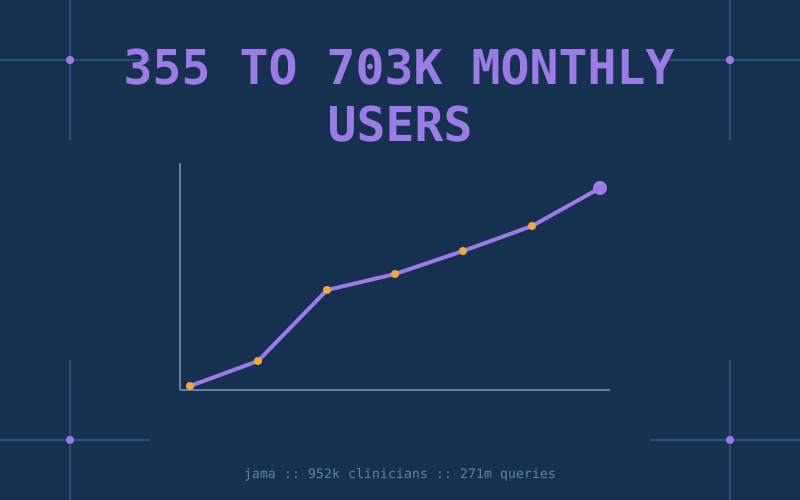
A cross-sectional study published October 15 in JAMA is the first large count of how US clinicians use a medical AI tool day to day. Researchers at Harvard Medical School and Brigham and Women's Hospital analyzed NPI-verified accounts on OpenEvidence from January 2024 through June 2026: 952,008 clinicians, including 556,200 physicians, sent 271 million queries. Monthly active users went from 355 to 703,265. About half the queries concerned clinical decisions, mostly treatment and management, and only 13.9% were about diagnosis. Physicians also leaned on it hardest outside their own specialty. Three of the seven authors worked for OpenEvidence, and the study does not measure whether any patient did better.
What the study counted
The team took de-identified usage data from OpenEvidence, an AI clinical search and chat tool, limited to accounts verified against the federal National Provider Identifier registry. So the sample is licensed physicians, nurse practitioners and physician assistants, not students or curious patients. The window runs from January 1, 2024 to June 30, 2026.
To work out what people asked, the authors had a large language model classify a stratified random sample of 38.8 million queries by clinical purpose and topic. So an LLM sorted the questions people put to an LLM, which is about as 2026 as a methods section gets. The headline totals (users, queries, who sent them) come straight from the logs and do not depend on that classifier.
The adoption curve medicine never had
Average monthly queries per active user rose from 18.0 to 39.5 over the same period, so people kept asking more as the user base grew. Nurse practitioners and physician assistants were the heaviest users at 44.5 queries per active user-month each, ahead of physicians at 37.1.
Senior author Anupam Jena compared this with electronic health records, where adoption was slow and "only really occurred after government regulation." Nobody mandated OpenEvidence. Clinicians signed up on their own, inside a profession famous for running on fax machines well into the smartphone era.
"AI tools have become integrated into routine in clinical practice faster than almost any technology we've seen, but until now we've had very little data on how clinicians actually use them." - Vishal Patel, first author, HMS clinical fellow in surgery at Brigham and Women's
Who uses it, relative to their headcount
The study's sharpest tool is the use ratio: a group's share of queries divided by its share of the national clinical workforce. Internal medicine shows how it works. Internists are 14.5% of the physician workforce but sent 27.3% of physician queries, so their ratio is 1.88. A ratio of 1.0 means a group asks exactly its headcount's worth of questions.
Young doctors and the cognitive specialties, where the job is reasoning across a long list of conditions and drugs, use it at about double their headcount. Physicians within a decade of graduation post the top ratio at 2.54, and residents and fellows come in at 1.84. Procedural and diagnostic fields sit near zero: ophthalmology at 0.23, radiology and orthopedics at 0.24.
Treatment questions, not diagnosis
The public pitch for medical AI is usually diagnosis: the model that spots what the doctor missed. In the logs, clinical decision-making made up 51.9% of queries, and the largest slice of that was treatment and management at 33.1%. Diagnosis accounted for 13.9%.
The other pattern is where the questions point. Physicians often asked about subjects outside their own specialty. The share ranged from 35% among oncologists and hematologists to 88% among emergency physicians. HMS's summary gives surgeons as an example: they frequently ask about things that are not surgery.
Hospitals have always had a word for this: the curbside consult, where you catch a cardiologist in the hallway and ask a quick question about your patient's heart. The tool is doing that job at scale, and it is available at 3 a.m. "Two key takeaways are that an enormous number of physicians are using AI for clinical care and that they are often using it in areas where they don't have specific expertise," Jena said.
The second finding has a downside. Clinicians use the tool most in the areas where they are least able to judge whether an answer is wrong.
What to discount
- Company data, company co-authors. OpenEvidence did not fund the study but supplied the de-identified data. Three co-authors worked there during the study, including chief medical officer Travis Zack. The funding came from an NIH/NIBIB fellowship grant.
- The journal is a content partner. JAMA Network signed a multi-year content deal with OpenEvidence in June 2025, so OpenEvidence's answers draw on JAMA journals. That says nothing about the study's quality on its own, but you should know it.
- No outcomes. The paper measures usage, not care. Whether patients fared better or worse is the authors' stated next question.
- One platform. Clinicians asking ChatGPT, Claude or a hospital-licensed tool are invisible here. The 703,265 figure is a floor on AI use in US clinics, not a census.
What builders should take from it
For anyone selling AI into a professional vertical, this is a rare public look at real usage logs. Free, credential-verified accounts let OpenEvidence grow from individual clinicians up instead of waiting on hospital procurement, and the company is now adding health-system deals on top of that base: its announcements page lists collaborations with Northwestern Medicine on October 12 and Johns Hopkins Medicine on October 13.
Demand concentrated in treatment choices and in the gaps between specialties. Diagnosis, the part that gets demoed on stage, was 13.9% of queries. The heaviest users were the least senior and the ones whose jobs are most about recall across fields. If you are building for lawyers, accountants or engineers, the first job your users hire you for may also be answering questions just outside their lane. Those are also the answers your users are worst at checking, so that is where your product needs its strongest citations.
Key Takeaways
- JAMA published the first large-scale study of clinician AI use on October 15: 952,008 NPI-verified US clinicians sent OpenEvidence 271 million queries from January 2024 to June 2026.
- Monthly active users rose from 355 to 703,265, and queries per active user per month rose from 18.0 to 39.5.
- Treatment and management (33.1%) far outweighed diagnosis (13.9%); 51.9% of queries concerned clinical decision-making.
- Out-of-specialty questions ranged from 35% (oncology/hematology) to 88% (emergency medicine), and early-career physicians used it at 2.54 times their workforce share.
- Radiology, orthopedics and ophthalmology barely use it, with use ratios of 0.23-0.24.
- OpenEvidence supplied the data and employed three co-authors, JAMA is a content partner, and the study does not measure patient outcomes.
Sources: JAMA: Clinician Use of an Artificial Intelligence-Enabled Clinical Information Platform, Harvard Medical School news release, Medical Xpress, OpenEvidence announcements, Fierce Healthcare on the JAMA-OpenEvidence content deal