LibreOffice Shipped No AI. 1,031,162 Downloads Followed.
TL;DR
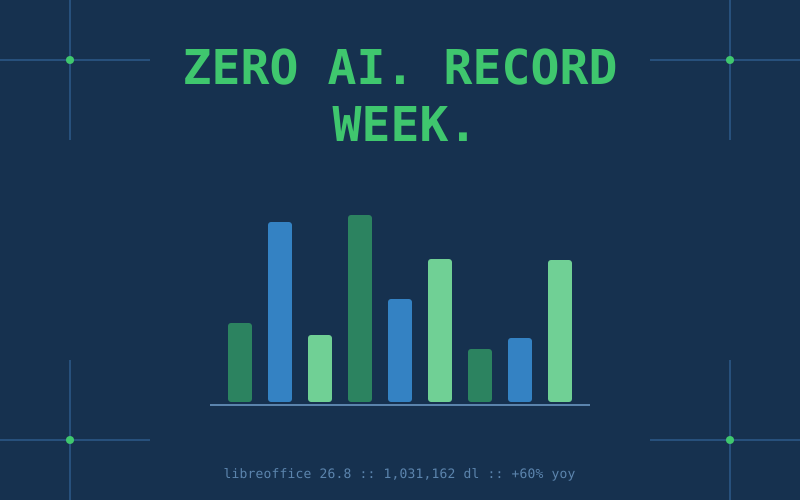
On August 26, The Document Foundation shipped LibreOffice 26.8 with a sentence most vendors would have buried in a footnote: the suite "contains no generative AI features." A week later it published the count. 1,031,162 downloads from its own site in seven days, which TDF calls "the highest number of downloads in the first week of any LibreOffice release." That is roughly 60% above the equivalent release one year earlier. On September 3 it published the reasoning: six conditions any AI integration has to meet before it ships enabled by default, and a flat statement that nothing currently clears them. TDF never claims the record is because of the AI stance. At this point it does not really have to.
The number, and the two years of flat line behind it
First-week downloads from LibreOffice's official page are one of the few consistently published, consistently measured numbers in desktop open source. TDF has posted the same stat, the same way, for years. That makes the comparison unusually clean.
25.2 did 647,961 in February 2025. 25.8 did 642,564 in August 2025, essentially flat. Then 26.8 did 1,031,162.
The count understates the real total, because TDF only sees its own download page. Most Linux users get LibreOffice from a distribution repository, Flathub or Snap, and none of that is in the figure. That cuts both ways: the absolute number is low, but the methodology has not changed, so the year-over-year delta is real.
Social reach moved with it. The same three stats posts report 11,313 combined views, shares and likes for 25.2, then 23,399 for 25.8, then 50,061 for 26.8. Attention roughly doubled, twice.
What TDF refused, and the gate it published
This was not a thin release dressed up with a slogan. 26.8 shipped a new Paragraph Composer for multi-line justification, native OpenType font variation support, automatic paragraph direction detection for bidirectional text, calculated fields in Calc pivot tables, round-trip support for Microsoft Office chart types including waterfall and treemap, multiple page sizes inside a single Impress or Draw document, and a distraction-free draft view.
Alongside all that, the announcement states plainly that documents "are not transmitted to remote services for processing, and no component of the suite requires network access to function."
Then, on September 3, TDF published the post explaining why, including the six conditions any AI integration would have to satisfy to be enabled by default.
TDF's conclusion is that "there is no integration that meets all the requirements and that could be deployed, enabled by default, and supported throughout the entire lifecycle of a release."
Read the list again. None of it is exotic. Local execution, consent before upload, no telemetry, pluggable backends, clean document output, and an off switch that actually removes the thing. Every one of those is achievable today with a local model. The notable part is not that the bar is high, it is that so little clears a bar this ordinary.
And TDF did not ban AI. It refused to enable it by default. Extensions exist, several of them wired to local runtimes like Ollama or LM Studio, which keeps the document on the machine. The distinction between "not available" and "not on by default" is the whole argument.
The correlation trap, stated honestly
TDF does not claim the record was caused by the AI stance, and neither should you. This is the difference between a restaurant that got busier the week it hung a new sign and a restaurant that got busier because of the sign. Same week, two very different claims, and one download chart cannot tell them apart.
The confounders are real. 26.8 is a substantive feature release. Migration pressure from a year of desktop churn is not measurable here. Downloads are not installs, installs are not active users, and a first week captures curiosity as readily as commitment.
What survives the caveats is narrower but still worth something: the same measurement, taken the same way, in the same seasonal slot, moved 60% in a year on the release that made "no generative AI" an explicit headline claim. That is not proof of causation. It is a strong hint that the positioning is not costing them anything, which is the opposite of what every product roadmap in 2026 assumes.
The other bet on the same question
Twenty months earlier, Microsoft made the opposite call: it bundled Copilot into Microsoft 365 Personal and Family and raised the US price by $3 per month, the first increase since the product launched.
Consumer sentiment has since drifted toward the second row. A Gartner survey of 1,539 US consumers, conducted in October 2025 and published in March 2026, found that 50% would prefer to give their business to brands that do not use generative AI in consumer-facing messages, advertising and content. In the same survey, 61% say they frequently question whether the information behind their everyday decisions is reliable, and 68% frequently wonder whether the content they see is real.
Be precise about what that measures. Gartner asked about GenAI in marketing and content, not about AI features inside a product, and those are genuinely different questions. But when half your addressable market flinches at the label in one context, shipping the label as a default in another is a choice, not an obligation.
What to actually do with this
If you ship software, three things fall out of it.
- The default is the product decision, not the feature. TDF shipped an AI-capable extension ecosystem and still gets to say the suite has no generative AI. Opt-in costs you almost nothing and buys the entire "no AI" position.
- The six conditions are a usable spec. Local or user-chosen inference, consent before any upload, no telemetry, multiple backends, structure-preserving output, and a real uninstall. Meet them and the backlash has nothing to grab.
- Local runtimes are what make conditions one through four achievable. An integration that speaks to a local endpoint by default satisfies the hard half of the list on day one.
One release week is not a movement, and a download counter is a weak instrument. But this is the first time a mainstream desktop project has treated the absence of AI as a shippable, marketable feature, published the number afterwards, and had the number come back bigger than every release before it.
Key Takeaways
- LibreOffice 26.8 recorded 1,031,162 first-week downloads, the highest of any release, against 642,564 for 25.8 a year earlier and 647,961 for 25.2, a jump of roughly 60% on a flat two-year baseline.
- The release announcement states outright that the suite "contains no generative AI features" and that no component requires network access to function.
- TDF published six conditions any AI integration must meet to be enabled by default, and says nothing on the market currently meets all of them.
- AI is not banned, just not default: extensions exist, many of them pointed at local runtimes so documents never leave the machine.
- TDF claims no causation, and the honest read is correlation: same methodology, same seasonal slot, 60% more demand on the release that made "no AI" explicit.
- Gartner's October 2025 survey of 1,539 US consumers found 50% prefer brands that avoid generative AI in consumer-facing content, which is a different question but points the same direction.
Sources: One week of LibreOffice 26.8, the stats (TDF), Yes, no AI is now a feature (TDF), LibreOffice 26.8 release announcement, LibreOffice 25.8 first week statistics, LibreOffice 25.2 first week statistics, Microsoft 365 blog on Copilot inclusion and pricing, Gartner consumer GenAI survey, CMSWire on the Gartner survey methodology, OMG! Ubuntu on the download record