DeepSeek-VL Lead Open-Sources Linger, a Local Agent Running 125B on a 12GB GPU
On this page 8 sections
TL;DR
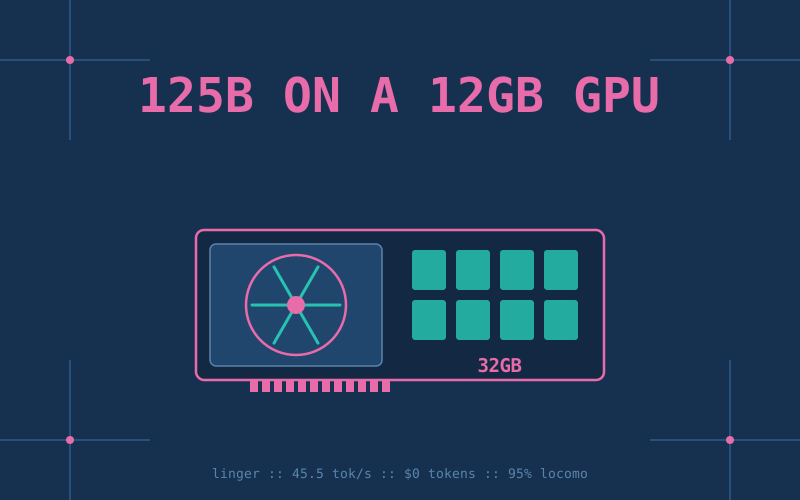
Linger, open-sourced Nov 19 by SimplexAI, is a personal agent that runs its model, memory, tools and orchestration entirely on your own computer. Its PolyStrata inference engine keeps a 125B-parameter MoE model's busiest experts on a 12 GB GPU and parks the rest in RAM or on SSD, which is how a 39 GB two-bit Qwen3.8-Flash-Next writes at 45.5 tokens per second on an RTX 3060. Local inference costs nothing per token. The catches: the headline speed assumes 64 GB of RAM, the memory benchmark is self-reported, and the Apache 2.0 license bars you from reselling Linger as a hosted service.
What shipped
The founder is Tony Zhang, who joined DeepSeek as an AI scientist in 2023, contributed to DeepSeek LLM V1 and led the DeepSeek-VL vision-language project before founding Simplex AI, per 36kr. His launch post runs the obvious analogy: computing was centralized until the PC, and AI is trained in datacenters and rented back to you token by token. Linger is the counter-argument, installed.
What you can download today is a desktop app for macOS (Apple silicon, 14.0 or later), Windows x64 and Linux x64, plus Docker Compose self-hosting, from the GitHub releases. The cadence is aggressive: 0.1.3, 0.1.4 and 0.1.5 all landed between Nov 18 and Nov 19. The product site still says "coming soon" for downloads, which tells you how fast this moved.
The agent surface: a primary agent called Another Me that reads Gmail, Outlook, Slack and your calendar, drives your desktop and your already-signed-in Chrome, and asks before it sends anything. Bigger jobs get delegated to a team of agents under one shared team.md plan. A Pi runtime runs local models by default, and your existing Claude Code or Codex subscription, or any OpenAI-compatible endpoint with your own key, can plug into the same rooms.
The engine treats experts like cache levels
PolyStrata, built on the Strata project's engine, exploits one property of MoE models: each token activates only a few experts. The engine ranks experts by how often the router picks them, keeps the hot ones in VRAM, the warm ones in system RAM, the cold ones on SSD, and moves experts up or down as usage shifts. It is a cook's station: the knife and salt live on the counter, the weekly staples in the pantry, the turkey platter in the basement. You visit the basement rarely enough that the trip stops mattering.
Against llama.cpp b11540 on an 8 GB laptop card, PolyStrata read prompts 2.7 to 3.5 times as fast and wrote 1.5 to 1.8 times as fast, measured with Qwen3.6-35B-A3B and Tiel Coder, two runs published in the repo. The write speedup is real but modest; the read speedup is the one an agent feels, because agents spend their lives re-swallowing context.
A memory system with receipts
The memory design is the most borrowable part. Connect your inbox and Another Me reads back through months of mail, then rebuilds a personal wiki every night: typed Markdown pages for clients, contacts, projects and topics, one page per real-world entity. A model proposes edits section by section, and the app verifies each change against the page it replaces; facts cite the message they came from, and the change log is written by the app, not the model. Search runs on PostgreSQL full-text plus reciprocal rank fusion; no embedding model is involved. Day-one inbox archaeology is either onboarding or a hostile audit, depending on what is in there.
On LoCoMo, the long-conversation memory benchmark, the team reports 95% for Linger against 94.7% for Zep, 92.5% for Mem0, 72.9% for GPT-4o-mini with full context and 52.9% for OpenAI Memory. Treat the ordering as the vendor's own homework; the method doc is public, which is more than most memory vendors offer.
The proactive layer learns rules instead of retraining. Every night a "Dreaming" pass reads how Another Me's own messages landed and rewrites the rules it decides by. Push back on courier notifications twice and deliveries become a stay-silent rule; say "tell me the moment an invoice lands" once and it becomes a rule after a single night. Quiet hours are enforced: nothing goes out from 22:00 to 08:00.
Model Autopilot picks your brain
You should not have to know what a quant is to run a local model, so the installer does the choosing. SimplexAI's lab swept 49 models across two engines, quantizations from 1-bit to 8-bit and contexts from 64K to 256K, and the installer ranks what fits your GPU, RAM and bandwidth with at least a 64K context, smartest first. The results feed a score on the third-party AIHOT scale, where 50 is the reference average: an 8 GB card with 32 GB of RAM lands at 35.4, which the company compares to Gemini 2.5 Pro; a 24 GB Mac at 51.9, compared to Claude Opus 4.5; a 12 GB card with 32 GB at 57.3, compared to Claude Opus 4.6. Those cloud comparisons are the vendor's mapping, not a benchmark result. The defensible claim is smaller and still useful: the 35B class now runs at 60-100 tok/s on an 8 GB laptop.
The fine print
The license is Apache 2.0 with two additions: you cannot offer Linger as a hosted or managed service to third parties without written authorization, and you cannot strip the logo or copyright from the frontend. Commercial use inside your own company is explicitly fine. The contributor terms also let the producer tighten or loosen the agreement later, so read before you build a business on it. A hosted Linger exists as a waitlist on the product site, which explains the hosting clause: the open-source core is the funnel, the hosted tier is the business.
Rough edges, stated by the project itself: the macOS app is unsigned and not notarized, the Windows installer is not code-signed, quitting from the tray leaves some services running, and voice depends on external providers (Soniox for meetings, xAI for live conversation). One more license landmine sits in the model catalog: LFM2.5 allows commercial use only to companies under $10M in yearly revenue. The engine itself credits PolyStrata's creator VecSzn and the Strata project by Niko1221; Zhang told 36kr the engine's author is 18 years old.
What it means if you build
- Expert tiering by router frequency is the reusable idea. If you serve MoE models on constrained hardware, GPU-RAM-SSD placement by pick frequency is now demonstrated in the open, with the benchmark conditions published.
- Steal the memory architecture, not just the benchmark number: typed pages, section-level verified edits, app-written change logs, and keyword search with rank fusion instead of an embedding pipeline you have to babysit.
- Rules that rewrite themselves nightly are a cheap middle ground between a static prompt and fine-tuning. Two rejections becoming a persistent rule is behavior users can feel without any training run.
- Read the license before you ship anything on top of it. Apache 2.0 with a no-hosting clause is source-available-friendly, not a foundation for your own SaaS wrapper.
- The repo's honesty about simulated tiers and slow configurations is the template. Publishing the conditions behind your numbers costs nothing and buys credibility, especially when the headline number needs 64 GB of RAM.
Key Takeaways
- SimplexAI open-sourced Linger on Nov 19: a desktop personal agent (macOS, Windows, Linux, Docker) whose model, memory, tools and orchestration run entirely on your PC, with desktop releases 0.1.3 through 0.1.5 shipped Nov 18-19.
- The PolyStrata engine tiers MoE experts by router pick frequency across GPU, RAM and SSD, so the 125B Qwen3.8-Flash-Next (39 GB, two-bit) runs on a 12 GB RTX 3060 at 45.5 tok/s with 64 GB of RAM; on an 8 GB laptop it manages 38.1, and a 5090 hits 179.
- Measured against llama.cpp b11540 on an 8 GB card: prompts read 2.7-3.5x faster and writing runs 1.5-1.8x faster, and the repo publishes both runs plus a slower 21.3 tok/s configuration with 32 GB of RAM and a roughly three-minute first token.
- Memory: a nightly personal wiki built from Gmail, Outlook, Slack and calendars, with model-proposed edits verified against the page they replace and a change log the app writes. Self-reported LoCoMo: 95%, ahead of Zep 94.7% and Mem0 92.5%.
- Model Autopilot ranks 49 models by a hardware fit test with a 64K context floor; on SimplexAI's own score scale an 8 GB card lands near Gemini 2.5 Pro and a 12 GB card near Claude Opus 4.6, though those pairings are the vendor's mapping.
- License: Apache 2.0 plus a ban on offering Linger as a hosted service without written permission, plus a no-logo-removal clause; LFM2.5 in the model catalog is commercial only under $10M revenue.
Sources: Linger GitHub repository, PolyStrata GitHub repository, Linger LICENSE, Linger wiki-and-memory doc, heylinger.com, Linger docs, Tony Zhang launch post, 36kr/QbitAI, Nov 20, 2026, AlphaSignal, Nov 19, 2026