AI Data Marketplace Mercor Raises $750M at $20B on Claimed $3B Run Rate
On this page 8 sections
TL;DR
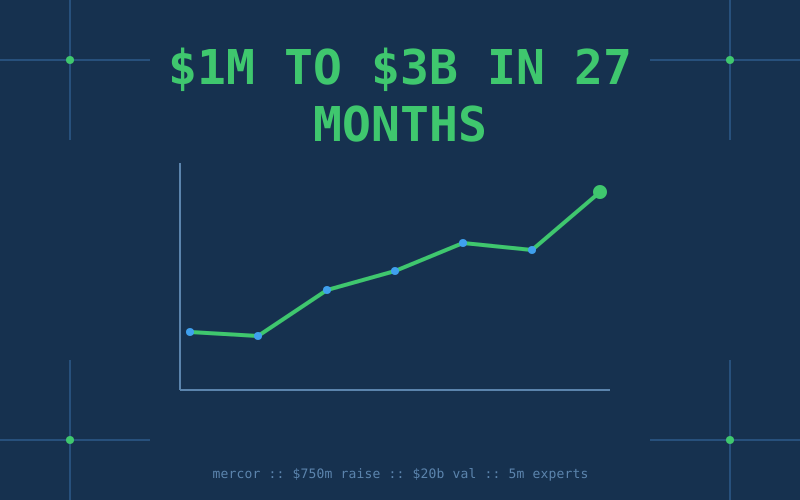
Mercor, the marketplace that bills AI labs and enterprises for human expertise and pays contractors to produce training data and evaluations, raised a $750 million Series D at a $20 billion valuation on Nov 10. CEO Brendan Foody says run-rate revenue went from $1 million to $3 billion in 27 months, a figure he posted on X that appears nowhere in the announcement. The valuation doubles the $10 billion of October 2025, and the money funds a second business: selling the evaluation, post-training and practice-environment tooling Mercor built for frontier labs to everyone else. Every growth number in the announcement is a company claim, gross rather than net.
What Mercor actually does
Mercor was founded in 2022 by three 21-year-old Thiel Fellows as an AI recruiting startup, and TechCrunch covered its $100 million Series B at a $2 billion valuation in February 2025. The company then rotated into the supply chain behind every frontier model. Its own May engineering post puts it plainly: "a two-sided marketplace at the forefront of AI; we bill leading AI labs and enterprise clients for access to the best global talent, and we pay independent contractors everywhere for their expertise and work."
The current scale, in the company's numbers: more than five million people have joined the network, payouts ran above $2 million a day to more than 30,000 weekly active contractors in May, and platform volume climbed from $200,000 to over $14 million a week. A September engineering post describes more than 2.5 million evaluation workloads a week, four every second, across 241 different models. Five million signups and 30,000 working in a given week: the bench is deep and mostly cold.
The number everyone will quote
The $3 billion comes from Foody's X post, which says Mercor "scaled from $1M to $3B in run-rate revenue in 27 months, the fastest in history to $3B." The release itself publishes no revenue figure, names no lead investor, and gives no split for the employee tender folded into the round. Run rate means annualized current sales at a private company with no audited numbers, and the earlier milestones come from the same channel: Mercor's May post claims $0 to $500 million in 17 months and crossing $1 billion annualized earlier in the year, and Dealroom reported over $2 billion gross annualized in June, citing a person familiar with the figures.
The figures are also gross. A marketplace quoting gross revenue is like an exchange quoting total trading volume: real information, while the business itself is the fees. At May's numbers, annualized expert payouts of roughly $730 million against a $2 billion run rate put about 36.5 cents of each gross dollar in contractors' hands. Dealroom found the ambiguity notable enough to publish a note titled "the great AI-revenue debate: GMV, ARR, or net?"
The round
Thirteen investors are named and none is designated lead: Benchmark, Felicis, Fundomo, funds managed by affiliates of Apollo, G Squared, General Catalyst, Glade Brook Capital, NVIDIA, Salesforce, Sapphire Ventures, StepStone Group, XTX Ventures and Zoom. The round "included an employee tender," which means part of the $750 million bought shares from staff rather than funding the company; the split is undisclosed. The strategic names are the tell: a chipmaker, a CRM vendor and a video platform all want exposure to the layer that measures whether agents do work worth paying for.
From labs to everyone else
The Series D post describes the next market: enterprises that want to own their intelligence rather than rent it. Mercor's stated playbook is "build public evals, post-train a model to cut costs, then train models for your customers," starting from a capable open model at "a fraction of the resources required at the frontier." Post-training an open model on your own workflows is the off-the-rack suit with alterations: you skip the fashion house and keep the fit. Mercor supplies the data and the measuring stick, drawn from the same expert network the labs use.
To give agents somewhere to practice, Mercor acquired Deeptune, announced in July, whose team "spent two years recreating hundreds of enterprise applications where AI agents can practice professional workflows." The post counts more than 800 distinct occupations in the United States alone, each with workflows no model has been evaluated against. That is either a very large market or a very large to-do list.
The catches
- The $3 billion is a run-rate claim in a founder's X post, not a filed number, and the "fastest in history" comparison has no independent verification.
- Revenue is gross. At May's payout rate, experts received roughly 36.5 percent of gross; Mercor's take, the number a valuation should rest on, is undisclosed.
- Concentration: one report cited by Dealroom put 91 percent of first-half 2026 gross revenue from foundation-model companies. The enterprise business is the plan to fix that, and it is young.
- Security history: Mercor was hit in late March by the LiteLLM supply-chain attack. Its June update says a "very limited subset" of nearly five million experts had sensitive information affected and customer impact was limited; Dealroom reports roughly 4TB of internal data was exposed and that Meta paused work at the time. Mercor says every frontier lab has since increased its work.
- The double-digit GDP extrapolation extends one company's cost structure to the whole economy: Mercor spends 3x on inference what it spends on salaries, and projects that ratio outward for everyone.
Why builders should care
If you have domain expertise, this market pays. More than $2 million a day was flowing to contractors in May, for work Dealroom describes as physicians, lawyers, engineers and consultants writing and grading the data that trains and tests models. The entry requirement is knowing something specific, not knowing machine learning.
If you build for companies, the playbook Mercor is selling is also the playbook you can run in-house: write evals against your own workflows, post-train a capable open model on them, and measure agents against your quality bar instead of a public benchmark. Mercor is betting $20 billion that most companies will buy that capability rather than build it. Your workflow data is the asset either way.
And if you sell into the AI supply chain, mind the concentration. When one report puts 91 percent of a supplier's revenue with the labs, every vendor downstream of lab budgets shares the risk, and the enterprise pivot across the industry is the hedge.
Key Takeaways
- Mercor raised a $750 million Series D at a $20 billion valuation on Nov 10, double its October 2025 mark and ten times its February 2025 mark; 13 investors are named, no lead, and the round includes an employee tender of undisclosed size.
- CEO Brendan Foody claims $1 million to $3 billion in run-rate revenue in 27 months, the fastest to $3 billion in history by his count; the release itself publishes no revenue figure.
- All figures are gross marketplace revenue: at May's disclosed payout rate, over $2 million a day to more than 30,000 weekly active contractors, roughly 36.5 percent of gross went to experts.
- The money funds a push from frontier-lab data work into enterprise evaluation, post-training and simulated practice environments, built on the July acquisition of Deeptune.
- Risks the release does not headline: one report puts 91 percent of first-half 2026 gross revenue with foundation-model companies, and Mercor was hit in the March LiteLLM supply-chain attack.
- Mercor spends 3x on inference what it spends on salaries, its own window into what an AI-heavy cost structure looks like from inside.
Sources: Mercor, Series D announcement (Nov 10, 2026), Brendan Foody on X (Nov 10, 2026), Mercor engineering (May 8, 2026), Mercor engineering (Sep 30, 2026), Dealroom News (Nov 10, 2026), Dealroom News (Jul 2026), TechCrunch (Feb 20, 2025), TechCrunch (Oct 27, 2025), CellCog (Nov 10, 2026), Mercor security update (Jun 25, 2026), Mercor, Deeptune acquisition (Jul 9, 2026)