Microsoft Made $3.2B on Anthropic in 90 Days. OpenAI Got a Markdown.
TL;DR
Microsoft closed its fiscal 2026 on July 29 with $90.0 billion in quarterly revenue, up 18%, and the first $100 billion revenue year in Azure history. Shares rose more than 7% after hours, the same night Meta fell roughly 8% for spending on exactly the same thing. Buried in the release is the quarter's best subplot: a $3.2 billion gain on the $5 billion stake Microsoft bought in Anthropic last November, worth 33 cents of EPS, while its roughly 27% stake in OpenAI took a markdown of about $600 million. Capex hit $41 billion in 90 days, and the guide says next quarter tops $50 billion.
One night, two verdicts
The June quarter was a beat on every line that matters. Revenue of $90.0 billion cleared the roughly $87.6 billion consensus, net income rose 31% to $35.8 billion, and diluted EPS of $4.81 grew 32%. Microsoft Cloud did $59.3 billion, up 27%, and Azure and other cloud services grew 43% in the quarter. For the full fiscal year, revenue came to $331.8 billion, up 18%, and Azure crossed $100 billion in annual revenue for the first time, a milestone CNBC put in its headline.
The stock jumped as much as 8% in extended trading, per the earnings call coverage. Hours earlier, Meta had reported 28% revenue growth and been sold off anyway. Same macro, same AI buildout, opposite verdicts: the market is not punishing AI capex, it is punishing AI capex without revenue attached. Microsoft walked in holding a $100 billion Azure receipt.
The best AI bet on Microsoft's books is not OpenAI
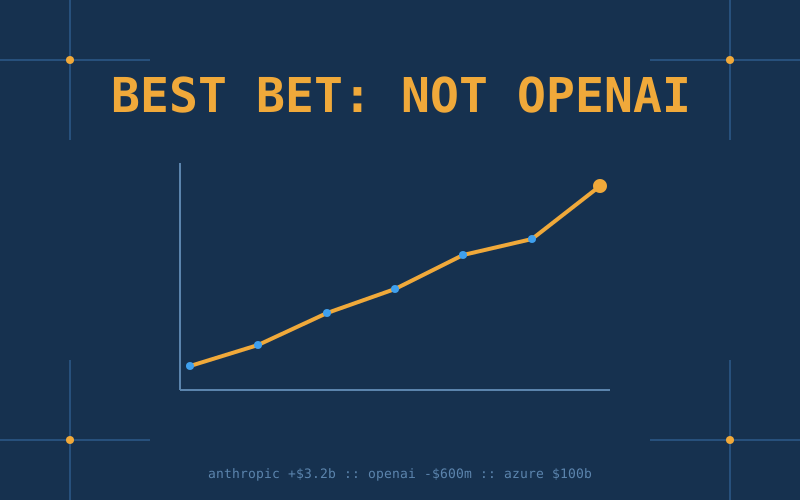
Now the subplot. In November 2025, Microsoft put $5 billion into Anthropic as part of a three-way arrangement in which Anthropic also committed to buying $30 billion of Azure compute. Eight months later, TechCrunch reports, that stake produced a $3.2 billion gain in a single quarter, adding 33 cents to diluted EPS.
The OpenAI line was, in TechCrunch's phrase, a mixed bag. For the full fiscal year, Microsoft's roughly 27% stake generated a $5 billion gain, worth 67 cents of EPS. But the fourth quarter itself included a markdown of about $600 million on the position, a 7-cent EPS hit. Put those side by side: thirteen weeks of Anthropic delivered nearly two-thirds of what a full year of OpenAI did. The most profitable AI relationship on Microsoft's Q4 books was with the lab it does not control.
Worth being precise about what this money is: a mark-up on an equity position, not cash. And the deal that produced it is circular by design. It works like a landlord taking equity in the anchor tenant: the restaurant signs a ten-year lease, the landlord books the restaurant's rising valuation as investment income, and the rent checks and the equity gains both trace back to the same doorway. Perfectly legal, frequently smart, and exactly the kind of arrangement you want marked honestly when the tenant has a slow quarter. This quarter, the marks ran in Microsoft's favor on one lab and against it on the other, which is at least evidence someone is doing the marking.
$41 billion in 90 days, and the meter is accelerating
Capital expenditures hit $41 billion for the quarter, which The Register pegs at 70% higher than a year ago; its tally puts full-year capex at $115.95 billion, up nearly 80% from fiscal 2025's $64.55 billion. On the call, CFO Amy Hood said roughly two-thirds of the spend went to short-lived assets, mostly CPUs and GPUs, and guided the first quarter of fiscal 2027 to more than $50 billion, with roughly $175 billion expected for the full fiscal year including finance leases.
That $175 billion comes with an accounting asterisk. Hood said Microsoft is extending the estimated useful life of its datacenter and office buildings from 15 years to 25, and reclassifying more future datacenter leases as operating leases. The buildings now age slower on paper, which does for depreciation what good lighting does for a headshot. The spend itself is not slowing: Satya Nadella said Microsoft brought 31 new datacenters online across five continents this quarter, and management repeated the line that has anchored every recent call, that demand continues to exceed the capacity Microsoft can stand up.
Why you should care
If you deploy on Azure, the operative numbers are 43% growth now and a guide of about 45% in constant currency next quarter, on a base that just passed $100 billion a year. Growth that fast against admitted capacity limits means GPU quotas, region availability, and spot pricing stay tight; plan for the constrained world, not the elastic one.
The enterprise pull is not hypothetical either. Nadella said Microsoft 365 Copilot passed 30 million paid seats, up from more than 20 million in April. Whatever you think of Copilot as a product, 30 million paid seats is distribution most AI startups would trade their model weights for, and it is the default surface your future agent integrations will be judged against.
Zoom out and the strategic picture is the strangest part. Microsoft now holds a material equity position in both frontier labs, sells the compute both of them train and serve on, and ships its own MAI models in parallel. Whichever lab wins, Redmond collects. For builders, the practical read is that Azure has become studiously lab-neutral infrastructure, and Microsoft's earnings now move on marks in labs you cannot buy shares of any other way.
Key Takeaways
- Microsoft's fiscal Q4 2026: revenue $90.0 billion, up 18%; net income $35.8 billion, up 31%; shares up 7-8% after hours the same night Meta fell roughly 8%.
- Azure grew 43% in the quarter and crossed $100 billion in annual revenue for the first time, with next quarter guided to about 45% growth in constant currency.
- The $5 billion Anthropic stake from November 2025, tied to Anthropic's $30 billion Azure commitment, produced a $3.2 billion gain in one quarter, worth 33 cents of EPS.
- The roughly 27% OpenAI stake gained $5 billion for the full year but was marked down about $600 million in Q4, per TechCrunch.
- Capex ran $41 billion for the quarter and about $116 billion for the year; fiscal 2027 is guided to roughly $175 billion including finance leases, with more than $50 billion in Q1 alone.
- Hood extended building useful life from 15 to 25 years, an accounting change that softens future depreciation while the physical buildout accelerates.
Sources: Microsoft Q4 FY2026 press release, TechCrunch, The Register, Investing.com earnings call transcript, CNBC