OpenAI Wants to Hand Washington 5%, Worth $42.6B. Call It Insurance.
TL;DR
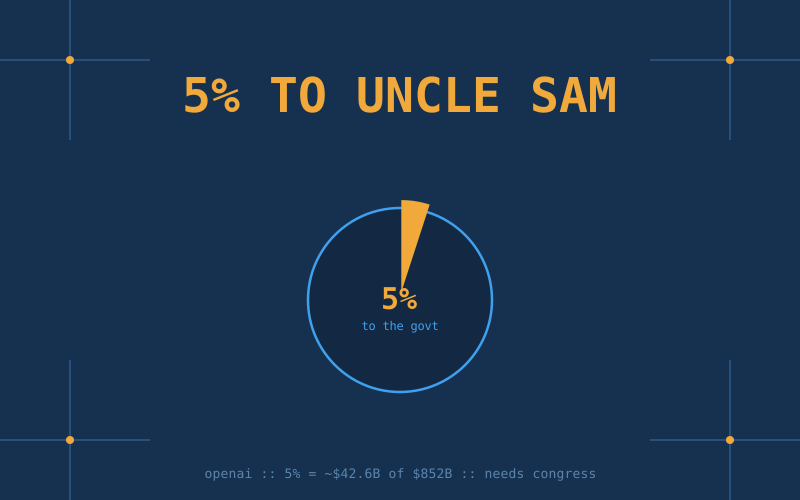
According to reporting from CNBC and the FT, OpenAI has proposed handing the US government a 5% stake in the company to defuse mounting political pressure in Washington. At OpenAI's recent $852 billion valuation, that slice is worth roughly $42.6 billion. Sam Altman's framing is that giving the public a financial interest is the best way to share AI's upside, and the bigger vision is grander still: other US labs (Anthropic, Google, and Meta) would cede similar stakes into a government-run sovereign wealth fund that pays dividends to citizens. The talks are conceptual and early, any real deal would likely need an act of Congress, and it landed days after Washington delayed GPT-5.6. Nothing warms up a regulator quite like handing them equity.
What is actually on the table
Strip away the framing and the proposal is simple: OpenAI gives the federal government equity, reportedly around 5%, and in exchange the public gets a direct financial claim on whatever AI turns into. This is not a brand-new impulse. Altman first pitched the concept of a government stake to the Trump administration in early 2025, and the two sides have been circling it for more than a year. What is new is that OpenAI is now the one publicly proposing it, and attaching a specific number.
The ambition is not one company. The pitch imagines every leading US lab paying into the same pot, a state-held fund that owns a sliver of the whole frontier and returns the proceeds to citizens. If the AI boom mints the trillions its boosters promise, the theory goes, the public should own a piece rather than watch it all accrue to a handful of private cap tables.
The Alaska playbook
The cleanest way to picture the endgame is Alaska. In the 1970s the state took its oil money and, instead of spending it all, parked it in the Alaska Permanent Fund, which invests the proceeds and mails every resident an annual dividend check. Some years it is a few hundred dollars, some years a couple thousand, but the principle is that a windfall from a shared resource gets shared. Altman's pitch is that same trick with AI standing in for the oil: the labs are drilling an enormous new well, so bank the nation a stake and cut the public a check. Whether AI actually behaves like a finite, dividend-throwing resource is the multi-trillion-dollar assumption underneath the whole idea.
Why now
Timing is the tell. Just days earlier, the government forced OpenAI to stagger the launch of GPT-5.6, approving customers one at a time during a security review (we covered that gating saga separately). So this equity offer arrives while OpenAI's flagship rollout sits in Washington's hands. It also lands into a live political argument about who profits from AI: Senator Bernie Sanders has floated part-nationalizing the industry with dividends to the public, and the White House has itself weighed taking stakes in companies. A voluntary 5% gift is a way for OpenAI to get ahead of both, shaping the terms of a windfall-sharing deal before someone less friendly writes them.
Altruism or insurance?
Read generously, this is Altman acting on his long-stated belief that AI's gains should be broadly shared, putting real equity behind the rhetoric. Read skeptically, it is one of the shrewdest defensive moves available. A 5% non-controlling stake is a rounding error against a $852B valuation, but it buys OpenAI a government that is now literally invested in its success, aligned against nationalization, harsh regulation, or a rival's antitrust complaint. It is cheap insurance dressed as generosity, and the two readings are not mutually exclusive. Giving a regulator upside in your company is a very old idea; doing it at this scale, in public, is not.
The honest caveats
Almost everything here is soft. The talks are described as conceptual and early-stage, it is not clear any of the other labs would agree to hand over equity, and actually creating a government stake or a sovereign fund would likely require Congress to act, which is not a fast or reliable machine. The $42.6B figure is paper: it is 5% of a private valuation, not cash, and it is 5% of a company that has poured out billions in losses chasing scale. A public dividend from AI profits assumes there will be steady AI profits to distribute, which remains the entire industry's open question. Treat this as a trial balloon with a big number attached, not a signed deal.
Key Takeaways
- OpenAI proposed giving the US government roughly a 5% stake, worth about $42.6B at its $852B valuation, to ease political pressure.
- The larger vision has every leading US lab ceding a similar stake into a government sovereign wealth fund that pays dividends to the public, explicitly modeled on Alaska's oil fund.
- It arrives days after Washington gated GPT-5.6 and amid live debate (Sanders on nationalization, the White House on equity stakes) about who captures AI's upside.
- A 5% non-voting slice is cheap against the valuation and aligns the government with OpenAI's success, so read it as much as insurance as altruism.
- It is conceptual and early: other labs have not agreed, it may need an act of Congress, and the $42.6B is a paper stake in a company still running at a loss.
Sources: CNBC, Semafor, Tom's Hardware, Forbes