Samsung Made $62B in 90 Days. Its Own Phone Division Lost Money.
TL;DR
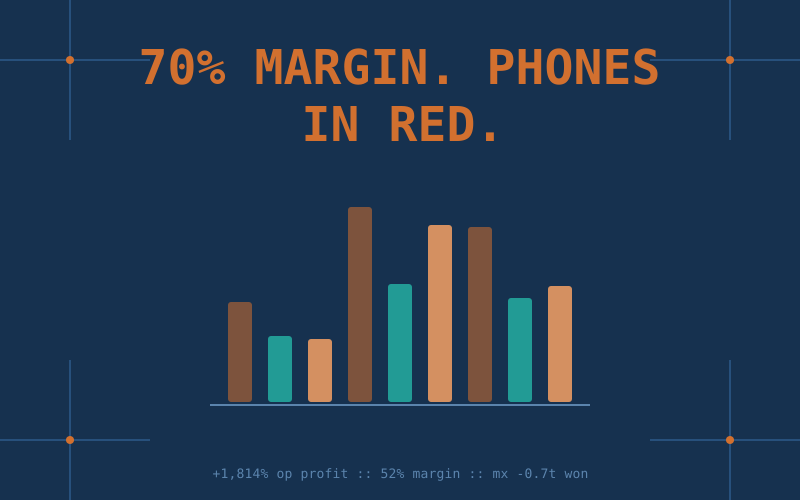
Samsung Electronics reported Q2 2026 consolidated revenue of 171.5 trillion won (about $118.7 billion) and operating profit of 89.5 trillion won, up 1,814% year on year. The Device Solutions chip division produced 89.2 trillion won of that on 127.5 trillion won of sales, a roughly 70% operating margin. The division that actually sells you a phone, MX and Networks, posted a 0.7 trillion won operating loss, because the memory its own colleagues make got too expensive to put in a Galaxy. Samsung's message about next year, delivered while booking the largest profit in its history: supply gets tighter in 2027.
The numbers stopped looking like a hardware company
A 52.2% consolidated operating margin is not a number electronics manufacturers post. It is a number licensing businesses post. Samsung got there because the memory business set all-time highs for both revenue and operating profit: 120.8 trillion won in sales, up 62% from Q1 and 471% year on year, on record bit shipments for both DRAM and NAND.
Against LSEG SmartEstimates, operating profit beat (89.5 trillion won versus 88.13 trillion expected) and revenue technically missed (171.5 versus 172.65 trillion). Missing a revenue estimate by 1.15 trillion won while your profit grows nineteen-fold is the kind of miss most CFOs would sign for in blood. Shares traded roughly 7% higher on the print, per CNBC. The Korea Times called the result enough to make Samsung the world's most profitable company, with DS division sales up 357% year on year and its operating profit up more than 220-fold.
Everything else was rounding. Samsung Display did 7.5 trillion won of revenue and 0.7 trillion of profit. Harman did 4.6 trillion and 0.4 trillion. Capex was 16.8 trillion won, of which 15.4 trillion went into Device Solutions, mostly the new Pyeongtaek fab. Samsung is now a memory company that also, incidentally, makes televisions.
Samsung's phone business is a casualty of Samsung
MX and Networks booked 33.2 trillion won of revenue and lost 0.7 trillion won doing it, a negative 2% margin, with the wider Device eXperience group down 0.8 trillion. Samsung attributed the swing to elevated component cost pressure across the industry, which is a careful way of saying its own product line got repriced by its own colleagues.
Here is the mechanism, and it is the part worth internalizing: HBM and commodity DRAM come off the same wafer capacity. Every wafer Samsung points at HBM4 for AI accelerators is a wafer not making the LPDDR that goes in a Galaxy. So the chip division raises the market price of memory, and the phone division buys memory at that market price. One arm of the company is the landlord, the other arm is the tenant, and rent went up.
Securities analysts cited by Korean outlet DealSite, via SamMobile, put RAM at 23% of the bill of materials for an $800 phone, up from 14%, with NAND storage adding as much as 15% on top. When roughly 38% of your parts cost is a commodity in a shortage, and you are competing on a price your customers already think is too high, the margin has nowhere to go.
For scale: Samsung's mobile division stayed profitable through the quarter its phones were catching fire. The Galaxy Note 7 recall still cleared 100 billion won (about $73 million) of operating profit. Exploding batteries were survivable. Its own RAM prices were not.
The line that actually sets your hardware budget
Skip the profit records. The sentence that matters for anyone speccing a workstation, a homelab node, or a self-hosted inference box is Samsung's forward view: it expects supply constraints to tighten further in 2027, and it named the driver explicitly as rapidly growing AI token generation creating exponential demand over the medium to long term.
That is a memory manufacturer telling you that inference volume, not training runs, is now what prices your RAM. Every agent loop someone leaves running, every long-context request, every reasoning trace lands somewhere in a server that needed DRAM, and the bid for that DRAM outranks yours.
The commercial detail underneath is worse for buyers. Samsung says more customers are moving to multi-year supply agreements, that it has finalized deals with the top five global data center customers, and that it is in final talks with five more. It is the restaurant that stopped taking walk-ins because next year is already booked. Once capacity is committed on multi-year contracts, spot buyers (you, your integrator, the shop that builds your GPU box) are bidding for whatever is left over.
HBM4 and the mix decision
Samsung scaled up HBM4, its sixth-generation high-bandwidth memory, and shipped what it says are the industry's first HBM4E samples to major customers. HBM4 feeds accelerators including Nvidia's Vera Rubin platform. Management guided HBM4 sales to more than triple quarter on quarter in Q3 and to account for well over 60% of total HBM revenue in the second half.
The company also said it is watching the relative pace of HBM versus server DRAM demand and keeping what it calls an optimal product mix, targeting an HBM market share in line with its conventional DRAM share. Read that as the allocation dial: it decides how much capacity is left for the parts you can buy at retail. Samsung expects accelerating demand for server DRAM and enterprise SSDs too, and cited broader adoption of agentic AI as a second-half driver, which means the eSSD you were going to put in a NAS is competing with the same wave.
The caveats
- These results were in line with the preliminary guidance Samsung issued on July 7, so the shape was known. The divisional split, the MX loss, and the 2027 commentary are the new information.
- Revenue came in slightly under consensus. Analysts had modeled a faster HBM4 ramp than actually happened, which pushes some recognition into the second half rather than removing it.
- The phone bill-of-materials percentages are securities-analyst estimates reported through DealSite, not figures Samsung published. Treat them as directional.
- Memory has always been a cycle. A 70% chip-division margin invites exactly the capacity expansion that ends cycles, and Samsung's 15.4 trillion won of chip capex is that expansion starting. It just will not land in 2027.
- Samsung said it is not currently reviewing an ADR issuance, despite reports, while calling it one of several options for the future. If you saw a US listing headline, that is the official position.
Key Takeaways
- Samsung posted 171.5 trillion won of revenue and 89.5 trillion won of operating profit in Q2 2026, up 130% and 1,814% year on year, at a 52.2% consolidated operating margin.
- The chip division did 89.2 trillion won of operating profit on 127.5 trillion won of sales, roughly a 70% margin. Memory alone did 120.8 trillion won of revenue, up 471% year on year.
- MX and Networks lost 0.7 trillion won. Analysts peg RAM at 23% of an $800 phone's parts cost, up from 14%, with NAND adding up to 15%.
- Samsung expects supply constraints to tighten further in 2027 and named AI token generation as the demand driver. Cheap memory is not coming back next year.
- Top-five data center customers are locked into multi-year agreements, with five more in final talks. Spot and retail buyers are last in line.
- If you are planning a local inference build, buy the RAM before the GPU. The GPU will still exist next year at a similar price. The memory probably will not.
Sources: Samsung Electronics Q2 2026 results, CNBC, The Korea Times, Investing.com (Q2 2026 results slides), TradingKey, SamMobile, GSMArena