Aschenbrenner Was Up 439%. Then Citadel Bought the Whole Book.
TL;DR
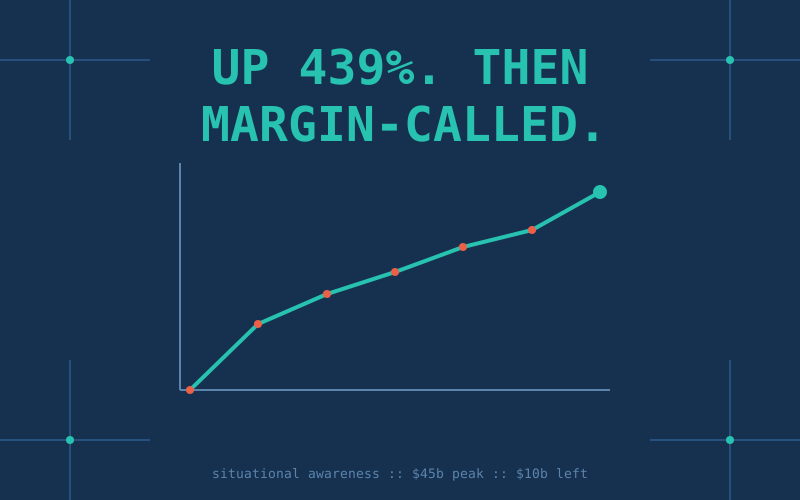
Situational Awareness LP, the AI fund run by former OpenAI researcher Leopold Aschenbrenner, was forced on July 30 to hand the bulk of its public equity portfolio to Citadel after its prime brokers issued margin calls. The fund returned 439% net in the first half of 2026 and peaked near $45 billion in assets. It is now around $10 billion, and most of what is left is a roughly $5 billion private stake in Anthropic, which is the one position a broker cannot call.
What actually happened
Aschenbrenner left OpenAI in 2024 and published Situational Awareness: The Decade Ahead, the essay series arguing the AGI race had already begun and that compute, power and security would decide it. He then did the unusual thing of putting money behind the thesis, launching a fund named after the essay with a few hundred million dollars in seed capital.
The thesis worked, spectacularly, right up until it did not. Roughly two thirds of the book was in public equities: semiconductors, data centers, power generation, and the neocloud tier. In July the AI infrastructure trade unwound. Chip stocks shed more than a trillion dollars of market value in the space of days, and the fund's concentrated names went with them. SK Hynix, SanDisk, Bloom Energy and Nebius Group each fell more than 30% over the month.
Goldman Sachs, JPMorgan and Bank of America, the fund's three prime brokers, called the loans. Situational Awareness sold the public book to Citadel. Millennium and Jane Street, itself an investor in the fund, also bid. The transaction price has not been disclosed.
The trade was long picks, short shovels' software
The structure was a leveraged long in AI hardware and energy against a short in application software, on the reasoning that model capability would commoditize the layer above it while the physical layer stayed scarce. It is a defensible view. Plenty of people reading this hold a version of it.
The problem is that both legs went the wrong way at once. Memory and neocloud names sold off hard while software rallied, so the hedge that was supposed to cushion the long side amplified it instead. A book built to express one idea very loudly has no second idea to fall back on.
Why a margin call is not the same as a bad month
This is the part worth internalizing, because it is the mechanism, not the market call, that ended the fund. Leverage means the broker owns part of your position, and the loan is collateralized by the position's daily mark. When the mark drops far enough, the broker demands cash. If you do not have cash, the broker sells, at whatever price clears, on its schedule.
Think of it as an infinite-scroll landlord: the rent is repriced every single afternoon against what the neighbors' houses just sold for, and if you cannot cover the new number by close, the landlord auctions your furniture. Being right about the neighborhood in five years is not a defense.
That is why a leveraged fund can be liquidated without ever being wrong. The market only has to move faster than your ability to post collateral.
The July 24 letter
Six days before the forced sale, Aschenbrenner wrote to investors calling the drawdown "one of the best buying opportunities since early last year" and invited fresh capital commitments starting August 1.
The capital window opens tomorrow. The portfolio it was meant to buy into now belongs to Ken Griffin.
The one asset nobody could call
What survived is instructive. The fund kept its private positions, chief among them a roughly $5 billion stake in Anthropic, plus holdings in chip startup MatX and AI data center company Fluidstack. Anthropic was last valued at $965 billion in its Series H in May 2026 and is reported to be eyeing a public listing as soon as October.
The reason those positions survived is not that they are better. It is that they have no daily price. A prime broker can only call collateral it can mark, and a private stake has nothing to mark against between funding rounds. Illiquidity, normally a cost, functioned here as armor. Situational Awareness will continue as a private investment vehicle, which is a polite way of saying it now holds only the assets it could not be forced to sell.
There is a genuine irony in the outcome. The essay argued that the constraint on AGI is physical: fabs, transformers, gigawatts. The fund bet on exactly that and was destroyed by the financing layer sitting above it, which turns out to be at least as physical and considerably less patient.
What this means if you build with AI
Nothing here changes what your models can do this morning. But the capital cycle is the thing that pays for the compute you rent, and it just demonstrated that it can seize up on a three-week timescale.
Concretely, three things worth watching:
- Neocloud pricing. The GPU-rental tier is the most financially levered part of the stack. Nebius, CoreWeave and peers were among the hardest hit names. If their cost of capital rises, per-hour pricing follows, and multi-year reservations start to look different.
- Memory, not just GPUs. SK Hynix and SanDisk were core to the trade. HBM and NAND pricing has already pushed hardware costs around this year, and it moves the economics of local inference for anyone building on their own hardware.
- Private marks are stale, not stable. The $965 billion Anthropic number is from May. It held up here because nobody re-marked it, not because it was tested.
The thesis that AI compute is scarce and valuable can be entirely correct and still bankrupt you if you express it with borrowed money. That is the whole lesson, and it is older than the technology.
Key Takeaways
- Situational Awareness LP was forced to sell the bulk of its public equity portfolio to Citadel on July 30 after margin calls from Goldman Sachs, JPMorgan and Bank of America. The price was not disclosed.
- The fund returned 439% net in the first half of 2026 and peaked near $45 billion in AUM. It is now roughly $10 billion, down from about $20 billion in recent months.
- The trade was long AI infrastructure, short application software. Both legs moved against it at once as SK Hynix, SanDisk, Bloom Energy and Nebius each fell more than 30% in a month.
- The roughly $5 billion Anthropic stake survived because private positions have no daily mark and cannot be margin-called. Anthropic was last valued at $965 billion in May 2026.
- A July 24 investor letter called the selloff one of the best buying opportunities since early 2025 and opened for new capital on August 1.
- For builders, the read-through is the cost of capital at the neocloud and memory layers, not model capability.
Sources: CNBC, TechCrunch, Bloomberg, Business Insider via Yahoo Finance, The Next Web, CNBC on the chip selloff, Situational Awareness: The Decade Ahead