Sony Music's AI Deepfake Takedown Requests Hit 260,000, Nearly Doubling Since March
TL;DR
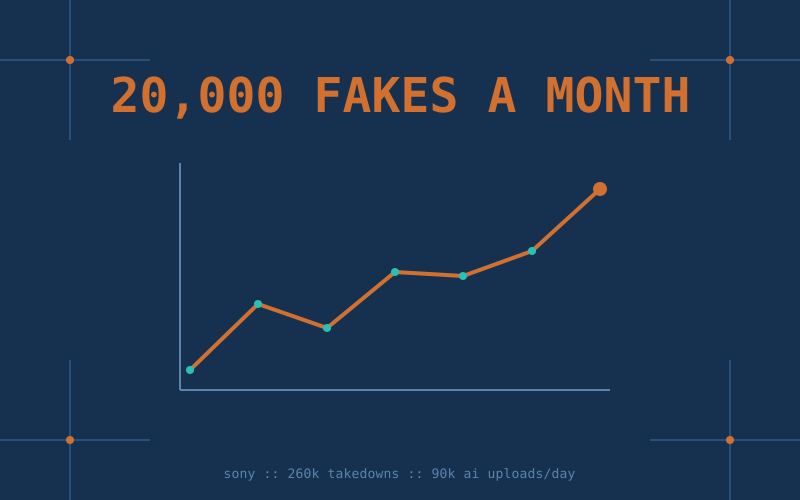
Sony Music told the Financial Times that by the end of September it had asked digital platforms to remove more than 260,000 AI-generated tracks impersonating its artists. That is nearly double the 135,000 the label reported in March, which works out to more than 20,000 takedown requests a month across the second and third quarters, four times the monthly pace of the previous year. Sony's own words: "it's becoming an uphill struggle." The reason is on the supply side. Deezer now sees about 90,000 fully AI-generated tracks a day, more than half of everything uploaded. Takedowns scale with lawyers. Generation scales with GPUs.
The number, and where it comes from
The 260,000 figure was reported by the FT on October 5 and relayed the same day by Music Business Worldwide and Music Ally. It is the fourth public data point in a series Sony has been disclosing for almost three years, each time in a different forum:
- November 2023: "close to 10,000" takedowns, in Dennis Kooker's statement to the Senate AI Insight Forum. Kooker is Sony Music's president of global digital business.
- March 2025: more than 75,000, disclosed in Sony's submission to the UK government's consultation on AI and copyright.
- March 2026: more than 135,000, announced by Kooker at the launch of the IFPI Global Music Report, reported by MBW and Music Week.
- September 2026: more than 260,000, per the FT.
Artists named in the latest batch include Harry Styles, Adele, Britney Spears, Queen and Michael Jackson, who has not been in a position to object since 2009. Sony's statement to the FT in full: "We will keep enforcing our artists' rights and expect platforms to act quickly and to prevent the same content from reappearing. But it's becoming an uphill struggle."
The rate is the story
Cumulative totals flatter everyone. The useful number is the slope. From Kooker's Senate statement to the UK filing, Sony averaged roughly 4,000 requests a month. Over the following twelve months, about 5,000. Over the six months from April to September 2026, more than 20,000, a figure MBW derived from the two disclosed endpoints.
Four times the monthly volume in a year does not read like a label getting more diligent. Nothing in the disclosures suggests Sony changed how it hunts. What changed is how much there is to find, and an enforcement team keeps up with that until it can't.
Kooker described the mechanism in March: "The problem with deepfakes is they are demand-driven. It is taking advantage of the fact that an artist is in cycle and is out there promoting their music." A release cycle for a Sony artist is now a demand signal that someone else's generator answers first.
The supply side: 90,000 a day on one platform
Sony's 20,000 a month is one label's count of deliberate impersonations. The water it is bailing from is much larger. Deezer, which publishes its detection numbers, has released a series covering the last 18 months in its January, April and July releases:
In January 2026 Deezer counted about 60,000 fully AI-generated tracks a day, 39% of daily intake. By April it was 75,000 and 44%. By June the peak was 90,000, more than half of all new uploads. The same releases note that AI tracks account for only 1 to 3% of actual streams, that up to 85% of the streams they do get were flagged as fraudulent in 2025, and that Deezer tags the tracks and removes them from algorithmic recommendations rather than deleting them.
Two more data points on where the volume comes from. The Sonic Intelligence Academy, which runs a voluntary registry of AI releases, found that 92.8% of the 1,743 tracks submitted in the first half of 2026 were made with Suno, and that more than three-quarters of those with distributor data went through DistroKid. That is a registry of self-identified AI artists, not a census of deepfakes, but it says which pipe most of the traffic flows through.
What the platforms have built so far
The platforms are not doing nothing. They are doing the kind of thing that works on a catalog and struggles on a firehose. In September 2025 Spotify published an impersonation policy with one operative sentence: "Vocal impersonation is only allowed in music on Spotify when the impersonated artist has authorized the usage." In March 2026 it launched Artist Profile Protection in beta, an opt-in setting that emails an artist when a release arrives with their name attached and keeps it off their profile unless they approve it. Decline, or ignore the email, and the track never lists them.
That fixes misattribution, which is the fake landing on the real artist's page. It does not touch a soundalike published under a slightly different name, which is where the impersonation problem actually lives. Deezer's approach is detection at ingest: it claims 99.8% accuracy on fully AI-generated audio, tags the result, and demotes it. Neither is what Sony is asking for. Read the statement again: "prevent the same content from reappearing." That is a request for stay-down, not takedown.
The difference matters technically. Notice-and-takedown is a bouncer who ejects only the people you personally point at, one at a time, and lets them back in through the side door wearing a different hat. Stay-down means the bouncer keeps the photo. In practice it means fingerprinting the removed audio and blocking re-uploads at ingest, the way YouTube's Content ID does for copyrighted recordings. No major streamer has announced that for voice clones, and a cloned voice singing a new song has no original recording to match against. The fingerprint has to be of the voice, not the track, which is a harder and less settled problem.
The legal lever: NO FAKES
Which is why Sony told Music Ally it wants "more support from policymakers," and why this figure was released now. The NO FAKES Act (S. 4591) would create a federal right in a person's voice and visual likeness, with a notice-and-takedown process modeled on the DMCA. Platforms that host an unauthorized replica with knowledge that it was unauthorized would be liable. An uploader can file a counter-notice; if the complainant does not sue within 14 days, the content goes back up, and a knowingly false counter-notice costs $25,000 per filing.
The Senate Judiciary Committee advanced the bill by unanimous voice vote on June 18, 2026, per the Recording Academy. It has not had a floor vote. Kooker was already pushing for it in that 2023 statement, in which he complained that "platforms are quick to point to the loopholes in the law as an excuse to drag their feet or to not take the deepfakes down when requested." Nearly three years and a quarter of a million takedowns later, the loopholes are still there.
Sony's three-front posture
Sony is not refusing AI music. It is refusing unlicensed AI music, which is a different business. In November 2025 all three majors, Sony included, signed licensing deals with Klay Vision, a startup that says its model is trained only on licensed music. In 2026 Sony filed a second suit against Udio over 30,117 recordings and, with Universal, a second suit against Suno over 60,202. Universal separately sued DistroKid in September over what its complaint calls an AI-slop pipeline.
The takedown count is the third front, and the one that cannot be settled with a cheque, because the uploaders are not a company. They are whoever has a Suno subscription and a release cycle to ride.
What this means if you build with voice
- Liability is moving from training to distribution. The fair-use fights are about what went into the model. NO FAKES is about what comes out and who hosts it. If your product publishes audio in a recognisable voice, you are the platform in that sentence.
- "Authorized" is the whole product. Spotify's rule is one sentence: impersonation is allowed only when the impersonated artist authorized it. A consent record attached to every generated vocal is going to be table stakes for anyone distributing into the majors' catalogs.
- Detection at ingest beats takedown after the fact. Deezer's numbers show why. Ninety thousand tracks a day cannot be reviewed by anyone. If you run a distribution or hosting pipeline, the classifier belongs at upload, and the output should be a tag plus a demotion, not just a removal queue.
- Stay-down is the next ask. Sony's statement makes re-appearance the complaint, not just appearance. The bill as advanced does not mandate it, so expect it to show up first in platform agreements and distributor terms.
Caveats
The 260,000 is Sony's own count of requests, not of removals, and it is not independently audited. It does not say how many were honored or how quickly. The monthly rate is MBW's arithmetic on two disclosed endpoints, and the earlier periods use "close to" and "more than" figures, so treat them as rounded. Deezer's upload numbers are one platform's detector and its own accuracy claim. The Sonic Intelligence Academy registry is self-selected. And none of the reporting says how many of the 260,000 were the same clone re-uploaded, which is precisely the number Sony's "reappearing" complaint turns on.
Key Takeaways
- Sony Music has requested removal of more than 260,000 AI deepfake tracks, up from 135,000 in March 2026, 75,000 in March 2025 and about 10,000 in November 2023.
- The monthly rate jumped from roughly 5,000 to more than 20,000 between the last two disclosures, four times the previous year's pace.
- Deezer now ingests about 90,000 fully AI-generated tracks a day, over half its uploads, which earn 1 to 3% of streams, up to 85% of them flagged as fraud.
- Spotify's Artist Profile Protection beta fixes misattribution. Nobody has shipped stay-down for voice clones, which is what Sony is now asking for.
- The NO FAKES Act cleared the Senate Judiciary Committee unanimously in June with DMCA-style notice-and-takedown and knowledge-based platform liability, and no stay-down duty.
- Sony licenses Klay, sues Suno and Udio, and takes down the rest. Builders should expect consent records and ingest-time detection to become distribution requirements.
Sources: Financial Times, Music Business Worldwide (Oct 2026), Music Ally, Dennis Kooker, Senate AI Insight Forum statement (Nov 2023), MBW (Mar 2025), MBW (Mar 2026), Music Week, Deezer newsroom (Jan 2026), Deezer newsroom (Apr 2026), Deezer newsroom (Jul 2026), Spotify for Artists, Mondaq on S. 4591, Recording Academy, Al Jazeera on Klay, MBW on UMG v DistroKid, Sonic Intelligence Academy