36 Billion Hours In, $725 Billion Out: AI's Mid-2026 Ledger
TL;DR
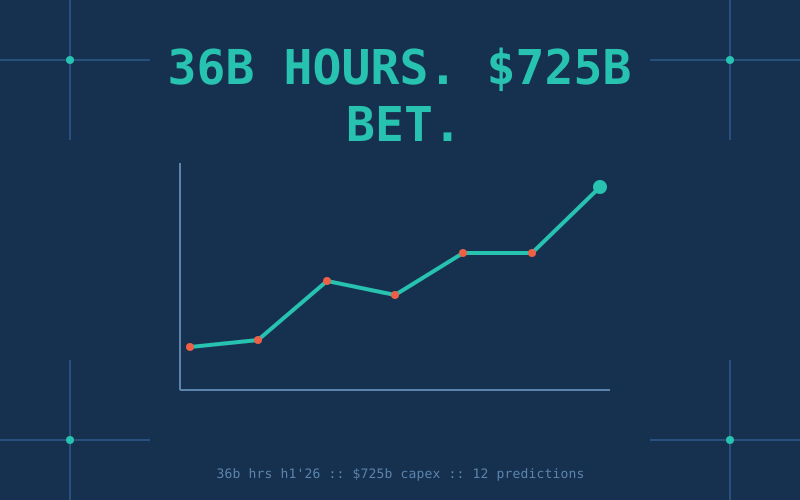
Demand for AI is not fake. Sensor Tower clocks 36 billion hours spent inside generative AI apps in the first half of 2026, up from 17.2 billion a year earlier. The problem is the other side of the ledger: Amazon, Google, Meta and Microsoft have committed roughly $725 billion of capex for 2026 alone, and the entire frontier-lab revenue base is a rounding error against it. Capability is still climbing (agents now handle tasks that take a human two working days), the measurement of that capability is getting shakier, and 88% of enterprise agent pilots still never reach production. Below: the numbers, the charts, and 12 dated predictions you can hold us to.
1. Attention: the demand side is genuinely real
Start with the least ambiguous number in AI, because it is measured the same way TikTok is measured: time.
The supporting numbers all point the same way. Roughly 10 billion downloads in H1 2026 for the 200,000+ apps that mention AI in their store listing. 67 billion web visits in Q1 alone, up 28%. ChatGPT became the fastest mobile app in history to hit one billion monthly actives, in three years, beating TikTok, Instagram and YouTube to the mark.
And yet ChatGPT's share of unique AI-assistant users fell below 50% for the first time in March 2026. The category is growing faster than its leader. Claude's unique audience grew 452% year on year by May, its US share went from 4.4% to nearly 14%, and its US mobile ARPU went from under $0.50 in September 2025 to $2.76 in May 2026.
Concentration is still brutal, though. ChatGPT, Gemini and DeepSeek account for nearly 90% of all time spent in AI assistant apps. Everyone else is fighting over the last tenth.
2. Money: revenue is real, and it is small
Two private companies now define the frontier-lab P&L, and one of them just overtook the other. Anthropic went from about $9B annualized at the end of 2025 to roughly $45B by June 2026. OpenAI went from about $20B to roughly $33B over the same window. Epoch AI pegs the growth rates at roughly 10x per year versus 3.4x per year, which is what a crossover looks like in slow motion.
The engine underneath is developer tooling. Claude Code hit a $2.5B run rate inside nine months of general availability, and Cursor crossed $2B ARR with a million paying users. Consumer, meanwhile, converts at about 5 to 6%: roughly 50 million paying ChatGPT subscribers against a base approaching a billion weekly users.
Hold that thought. Total frontier-lab run rate is around $78B. Now look at the spend.
3. Compute: $725 billion, and power is the new bottleneck
Amazon (~$200B), Google (~$175-185B), Meta (~$115-135B) and Microsoft (~$110-120B) have guided to roughly $725 billion of combined 2026 capex, up about 77% from last year's $410B. NVIDIA booked $81.6B of revenue in a single quarter (up 85% year on year), $75.2B of it data center, and guided the next quarter to $91B while assuming zero data center compute revenue from China.
Where does it all go? Inference, increasingly. Google disclosed the cleanest number in the industry at I/O:
The constraint has quietly moved. Global data center capacity is heading for about 132 GW in 2026, up from 104 GW, and AI-optimised servers will draw roughly 31% of all data center power. In a growing number of regions the question is no longer whether you can buy the racks, it is whether the utility can energise them. Deloitte expects inference to be two thirds of all AI compute this year, up from half in 2025.
4. The gap, and why everyone keeps saying "bubble"
Here is the uncomfortable chart. Full-year 2026 capex from four companies, against the combined annualized revenue of the two labs everyone is building for.
Think of it as building the interstate versus selling gas. The concrete bill lands this quarter; the tolls arrive over decades. That can be a perfectly good trade and still wreck anyone who has to refinance in the middle of it.
The financing is where it gets spicy. AI-linked debt issuance is tracking toward $570B in 2026, private credit lending to AI companies went from near zero to over $200B in a few years, and Morgan Stanley expects another $800B of private data center financing over the next two years, much of it off balance sheet and hard to see. In Bank of America's latest fund manager survey, 45% named the AI bubble as the single biggest tail risk, up from 28% a month earlier.
5. Capability: still climbing, harder to measure
The capability story is not slowing down. ARC-AGI-2, designed in 2025 to be brutal, now has frontier models above 90% against an average human score of 66%. The Stanford AI Index clocked SWE-bench Verified going from 60% to near 100% in a single year.
That second number, though, comes with an asterisk the size of a barn. OpenAI's evals team stopped reporting SWE-bench Verified in early 2026 after an audit found that more than 60% of a sample of problem tasks were unsolvable as written, and that models could reproduce gold-patch solutions verbatim from the task ID alone. Independent work found solution leakage in about 33% of successful patches. When a benchmark saturates, sometimes the model got smarter and sometimes the test got into the training set.
The more durable measure is time horizon: how long a task, measured in human hours, an agent can complete unaided. METR's 2026 pilot with four frontier labs put the strongest agents at roughly 16 to 20 hours at 50% success. That is two full working days of a competent professional, autonomously.
And the frontier stays jagged in ways that are almost funny. The same class of model that takes gold at the International Mathematical Olympiad reads an analog clock correctly 50.1% of the time. It can prove a theorem about circles but cannot reliably tell you it is quarter past three.
6. Adoption: the last mile is still the whole problem
Depending on who you ask, either 20% or 47% of US businesses use AI. The Census Bureau's survey says 17-20%. Ramp, which reads actual card and bill-pay spend across 70,000+ businesses, says 46.6%. Both are right: one measures what firms say, the other measures what they buy.
Agents are where the gap bites. Roughly 31% of enterprises have at least one agent in production, but 88% of agent pilots never get there. The ones that do land average a 171% ROI with a median 5.1 months to value, which tells you this is a deployment-competence problem, not a technology problem.
Gartner reckons only about 130 vendors out of the thousands marketing "agentic AI" actually ship agentic technology. The rest is RPA with a new haircut.
On jobs, the aggregate signal is still absent and the entry-level signal is not: job-finding rates for young workers in AI-exposed occupations are down roughly 14% relative to 2022, while overall unemployment stays flat.
7. The flip nobody priced in: open weights went east
The single biggest structural change of the last eighteen months is not a model launch. It is who serves the tokens. On OpenRouter, the share of routed tokens going to Chinese open-weight models went from under 1.2% in late 2024 to about 51% by April 2026. US-origin models fell from roughly 70% to about 30% over a year.
The reason is price. Gemini 3.1 Flash sits at $0.10 per million input tokens. GPT-4 launched in March 2023 at $30. That is a 99.7% cut in three years, and for a fixed capability level the cost is down roughly 95% in two. When intelligence gets that cheap, the deciding factor stops being "which model is best" and becomes "which model is cheap enough to call a hundred times in a loop."
12 predictions, with dates and confidence
Forecasts are worthless without a number and a deadline, so here are both. Each is checkable.
By 31 January 2027 (six months)
- Time spent keeps compounding. H2 2026 generative AI app hours clear 45 billion (from 36B in H1). 70%.
- The duopoly of attention cracks further. The top-three share of AI assistant time drops below 85%, from nearly 90% in Q1 2026. 60%.
- Combined OpenAI + Anthropic annualized revenue passes $120B, from roughly $78B today. 65%.
- 2027 capex guidance from the big four totals above $900B when Q4 results land. 60%.
- Power, not silicon, is named as the binding constraint on at least two of the big four earnings calls. 70%.
- Chinese open-weight share on OpenRouter tops 55% at some point in H2 2026. 65%.
By 31 July 2027 (twelve months)
- METR's 50% time horizon clears 40 hours, most likely landing in the 50-90 hour band. 60%.
- Frontier-tier inference falls another 60% or more per million tokens at constant capability. 70%.
- Aggregate hyperscaler capex for 2027 exceeds $1 trillion. 60%.
- ARC-AGI-2 is retired as the headline reasoning eval, replaced by a successor, after crossing 95%. 65%.
- The first visible AI-infrastructure credit accident happens: a cancelled or restructured multi-gigawatt project, or a distressed GPU-backed lender. 45%.
- The gap does not close. Trailing twelve-month AI revenue across the whole ecosystem stays under one third of trailing capex. 70%.
Read them together and the thesis is simple: usage, capability and cost curves all keep going the right way, and none of that settles whether $725 billion a year was the right number. The 2027 story is not "does AI work." It is "who is holding the debt when the depreciation schedule catches up."
Key Takeaways
- Demand is not the weak link. 36B hours in H1 2026, 10B downloads, ChatGPT at a billion monthly actives, Google at 3.2 quadrillion tokens a month. The usage is real and still compounding.
- Revenue is real but an order of magnitude short of capex. Roughly $78B of frontier-lab run rate against $725B of committed 2026 spend from four companies.
- The financing is the risk, not the technology. $570B of AI-linked issuance, $200B+ of private credit, and 45% of fund managers calling it the top tail risk.
- Benchmarks are saturating faster than capability. Frontier agents handle two-day tasks, but SWE-bench Verified got contaminated enough that OpenAI stopped reporting it.
- Deployment, not intelligence, is the enterprise bottleneck. 88% of agent pilots never ship; the 12% that do average 171% ROI.
- Open weights, mostly Chinese, now carry roughly half the routed token volume that used to be almost entirely American.
Sources: Sensor Tower State of AI 2026, NVIDIA Q1 FY2027 results, Google I/O 2026 keynote, Epoch AI on lab revenue, METR Time Horizon 1.1, Ramp AI Index, US Census Bureau BTOS, Stanford HAI AI Index 2026, ARC Prize results, Deloitte 2026 TMT Predictions, Federal Reserve FEDS Notes on AI adoption, NY Fed Liberty Street Economics.