AI Is Flooding Governments With Claims. Most of Them Are Real.
TL;DR
Three researchers have put a name and a dataset to something civil servants have been complaining about privately for two years. Characterizing Agentic Flooding of Government Services, accepted to this year's AAAI/ACM Conference on AI, Ethics and Society, catalogues 84 potential cases across 11 jurisdictions and 13 service domains where AI-assisted filings have overwhelmed a public service. The counterintuitive part: this is mostly not spam. In 90 percent of the cases the surge is qualitative, meaning the same requests arriving far longer and more citation-heavy, and the authors conclude that most of the new volume is people claiming things they were already entitled to. The fastest government response, adding friction, works by putting the barrier back in front of the people the tools just helped.
What the paper actually did
The authors are Chris Schmitz, Lewis Hammond of the Cooperative AI Foundation, and Alan Chan of GovAI. They posted the preprint on August 17 and it went up in revised form two days later. Rather than model what agents might do to government, they went looking for places where it already happened and built a case file.
The definition is deliberately narrow. Flooding is a surge in the volume or complexity of requests that strains a service's capacity, enabled by AI lowering the cost of making the request. Note what that excludes: this is not about fraud rings, and it is not about governments deploying AI themselves. It is about the demand side of the counter getting a very good ghostwriter.
Of the 84 cases, 58 (69 percent) are ones where a government official has publicly asserted AI involvement. The remaining 26 rest on third-party reporting only. That split matters, and we come back to it.
Two kinds of flood, and the nastier one is not volume
Quantitative flooding is more requests. Qualitative flooding is the same number of requests, each one three times longer, with statutory citations bolted on and every argument the model could think of. The second is the more common pattern by a wide margin, and it is the one that breaks a service quietly.
Think of it as the difference between more people queueing at the counter and every person at the counter handing over a forty-page dossier. The first is a staffing problem you can see in a queue length and fix with a budget line. The second is a reading problem, invisible on every dashboard the agency has, that shows up six months later as a backlog nobody can explain.
By domain, justice and legal services lead with 19 cases (23 percent), then regulatory complaints at 10 and benefits and social protection at 9. Roughly 73 percent of the set is service delivery. The other 27 percent is participation and transparency channels: consultation submissions, freedom of information requests, petitions.
The cleanest case in the file is American
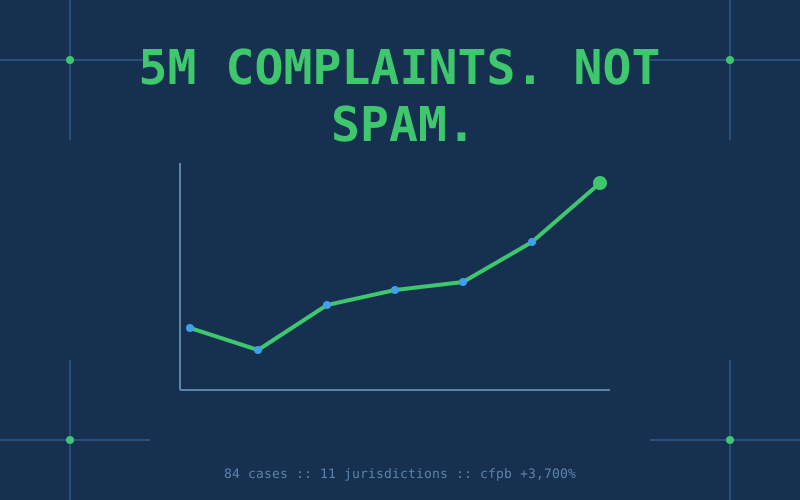
The Consumer Financial Protection Bureau publishes its own numbers, and they are extraordinary. Total complaints received went from 1.6 million in 2023 to 3.2 million in 2024 to 6.6 million in 2025. Credit and consumer reporting complaints alone went from more than 150,000 in 2019 to more than five million in 2025, which the Bureau puts at an increase of over 3,700 percent.
The Bureau names its causes explicitly, and AI is on the list alongside credit repair clinics and social media influencers: "adoption of new technologies (e.g., 'AI tools') that may act as an individual's agent." On June 24, 2026 it rebuilt the intake path around that diagnosis. Complaint accounts now require two-factor authentication on both email and mobile. Third parties must disclose their involvement. An address validation tool is going in. And consumers now get a notice telling them to exhaust their Fair Credit Reporting Act dispute rights with the agency directly before filing with the Bureau.
Read that last one again. The single fastest lever a government has against an agent-assisted flood is to make filing harder for everybody.
It is not an American problem
Germany's social courts are the sharpest non-US datapoint. At the eight social courts in North Rhine-Westphalia, urgent-relief proceedings rose by more than 55 percent in 2025, to 7,615, per the regional court president's annual press conference as reported by LTO. The court attributes a chunk of it to unrepresented claimants filing AI-drafted briefs, mostly over basic income. Because urgent proceedings jump the queue, the main proceedings behind them get slower, which is a fairly elegant way for a court to defeat itself.
In Britain, TechCrunch reports that complaints to the Housing Ombudsman went from about 2,600 in 2022 to over 7,000 in 2025. The Ombudsman's own 2024-25 annual review records 7,082 determinations, up 30 percent year on year, and 26,901 interventions.
The paper's ten illustrative cases give you the range: Australian federal FOI requests, German environmental impact assessment comments, Brazil's temporary disability benefit, UK Money Claims Online, UK local plan consultations, Japan's Strategic Energy Plan consultations, South Korean electronic payment orders, Dutch municipal property valuation objections, and US voter roll purge submissions. That last one is a reminder that the same capability points in both directions.
The finding that makes this genuinely hard
"The vast majority of cases we find are people who are entitled to claim for something, claiming for that thing."
That is Schmitz to TechCrunch, and it is the whole problem in one sentence. This is not a bug bounty program drowning in slop. Every public benefits system in the world has a take-up gap, the share of eligible people who never claim because the form is hostile, the deadline is obscure, or the appeal requires a vocabulary they do not have. Agencies have quietly budgeted against that gap for decades. A chatbot that reads the eligibility rules and drafts the appeal closes it, and the budget was never sized for everyone showing up.
Schmitz also describes the diffusion curve, which is the part that should worry anyone running an intake queue: the tools went from requiring careful prompting to accepting a photo of a letter. "People are finding out that this is something one can do, and incrementally, it is just getting easier."
What governments actually reached for
Fifty-six percent of the 84 cases show an explicit government response. Of the whole set, 17 percent (14 cases) added friction such as fees, rate limits or identity checks. Twenty-five percent (21 cases) deployed AI on the processing side for intake screening and triage. Fifteen percent (13 cases) redesigned the service itself, standardising formats and integrating identity.
The authors build a 13-factor risk matrix to predict exposure. On the likelihood side: agent capability maturity, cost of access, interface design, submission effort, expected benefit. On the severity side: processing effort, identity verification, how easily capacity scales, current utilisation, budget rigidity, legal mandates to process, the size of the take-up gap, and downstream costs. Their summary is blunt. Near-term risk is highest for services that are financially attractive and complex, which is a fair description of most of the welfare state.
If you build agents that file things
- Digital identity is the coming gate. The paper's first near-term recommendation to governments is a digital identity strategy for exposed services. If your product submits on a user's behalf, assume verified identity and disclosed third-party involvement become preconditions, not features.
- Disclosure is already law-adjacent. The CFPB now requires third parties to say they are involved. Building that field into your submission flow now is cheaper than retrofitting it after a rule lands.
- Length is not quality, and intake teams know it. A 40-page AI-expanded complaint is more likely to get deprioritised than a tight one. If you optimise for anything, optimise for the structured fields the agency actually parses.
- This is not only a government curve. Any intake surface with a low cost to submit and a real payoff behind it is on the same line: bug bounties, grant applications, support queues, appeals, refunds, marketplace disputes.
What the data does not say
Be honest about the limits, because the authors are. These are 84 potential cases. Nobody stamps a filing "written by ChatGPT," so attribution runs on officials' assertions in 69 percent of cases and on third-party reporting in the rest. The paper also notes that some of its volume series start rising before ChatGPT shipped, meaning AI is a contributing accelerant in an already-moving system, not a clean single cause. And the CFPB itself lists credit repair clinics and influencer campaigns next to AI tools. Anyone who tells you the entire 3,700 percent is language models is reading past the source.
Key Takeaways
- 84 documented cases across 11 jurisdictions and 13 service domains, presented at this year's AAAI/ACM Conference on AI, Ethics and Society.
- 90 percent of cases are qualitative flooding, meaning longer and more complex requests rather than simply more of them. That is the failure mode your dashboards will not show.
- CFPB complaints went 1.6M to 3.2M to 6.6M across 2023 to 2025, with credit reporting complaints up over 3,700 percent since 2019. The Bureau named AI tools as one cause and answered with two-factor authentication and exhaust-first notices on June 24, 2026.
- Germany's NRW social courts logged a 55 percent rise in urgent proceedings to 7,615 in 2025, attributed partly to AI-drafted filings from unrepresented claimants.
- Most of the flood appears to be legitimate claims from eligible people, which is why friction is both the fastest fix and the one that reverses the accessibility gain.
- If you build filing agents, expect verified identity and third-party disclosure to become entry requirements rather than differentiators.
Sources: Characterizing Agentic Flooding of Government Services (arXiv), TechCrunch, Consumer Financial Protection Bureau, LTO, Housing Ombudsman Annual Complaint Review 2024-25