Alphabet Says AI Mode Monetizes Less as Search Growth Slows to 12% and Shares Fall 10%
TL;DR
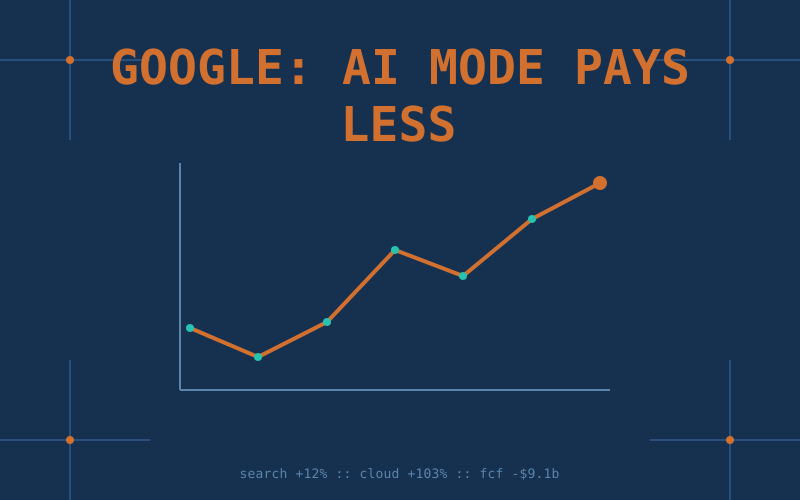
Alphabet grew Q3 2026 revenue 25% to $127.6 billion and more than doubled Google Cloud to $30.7 billion, and the stock still dropped about 10% after hours. Search and other revenue grew 12%, down from 19% in Q1 and 17% in Q2, and chief business officer Philipp Schindler told analysts that fast growth in AI Mode queries weighed on Search "because of the lower monetization we were seeing in AI Mode." Capex reached $51.4 billion in a single quarter, free cash flow was negative $9.1 billion, long-term debt has nearly tripled since December, and CFO Anat Ashkenazi repeated that 2027 capex will "increase significantly." Google's answer to the Search problem shipped the same afternoon: ads in AI Mode in ten more countries, and a new ad slot inside follow-up questions in the US.
The numbers, from the 8-K
Alphabet filed the release as an exhibit to its 8-K on October 28. Comparisons are against Q3 2025 unless noted.
- Revenue: $127.58 billion, up 25%, the same in constant currency. Pichai called it a "half-trillion dollar revenue run rate" and the thirteenth straight quarter of double-digit growth.
- Google Search and other: $63.35 billion, up 12%. Q2 was $63.27 billion, so Search was flat in dollars quarter over quarter.
- YouTube ads: $11.21 billion, up 9%. Subscriptions, platforms and devices: $14.29 billion, up 11%.
- Google Cloud: $30.71 billion, up 103%, with $11.12 billion of operating income against $3.59 billion a year ago.
- Operating income: $40.58 billion, up 30%, a 31.8% margin. The "Alphabet-level activities" line, which the company says mostly reflects shared AI research and development, lost $7.66 billion, up from $4.47 billion.
- Net income to common stockholders: $26.17 billion, down from $34.98 billion. Diluted EPS $2.12 against $2.87.
- Headcount: 204,757, up from 190,167.
More queries, longer queries, less money per query
Sundar Pichai opened his prepared remarks with the good half: "our year-over-year query growth rate is the highest it's been in the last five years," commercial queries included. Queries in AI Mode run about three times longer than a traditional search, and one in five of them worldwide now includes voice, an image or a document.
Schindler then walked through what slowed Search from Q2. Currency was the biggest factor. Retail advertisers in APAC were hit by the EU's de minimis change. Media spending normalized after a FIFA World Cup bump in Q2. He also said, as recorded in the call transcript: "the strong growth in AI Mode queries had an impact because of the lower monetization we were seeing in AI Mode."
Picture a shop that has started seating customers for long conversations instead of handing them a box off the shelf. Visits are up and each visit lasts longer, but the till rings less often per visit. Google's position is that most of those visitors are new ("the majority of AI Mode queries are incremental," Schindler said), so the extra foot traffic pays off later. Q3 shows the first half of that bet. Search revenue sat at $63.3 billion in both Q2 and Q3 while queries grew at their fastest rate in five years.
Schindler added, "we feel very good about our trajectory here." Ashkenazi was more guarded about Q4, which has to lap the Search acceleration of late 2025 and absorb a slightly larger currency headwind. Search Engine Journal traced the same slide, 19% to 17% to 12%, and noted that Schindler never said how much revenue AI Mode cost or what its monetization is lower than.
The fix shipped the same afternoon: ads in AI Mode go global
Shashi Thakur, who runs Search Ads, posted the expansion notice on October 28. Ads in AI Mode are rolling out now in Australia, Canada, India, Kenya, Malaysia, New Zealand, Nigeria, Pakistan, the Philippines and Singapore, with Brazil, Mexico and the UK among the locales planned for Q4. In the US, Google is launching "multiturn ads," which put sponsored results into follow-up questions as well as under the first answer.
The evidence Google offers is a single footnoted claim: click-through rates on sponsored product listings inside AI Mode are "already similar" to organic listings, based on US internal data from August 20 to September 3, 2026. That is a two-week window and it covers product listings only, so it points in a direction without proving much.
If you run a small business on Search or Shopping campaigns, the practical change is that your ads now follow the user into the conversation. A query that used to end at one results page can show your ad on turn one and again on turn three. Whether that turns out to be a cheaper click or a pricier one is the number nobody has published yet.
Cloud doubled, and TPUs are now a line item on the balance sheet
Google Cloud is the part of the quarter that beat. Revenue of $30.71 billion was up 103%, against the $28.7 billion that analysts expected, according to CNBC. Segment operating income tripled to $11.12 billion, a 36% margin. Alphabet credits enterprise AI infrastructure and AI solutions on GCP, and says sales of TPU systems "were also a meaningful contributor to revenue growth."
That last line shows up on the balance sheet. Inventory, normally a rounding error for a software company, went from $2.4 billion at the end of December to $13.3 billion at the end of September, and Ashkenazi named the "inventory build of TPU systems" as one reason free cash flow turned negative. Google is now, in part, a hardware vendor that has to carry chips before it sells them.
Thomas Kurian, in what CNBC describes as his first public earnings remarks as Cloud CEO, said demand is coming from "AI labs, capital markets, financial service institutions, and enterprises." Pichai added that first-party model APIs are processing nearly 32 billion tokens per minute, more than four times the year-ago rate and 40% more than last quarter, and that the Gemini app has reached one billion users, which he called the fastest-growing product in Google's history.
The bill: $51 billion of capex in thirteen weeks
Purchases of property and equipment came to $51.36 billion in the quarter, more than double the $23.95 billion a year earlier, and $131.95 billion for the first nine months of 2026. Operating cash flow was $42.29 billion, so free cash flow was negative $9.07 billion. That is far below the roughly $2.7 billion figure analysts expected, per CNBC.
Alphabet kept its 2026 capex guidance at $195 billion to $205 billion, which leaves $63 billion to $73 billion for Q4 alone. Ashkenazi: "We continue to expect our capex to increase significantly in 2027, and will provide further details on our Q4 call."
The funding has changed shape to match. In Q3 Alphabet raised $29.0 billion net from debt and $12.4 billion from selling 36 million new shares through its at-the-market program, and bought back no stock, compared with $11.5 billion of repurchases in Q3 2025. Long-term debt stood at $125.1 billion on September 30, up from $46.5 billion on December 31. Total assets stood at $1.0 trillion, up from $595 billion at the end of 2025, with net property and equipment alone at $372.8 billion.
Why the stock fell anyway
CNBC called it Alphabet's first miss on both revenue and earnings in nearly four years. By CNBC's tally of analyst estimates, revenue of $127.58 billion missed $128.22 billion, Search missed $64.96 billion, capex came in under the $55.09 billion expected, and adjusted EPS of $2.67 missed $3.02. GAAP EPS was lower still at $2.12, because other income swung from a $12.76 billion gain a year ago to an $8.22 billion loss, mostly an unrealized loss on equity holdings. The call pinned it on the SpaceX stake, per the MarketBeat transcript.
Shares closed at $322.22 and traded at $288.35 after hours, down 10.4%, according to Investing.com. Jefferies analyst Brent Thill summed up the mood on CNBC: "The Street wanted 100%, so it didn't beat by much, and it missed some of the high-end targets. Everything else missed."
So Alphabet grew 25%, doubled its cloud, put Gemini in a billion hands, and still got sent to its room. Wall Street parenting is strict this year.
What this means if you build on Google
- Search traffic and ads: query growth is happening in AI Mode, Google says it monetizes less per query today, and ads are expanding into it in ten more countries now, at least three more in Q4, and follow-up turns in the US. Expect your Shopping and Search spend to land inside conversations, and watch your cost per click.
- Gemini API: 32 billion tokens a minute across first-party APIs and a 40% jump in one quarter means Google's inference capacity is being consumed as fast as it lands. Pichai said Gemini 4 Argon usage on developer platforms ramped three and a half times faster than Gemini 3 did in its first week, and Gemini 4 Carbon launched the same day.
- Cloud and TPUs: $11 billion of quarterly Cloud operating income and an inventory line that swelled to $13 billion, which the CFO tied to TPU systems, say Google intends to sell its chips as systems, a second source besides Nvidia for anyone renting accelerators.
- Capex: about $200 billion this year and "significantly" more in 2027, funded with debt and new shares. Everyone competing for accelerators, memory and power in 2027 is now bidding against a buyer that has said so out loud.
Key Takeaways
- Alphabet revenue rose 25% to $127.6 billion in Q3 2026; Search and other grew 12%, down from 19% in Q1 and 17% in Q2, and was flat against Q2 in dollars.
- Schindler named lower AI Mode monetization as a drag alongside currency, retail and media, while Pichai reported the highest query growth in five years and AI Mode queries three times longer than normal searches.
- Google Cloud more than doubled to $30.7 billion with $11.1 billion of operating income; TPU systems sales were a "meaningful contributor" and inventory rose to $13.3 billion.
- Capex was $51.4 billion for the quarter and $132 billion year to date; free cash flow was negative $9.1 billion; 2026 guidance of $195-205 billion is unchanged and 2027 will be "significantly" higher.
- Alphabet funded the quarter with $29 billion of new debt and $12.4 billion of new shares, bought back nothing, and now carries $125.1 billion of long-term debt.
- Ads in AI Mode expanded to ten more countries on October 28, multiturn ads are launching in the US, and the UK, Brazil and Mexico are due in Q4.
Sources: Alphabet Q3 2026 results (SEC 8-K Exhibit 99.1), Alphabet Q2 2026 results, Alphabet Q1 2026 results, Alphabet Q4 2025 results, Sundar Pichai's Q3 2026 call remarks, Google Ads: Ads in AI Mode expand to new markets, CNBC, Investing.com call transcript, MarketBeat transcript, Search Engine Journal