Anthropic Booked 2 Gigawatts of AMD GPUs. AMD Is Paying for the Privilege.
TL;DR
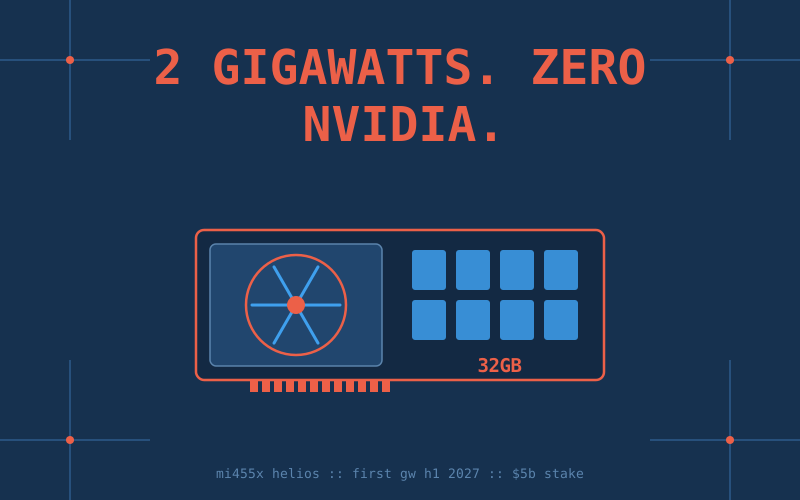
On July 22, AMD and Anthropic announced a strategic partnership to deploy up to 2 gigawatts of Instinct MI450-series GPUs, with the first gigawatt coming online in the first half of 2027. The hardware ships as Helios rack-scale systems: MI455X GPUs, EPYC "Venice" CPUs, Pensando networking, and ROCm software, meaning there is not a single Nvidia part in the rack. AMD is also committing a strategic equity investment of up to $5 billion in Anthropic, and the two will run a multiyear engineering collaboration in which Claude is used to optimize workloads for Instinct GPUs and to accelerate ROCm development. For a company whose training story has so far run on Trainium, TPUs, and Nvidia, this is the clearest signal yet that AMD's datacenter stack is now frontier-lab grade.
The deal, in numbers
The press release is short and the numbers do the talking. Anthropic will deploy up to 2 gigawatts of AMD Instinct MI450-series GPUs in AMD Helios rack-scale systems. The first gigawatt begins deployment in the first half of 2027. This is not a cold start: Anthropic already runs production workloads on AMD's current Instinct MI355X GPUs, so the MI450 commitment is a scale-up of something in use today, not a science project.
Why gigawatts and not chip counts or dollars? Because power is the one input nobody can fab more of on demand. Measuring an AI deal in gigawatts is like sizing a restaurant by its gas line instead of its menu: the hookup is the thing you cannot swap out later, so it has become the honest unit of commitment.
Lisa Su, AMD's chair and CEO, kept the framing simple: "We are thrilled to deepen our partnership with Anthropic and deploy AMD Helios at gigawatt scale." On the Anthropic side the quote came from Tom Brown, co-founder and chief compute officer: "Access to compute is central to keeping Claude at the frontier and meeting demand from our customers."
What is actually in the rack
The detail that matters more than the wattage is the bill of materials. Helios is not a GPU tray you bolt into someone else's system; it is a vertically integrated rack where every layer, from silicon to software, comes from one vendor.
That last layer is the one AMD has been beaten up over for a decade. Which is exactly why the engineering half of this deal is more interesting than the procurement half.
The $5 billion boomerang
The release's exact wording: "AMD has committed to make a strategic equity investment of up to $5 billion in Anthropic." No closing date, no tranche structure, just the ceiling.
This is vendor financing, the AI buildout's signature dance move: the check crosses the table, then comes right back as GPU orders. AMD gets a marquee frontier customer locked to its roadmap; Anthropic gets capital and capacity from a supplier with every incentive to keep it happy. Skeptics will note, correctly, that money circulating between vendor and customer makes both order books look bigger than the outside cash entering the system. That critique has chased every mega-deal of the past year, and it applies here too. It is also, for now, how frontier compute gets built.
ROCm is the real story for builders
Buried under the gigawatts is the clause that should matter most to anyone who has ever fought a driver: a multiyear engineering collaboration in which Claude is used to optimize workloads for Instinct GPUs and to accelerate ROCm development, while AMD adopts Claude broadly across its own engineering and product teams.
ROCm's problem was never the spec sheet; it is the thousand paper cuts between the spec sheet and a training run that survives the weekend. Having a frontier lab live on your stack full time is like a restaurant chain moving its entire kitchen onto your stove line: the burner bugs get found, reported, and fixed at a rate no internal test kitchen can match. Anthropic hits the sharp edges at 2 GW scale so the rest of the ecosystem, down to the person running an Instinct card or a ROCm build on a home rig, inherits the patches.
There is also a pleasing recursion in AMD using Claude to improve the software that runs Claude. If the loop works, it compounds; models make ROCm better, which makes the models cheaper to serve, which funds more models.
Where this sits on Anthropic's silicon map
Anthropic has been unusually public about spreading its compute across silicon families. In April it expanded its AWS deal to up to 5 gigawatts of new Trainium capacity, backed by a $100 billion spend commitment over the next decade, and disclosed it already runs on over one million Trainium2 chips. Two weeks before that it announced multiple gigawatts of next-generation TPU capacity with Google and Broadcom, arriving from 2027. Both posts note run-rate revenue has passed $30 billion, up from roughly $9 billion at the end of 2025, which is the demand curve all these gigawatts are chasing.
The timing is not subtle either. The announcement landed the day AMD's Advancing AI 2026 event opened in San Francisco, and two days after AMD disclosed that Microsoft will deploy its next-gen Instinct and EPYC processors in an expanded partnership. AMD's July so far: Microsoft on the 20th, Anthropic on the 22nd. The Instinct order book is having a moment.
The caveats
Read the qualifiers before repricing anything. The 2 gigawatts is an "up to" figure, and nothing new deploys until the first half of 2027, roughly a year out. The equity investment is also "up to" $5 billion, with timing described only as prospective; no tranche has closed. The release discloses no rack-level performance figures, no pricing, and no split between training and inference workloads. And every gigawatt-scale plan in the industry ultimately depends on power and datacenter buildout timelines that have slipped before.
Key Takeaways
- AMD and Anthropic announced a deal for up to 2 GW of Instinct MI450-series GPUs in Helios racks, with the first gigawatt deploying in H1 2027.
- AMD committed a strategic equity investment of up to $5 billion in Anthropic, continuing the vendor-finances-customer pattern of the AI buildout.
- The Helios rack is a fully AMD stack: MI455X GPUs, EPYC "Venice" CPUs, Pensando networking, and ROCm. No Nvidia part in the BOM.
- A multiyear engineering collaboration puts Claude to work optimizing Instinct workloads and accelerating ROCm, the layer that has historically held AMD back.
- Anthropic already runs on MI355X today, and this joins disclosed deals for up to 5 GW of AWS Trainium and multiple gigawatts of Google TPUs.
- All the headline numbers are "up to" ceilings, and nothing new comes online until H1 2027.
Sources: AMD Newsroom, GlobeNewswire (press release), HotHardware, Anthropic (Amazon compute expansion), Anthropic (Google and Broadcom partnership), AMD Investor Relations