Steam Next Fest Hits 7,164 Demos as Players Ask Valve for a Filter to Hide AI Games
TL;DR
Steam Next Fest runs October 19-26, and this edition is the biggest yet: GamingOnLinux counted 7,164 demos on SteamDB's event page on launch day, against 4,382 in June by GameDiscoverCo's count. Nobody agrees on how many of them disclose generative AI. SteamDB filters give anything from at least 1,054 demos to 2,593 titles (about 36%), but every count points up from GameDiscoverCo's 21.2% in February and 26.5% in June. Steam shows the AI disclosure on each store page and offers no way to hide those games, and the loudest demand from players this week is a "no AI" filter. Meanwhile one Japanese studio cancelled its public demo because it feared AI clones would ship before its game did.
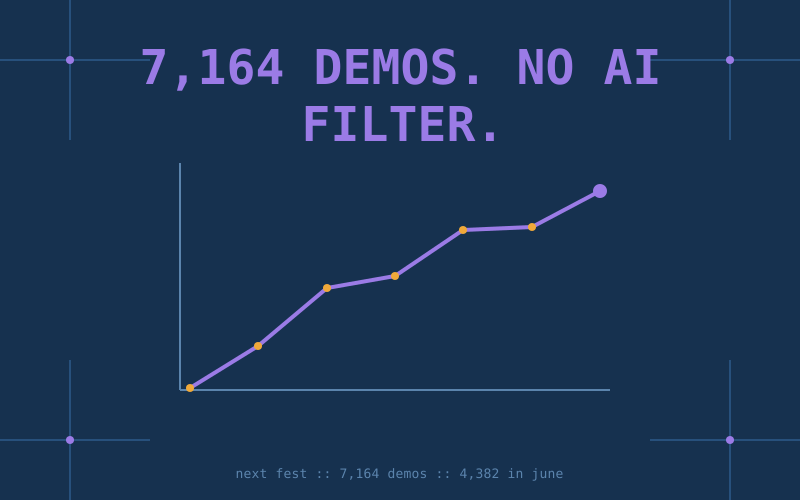
The demo count went vertical
Next Fest is Valve's free demo festival for unreleased PC games, and indie developers plan whole launches around it. A good Next Fest week is where wishlists come from, and wishlists decide whether Steam's algorithm ever shows your game to anyone again.
The festival has been growing for years, but the last two editions broke the curve. Kotaku, citing GameDiscoverCo, puts October 2023 at about 900 demos and October 2024 at about 2,700. GameDiscoverCo's own June 2026 wrap-up counted 4,382 demos, "66% more than the 2,645 demos in June 2025's Next Fest." Four months later, SteamDB's live October count was 7,164.
The exact number depends on who counted and when. A figure of 8,011 circulated before launch, other outlets reported 8,202, and Kotaku's own piece says "nearly 7,100." Valve's festival page just says "thousands," which is the right word when the total changes every time you refresh.
How much of it is AI depends on how you count
Since Valve's January 2024 AI content rules, developers have had to disclose generative AI use when they submit a game, and the disclosure appears on the store page. That makes AI use countable, in theory. In practice the counts for this edition disagree by more than a factor of two:
- GameDiscoverCo counted demos with the AI disclosure enabled: 750 (21.2%) in February 2026 and 1,163 (26.5%) in June. It has not published October numbers yet.
- PC Guide used SteamDB's event page with the AI tag excluded: 7,145 titles in total, 4,552 without a disclosure, so 2,593 with one, "just over 36%." Its June count on the same method was 1,715 of roughly 8,700 participating titles, or 19.71%.
- GamingOnLinux filtered the same SteamDB page to demos only and found "at least 1,054" with an AI disclosure notice, which it presents as a floor.
The October share is somewhere between "a sixth" and "over a third" depending on whether you count demo listings or parent titles. GameDiscoverCo also points out that the disclosure is one broad checkbox, so a game with an AI-generated placeholder logo and a game whose entire art, code and voice track came out of a model wear the same label. When PCGamesN checked the top 100 demos in February, 10 disclosed AI, and four of those said it was for placeholder images or music.
What players are asking for
The festival opened on Monday, and the backlash landed the same day. An IGN story titled "Steam Fans Are Begging for a No-AI Filter" reached 172 points and 202 comments on Hacker News. Kotaku quoted Nexxtic, lead developer of the shooter Selaco, calling it "the most depressing Steam Next Fest I have ever seen," and its headline called the event "a massive disaster."
The ask itself is small. The disclosure data already exists on every store page, since Valve makes developers fill it in. What Steam lacks is a toggle or a searchable tag that lets a player act on it, and Valve has not said whether it will add one. Today the label works like an allergen warning printed on the receipt: technically disclosed, but only after you have already picked the thing up.
Developers are pulling demos to avoid AI clones
The flood also changes what it costs to show your game early. On October 16, Japanese publisher Alliance Arts cancelled the public Next Fest demo of its horror game Drunken Goddess Reflux, three days before it was due. It moved to closed online sessions for a limited group of players instead. One of the two reasons it gave was concern "that the demo's content could be used to quickly imitate or replicate the game's presentation and gameplay with AI or other tools, and that such works could be released before our launch."
For a small studio, a public demo has always been a trade between exposure and the risk of being copied. For most games that trade used to favor exposure. Alliance Arts decided it no longer does, at least for a horror game whose look is the selling point.
The view from the builder side
The same day the HN thread took off, Simon Willison published the story of Battle Drones, a mobile browser RTS built over 12 major versions and 321 commits by coding agents, mostly Claude Code. He linked the IGN story and said he "wouldn't personally dream of submitting Battle Drones to an event like this," because it is "still way too low effort to warrant consideration as a legitimate indie gaming project." He also wrote that he can "now see a path to vibe coded games like this being taken seriously."
Put those two statements together and you have the Next Fest problem. A person with no game-dev background can now get a playable, good-looking game out of coding agents, and Willison's judgment about what belongs in a festival is a personal choice, not a rule anyone enforces. Steam's discovery system has no way to tell a careful experiment from the kind of quick clone that worried Alliance Arts, other than a checkbox that both would tick.
If this sounds familiar, Spotify said this week that it had pulled 50 million AI slop tracks from recommendations this year. Different medium, same supply curve.
Why builders should care
- Labels become filters. Once players can hide AI-disclosed games, the disclosure checkbox turns into a ranking input. If you ship anything to Steam, decide now what your disclosure says and whether a placeholder asset is worth carrying that label into launch week.
- Discovery events stop scaling. A festival with 7,000+ demos no longer works as a showcase. Expect more weight on curated slices, publisher spotlights and outside curators, and less on the raw event.
- Public demos now carry clone risk. Alliance Arts' closed playtest is one data point, but the reasoning will apply to any game whose value is mostly presentation.
- The numbers are messy, so read the method. "36% of Next Fest is AI" and "at least 1,054 demos" both come from SteamDB. Before quoting one, check whether it counts demos or parent titles.
Key Takeaways
- October's Steam Next Fest (Oct 19-26) had 7,164 demos on SteamDB's launch-day count, up from 4,382 in June and about 900 in October 2023.
- AI disclosures among demos rose from 21.2% in February to 26.5% in June by GameDiscoverCo's count; October SteamDB-based counts range from at least 1,054 demos to 2,593 titles (about 36%).
- Steam shows the AI disclosure on each store page but has no filter or searchable tag to hide those games, and Valve has not said whether it will add one.
- Alliance Arts cancelled the public demo of Drunken Goddess Reflux, citing the risk of AI-assisted imitations launching first.
- The disclosure checkbox is broad: placeholder art and fully generated games carry the same label, which makes the numbers hard to read and a blunt filter unfair to some developers.
Sources: GamingOnLinux: Steam Next Fest Oct 2026 is live, PC Guide: October Next Fest AI count, PC Guide: June Next Fest AI count, GameDiscoverCo: Who won June 2026's Steam Next Fest, Kotaku: Steam Next Fest has become a massive disaster, Alliance Arts on X: Drunken Goddess Reflux demo change, Steamworks: AI Content on Steam, PCGamesN: February 2026 top-100 demo AI check, Hacker News discussion, Simon Willison: Battle Drones, Steam Next Fest