arXiv Caps Submitters at Two Papers a Month After September Hit a Record 40,363
TL;DR
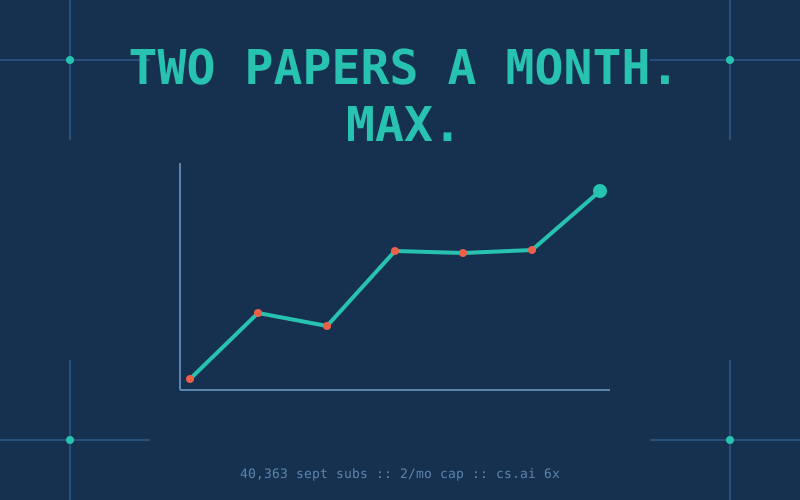
arXiv, the preprint server most of AI research runs on, now limits each submitter to two submissions per calendar month, with no more than three active submissions at once. The rule took effect on October 1, 2026, and applies across every category. The trigger is volume: arXiv says it received 40,363 submissions in September, a single-month record, double September 2024 and roughly four times September 2016. The moderators say a meaningful share of that growth is thin, sliced-up, or densely AI-written work, and cs.AI submissions alone grew more than sixfold in two years.
What changed
The announcement, Fair Moderation, Equitable Access, and AI: arXiv's Updated Rate Limit Policy, went up on the arXiv blog on October 1. arXiv calls it a stopgap while it works out "the new best practice for authors employing more and more advanced AI tools" and upgrades its moderation tooling.
The rule is now written into arXiv's content moderation policy: each author may submit up to two submissions per calendar month, with a limit of three active submissions, and arXiv may ask a particular author to go lower. The three-active cap has existed since 2024. The monthly cap is new; before this, rate limiting was mostly left to moderator discretion.
Thomas Dietterich, chair of the arXiv Editorial Advisory Council, put it in one line on X: "Because of the exponential increase in submissions, arXiv is limiting the number of papers that a person can submit each month to two."
The numbers behind it
arXiv's own monthly submission statistics show how fast the curve bent. It took eight years, from September 2016 to September 2024, for monthly submissions to double. It took two more years to double again.
The September spike is not just a long trend continuing. Submissions ran between roughly 28,000 and 32,000 a month from March through August 2026, then jumped about 29 percent in a single month. Year over year, September 2026 is up about 51 percent on September 2025.
The blog post adds the operational cost: those 40,363 submissions generated almost 9,000 support tickets for arXiv staff and moderators. And the growth is lopsided. arXiv says cs.AI submissions increased more than sixfold over the past two years, while other categories roughly doubled.
What the moderators are actually seeing
arXiv is careful not to blame AI use as such. Its generative AI policy allows authors to use AI tools as long as they disclose it and the work meets arXiv's bar for scholarly interest. The complaint is about what the tools make cheap. Moderators report more "thin papers of narrow scope," more "salami" papers where one piece of work is cut into several smaller submissions, and "a marked increase in dense, AI-written papers."
The blog says the load is concentrated: a relatively small share of authors submit large numbers of low-quality papers and consume a disproportionate share of volunteer moderator time. Everyone else pays for it in queue delay, with good papers sitting for days or weeks. A flat per-person cap is a blunt fix, but it targets that concentration directly. Two papers a month is plenty for a human research career and very little for a pipeline.
The salami problem has a certain dark comedy to it. For decades the publish-or-perish system rewarded slicing one result into as many papers as reviewers would tolerate. AI did not invent that incentive. It just removed the last bit of friction that kept it in check.
The fine print
The FAQ in the announcement settles the edge cases most people will hit:
- Rejections count. The cap is on submissions, not announced papers, because submissions are what cost moderator time. Submit two in a month and get both rejected, and you wait until next month.
- Deletions do not count. If you delete a submission before it is announced, it does not count toward the monthly or active limits.
- All categories share one quota. Spreading papers across subject areas does not get you extra slots.
- Holds roll over differently. Papers still on hold from a previous month do not eat next month's quota, but they still count toward the three-active limit.
- It is per submitter, not per author. Submitting a paper with co-authors only counts against the person who clicks submit. arXiv tells co-authors to coordinate.
That last rule is the one worth understanding. The limit is keyed to the submitting account, not to the authors on the paper. Think of it like an API rate limit keyed to an API key rather than to the end user: a team of five has five keys, and the quota is effectively shared across whoever on the paper has spare capacity. A lab with many co-authors gets more headroom than a solo researcher, which is the trade arXiv accepted to keep the rule simple to enforce.
Why builders should care
Agentic research meets a human-scale throttle
This blog has spent the past month covering agents that run experiments, prove lemmas, and draft papers in hours. The infrastructure of science was built around human output rates, and arXiv just made that assumption explicit. If your workflow, product, or lab plan involves AI agents producing a steady stream of preprints, the real limit is now two submissions per human per month, not compute.
The corpus you train and retrieve on is changing
arXiv is a default source for training data, RAG indexes, literature-review agents, and paper-recommendation tools. A moderator corps that is falling behind means more low-value papers slipping into that corpus. If you build anything that ranks or summarizes papers, assume the noise floor in cs.AI rose sharply over 2025 and 2026, and weight signals beyond "it is on arXiv" accordingly.
Flat caps are the first response, not the last
arXiv frames this as a stopgap and says it will monitor the effect and change the rule as needed. It also recently became an independent nonprofit, with new leadership and new funding. Expect better moderation tooling, and possibly AI-assisted screening, to follow the blunt cap. For anyone running a platform that accepts user content, it is a familiar pattern: when generation gets cheap, rate limits come first and smarter filtering arrives later.
Key Takeaways
- Since October 1, 2026, every arXiv submitter is limited to two submissions per calendar month and three active submissions, across all categories.
- arXiv received a record 40,363 submissions in September 2026, versus 20,569 in September 2024 and 9,869 in September 2016, along with almost 9,000 support tickets.
- cs.AI submissions grew more than sixfold in two years, while other categories roughly doubled.
- Moderators cite thin papers, salami-sliced papers, and dense AI-written papers, mostly from a small group of very high-volume authors.
- Rejected submissions count toward the cap, and the limit applies to the submitter, not to co-authors.
- If you build on arXiv as a data source or an output channel, plan for both a noisier corpus and a hard human-scale throughput limit.
Sources: arXiv blog: Updated Rate Limit Policy, arXiv content moderation policy, arXiv monthly submission statistics, Thomas Dietterich on X, Startup Fortune, arXiv blog: independent nonprofit