AI Deals Drive Two-Thirds of Similarweb's New ARR as It Posts First GAAP Profit
On this page 8 sections
TL;DR
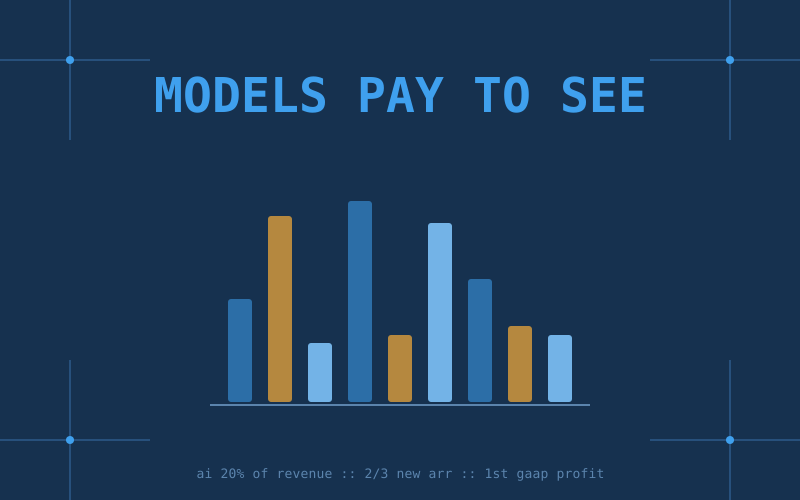
Similarweb has turned AI companies into its main growth engine, and it has the filing to prove it. In third-quarter results published 17 November, the web-data company grew revenue 15.6 percent to $83.0 million and booked its first positive GAAP net income as a public company: $3.5 million, or $0.04 a share. Chief financial officer Ran Vered said AI-related businesses "drove roughly two-thirds of ARR added in the quarter", and AI-related revenue reached almost 20 percent of the total, up from 11 percent at the end of 2025. Full-year guidance rose for the third time this year.
The quarter, in numbers
Revenue of $83.0 million came in above the guidance range, and non-GAAP operating profit more than doubled to $10.1 million, a 12 percent margin and a company record. Normalized free cash flow hit $10.5 million, also a record, once you exclude one-off payments, among them a $4 million legal settlement. Remaining performance obligations, the contracted backlog, climbed 25 percent to $334.2 million.
One asterisk on the profit line. The nine-month GAAP result is still a $6.5 million net loss, and the Q3 figure includes $1.5 million of net finance income, including a $1.2 million currency gain. The operating business is plainly improving; the first GAAP profit got some help from below the operating line.
It was also founder Or Offer's last earnings call as chief executive. Michael Akkerman, announced in September, took over on 2 November. Offer hands over the keys in the quarter his company posts its highest-ever sequential revenue add, record margins and its first positive GAAP net income.
Who is buying all this data
This is the second straight quarter AI drove the majority of new ARR, per Offer, built on what he called "multiple 7- and 8-figure engagements across many different customer categories". More than ten customers are now at that scale, and Vered added that no single customer exceeds 10 percent of revenue. Every AI-related deal is annual-recurring with a yearly commitment, most of them multi-year.
The buyer list is broader than model labs. Offer's description on the earnings call: "For AI-native companies like LLMs and OEMs to investors, enterprise brands, and market research companies, the range of ways our data is being used is wide." The largest named bet is the multi-year partnership with NIQ, the retail-measurement company, announced in September; a joint product for measuring shopping inside AI assistants lands around December, with a revenue uplift expected in 2027.
From dashboards to data pipes
Offer's pitch on the call was blunt: "Models can reason, but they cannot see the digital world on their own. AI needs context." For two decades Similarweb sold that context to humans through dashboards. The new revenue comes from models and agents consuming the data directly, through APIs and the Model Context Protocol. In Offer's words, customers who "land in buying more like API, MCP, usually, the deals are bigger from day 1".
The economics improve with the pipe. "When you start selling data to AI and to agents, you mostly sell data. This is much more profitable for us as a company," Vered said, without putting a number on it. A dashboard subscription rents one analyst a seat in the lookout tower; a data license sells the view itself, and showing the view to the next customer costs roughly nothing. Headcount stayed flat through the growth quarter, which management partly credits to internal AI use.
The shift shows in the customer base, too. The count of customers paying $25,000 or more fell to 1,790 from 1,828 a year earlier, a deliberate choice to spend sales capacity on large accounts instead of small inbound deals. Customers above $100,000 in ARR grew 6 percent to 474, and the average account in that cohort swelled 27 percent to $464,000.
Measurement follows the money
Similarweb is also building for the demand side. AI Ads, launched in August, gives advertisers a competitive view of ads inside ChatGPT, Google AI Mode and Google AI Overviews. The NIQ product, per the September announcement, covers shopping answers across ChatGPT, Gemini, Google AI Mode, Perplexity and Claude. If agents start doing the buying, someone has to count what they bought.
The competitive backdrop shifted as well: Adobe agreed in November 2025 to buy Semrush for $1.9 billion in cash, per PPC Land's reporting, while Similarweb stayed independent. It is now the clearest public window into what AI buyers actually pay for web data.
Read the fine print before you quote it
"AI-related" appears in no definition. Neither the release nor the call says which contracts count, and no dollar figure is given; applied to $83.0 million, just under 20 percent implies something below $16.6 million, a PPC Land calculation. When a Jefferies analyst asked whether the big contracts cover training data or inference, Offer answered a different question about contract length and upsell. Total ARR is undisclosed as well; the cohort math implies roughly $314 million, again PPC Land's arithmetic. "AI-related" is a conveniently stretchy adjective.
One more drag: about half of Similarweb's employees sit in Israel, and the strengthening shekel against the dollar keeps pressure on profits, per Vered.
Why a builder should care
- If you sit on proprietary behavioral data, AI companies are a buyer class that barely existed two years ago, and they arrive with seven- and eight-figure budgets. Similarweb's quarter is the receipts.
- Ship the pipe before the enterprise seller books the flight. Deals that land through an API or MCP server start bigger on day one, per Offer, because the buyer can consume the data immediately.
- Structure data deals as multi-year ARR with dataset-by-dataset upsell. Offer: "Usually, they buy one kind of dataset, and there is always need for more data sets." Land and expand, applied to columns instead of seats.
- Watch concentration as the big contracts grow. No customer above 10 percent of revenue is the line that keeps an eight-figure data business stable when one lab changes strategy.
- Raw data sales carry better margins than seat-based dashboards, per Vered. If your SaaS margins are stuck, the AI data channel is the one place this quarter where the margin story got easier rather than harder.
Key Takeaways
- Similarweb's Q3 2026 revenue rose 15.6 percent to $83.0 million, above guidance, with GAAP net income of $3.5 million and diluted EPS of $0.04, the company's first positive GAAP quarter as a public company.
- AI-related deals drove roughly two-thirds of ARR added in the quarter, the second straight quarter AI drove the majority of new ARR; AI-related revenue reached almost 20 percent of the total, up from 11 percent at the end of Q4 2025.
- Full-year 2026 guidance rose to $318-320 million in revenue, about 13 percent growth at the midpoint, and $29-31 million in non-GAAP operating profit: the third raise this year. Q4 guidance implies 16.7 percent growth, accelerating from Q3.
- Retention improved across the board: overall NRR 104 percent (from 98), 114 percent for customers above $100,000 ARR (from 105), and 66 percent of ARR under multi-year contracts (from 58).
- Buyers span AI-native companies like LLM developers and device makers, plus investors, enterprise brands and market research firms; more than ten customers run seven- or eight-figure engagements and none exceeds 10 percent of revenue.
- Caveats that travel with the story: "AI-related" is undefined with no dollar figure, the nine-month GAAP result is still a $6.5 million loss, the training-versus-inference question went unanswered, and the NIQ joint product lands around December.
Sources: Similarweb Q3 2026 press release, Q3 2026 earnings call transcript (Motley Fool), PPC Land