The Central Bank of Central Banks Just Called the AI Buildout a Systemic Risk
TL;DR
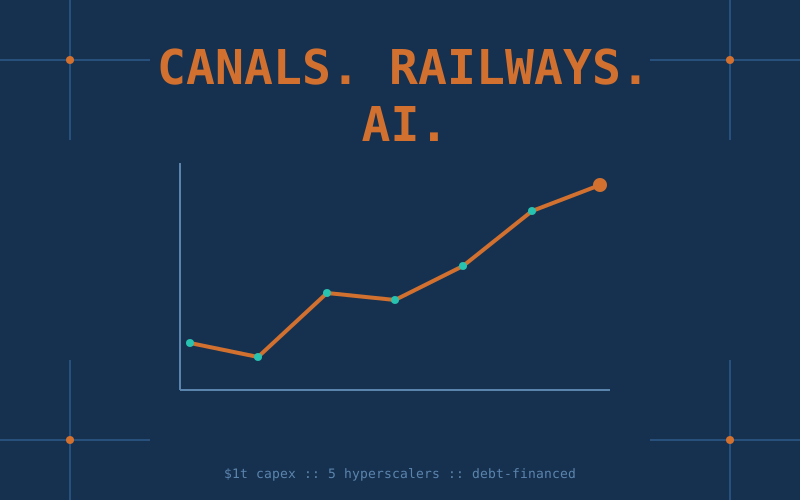
On June 28 the Bank for International Settlements (BIS), the bank that central banks themselves bank with, published its Annual Economic Report 2026 and spent a chapter warning that the AI capital-expenditure boom looks like a classic debt-fuelled mania. The headline numbers: the five largest hyperscalers are on track to spend more than one trillion dollars on AI infrastructure across 2025 and 2026, those commitments are outrunning their own cash flow, and the gap is increasingly being plugged with debt routed through private credit funds and other lightly-regulated non-bank lenders. The BIS lined the moment up next to canal mania, railway mania, 1920s electrification, and the dot-com bust, all of which were real revolutions that still ended in economy-wide recessions. This is not a model release. It matters anyway, because the inference capacity you rent sits at the end of that financing chain.
What the BIS Actually Said
The relevant chapter is titled "Progress and peril", which is about as much editorializing as a central-bank report allows itself. The core finding is structural, not moral. AI is delivering genuine productivity gains, but financial markets are pricing in those gains faster than the real economy is delivering them, and the buildout funding it has shifted from equity and retained earnings toward debt.
Concretely: the biggest hyperscalers (the report points at the cohort of Amazon, Alphabet, Microsoft, Meta, and Oracle) have committed over a trillion dollars of AI-related capex for 2025 to 2026 combined. That spend now exceeds their combined free cash flow, so some are issuing corporate bonds in record volume (more than $100 billion in 2025 by the largest names, per reporting on the report) to keep the data centers going up.
Why This Isn't Just Another Hot Take
Plenty of people have called an AI bubble. What makes a BIS warning different is who is saying it and what they are pointing at. The BIS is the central bankers' central bank, which makes this roughly the most cautious institution on the planet issuing its least cautious financial warning in years. And it is not waving at stock valuations; it is pointing at the plumbing.
The specific worry is that AI is increasingly debt-financed through hedge funds, private credit vehicles, and other non-bank intermediaries that carry less regulatory oversight than banks. The BIS notes that direct-lending funds have roughly quadrupled their exposure to the AI and IT sectors over the past five years, to around 15% of their portfolios. That is the part you cannot see from a price chart.
Here is the uncomfortable shape of it in plain terms. Picture a group of friends who keep co-signing each other's loans to buy things from each other: the chip maker, the cloud, the model lab, the startup renting the model, the fund lending to all of them. While everyone keeps buying, it looks like a thriving economy. The instant one link stops buying, every co-signed loan in the circle gets nervous at once. The BIS's term for that is "interconnectedness." Yours might be less printable.
Canals, Railways, and Now GPUs
The most quotable move in the report is the history lesson. The BIS lists four prior episodes where a genuine technological breakthrough pulled in more capital than the eventual returns could justify, and each one ended in a broad reversal: canal construction in the 1830s, the British railway mania of the 1840s, electrification in the late 1920s, and the dot-com surge of the late 1990s.
The point is not that railways or the internet were fake. They obviously were not; you are reading this over one of them. The point is that being a real revolution does not exempt you from a financing bust. The track still got laid. The companies that laid it mostly went bankrupt first.
Why You, a Person Who Ships Software, Should Care
You do not lend to data centers, so why read past the headline? Because almost every cost in your stack is a derivative of this capex cycle, and you have already felt it. GPU rental prices, frontier API pricing, and even DRAM in your laptop are all set by the same demand surge the BIS is describing. When capacity got tight this year, the bill landed on you: we wrote up the 20% jump in EC2 GPU capacity blocks the moment it hit.
A debt-financed boom cuts both ways for builders. On the way up, cheap capital subsidizes your tokens; a lot of inference is sold below cost to win the land grab, and you are the happy beneficiary. On the way down, that subsidy is the first thing to go. If financing pulls back the way the BIS sketches, the realistic outcomes are repriced API tiers, thinner free quotas, and a few well-funded inference startups quietly not renewing their leases.
The hedge writes itself, and it is the same one we keep landing on: do not hard-wire your product to a single rented frontier endpoint whose unit economics you cannot see. Keep a fallback to a cheaper tier, a rival API, or an open-weight model you run on hardware you own. Capability you rent rides on someone else's balance sheet. Capability you can download does not.
What the BIS Is Not Saying
Read this straight, because the caveats are load-bearing. The BIS is not predicting a crash, and it is explicitly not telling central banks to raise rates to cool the boom; it judged the policy trade-offs too uncertain to make that call. It is flagging a risk and its transmission path, which is its actual job.
It is also not saying AI is hype. The whole premise is that the technology is real, which is exactly what makes the financing dynamics dangerous: real breakthroughs are the ones that attract more capital than near-term returns can support. BIS general manager Pablo Hernandez de Cos put the conditional plainly.
Large-scale investment in AI infrastructure could become excessive, leaving the sector more vulnerable if AI underdelivers, possibly bringing the current investment boom to an abrupt end, with large macroeconomic consequences.
Translation for builders: nobody is ringing a bell at the top, least of all the BIS. They are noting that the floor is wired to the ceiling and asking everyone to watch the load-bearing beams. Adjust your dependencies, not your blood pressure.
Key Takeaways
- Official, not a pundit: the BIS used its 2026 Annual Economic Report to flag the AI capex boom as a systemic financial risk, not just expensive stocks.
- The number: the five largest hyperscalers are committed to over $1 trillion in AI capex across 2025 to 2026, outrunning their own cash flow and pulling in record debt.
- The real worry is the plumbing: funding has shifted to private credit and non-bank lenders with lighter oversight; direct-lending funds quadrupled AI/IT exposure to about 15% of portfolios in five years.
- History rhymes: the BIS parked AI alongside canals, railways, electrification, and dot-com, all genuine revolutions that still triggered recessions on the way through.
- Builder move: your token prices and GPU bills are downstream of this cycle. Keep a fallback to a cheaper tier or an open-weight model you self-host, so a financing reversal does not become your outage.
- Calibrate the alarm: the BIS is describing a risk and a transmission path, not calling a date, and pointedly did not recommend rate hikes.
Sources: BIS Annual Economic Report 2026, BIS, "Progress and peril" chapter, CNBC, investingLive, Business Standard