Caine Prize Opens Investigation After Pangram Flags Its 2026 Winning Story as AI-Written
TL;DR
On 11 October the Caine Prize for African Writing said it has "initiated" a process to look into claims that its 2026 winning story, "The Blue Fighter" by Zimbabwean writer Simbarashe Steyn Kundizeza, may have been written with AI. The trigger was a same-day report in The Atlantic by Vauhini Vara, who ran the story through the detector Pangram and got an almost entirely AI-generated reading, while all 25 previous Caine winners and Kundizeza's own 2021 story came back fully human. The prize's chair says she wants "proof that does not come from a machine." After the Commonwealth Short Story Prize in May and the Prix Goncourt in September, this is the third major literary prize of 2026 to be dragged into a dispute by one AI detector, and the three organisations have now handled it three different ways.
What happened
Kundizeza, a Harare-based writer and associate editor at African Writer Magazine, was announced as the 2026 winner at a ceremony in London on 6 October. The prize is worth £10,000 and this year drew a record 407 entries from 27 African countries. Judging chair Bola Mosuro called "The Blue Fighter," first published in 2025 by The Shallow Tales Review, "gripping, moving and beautifully crafted." Kundizeza's debut novel manuscript, Freelance, had already won the 2024 Island Prize.
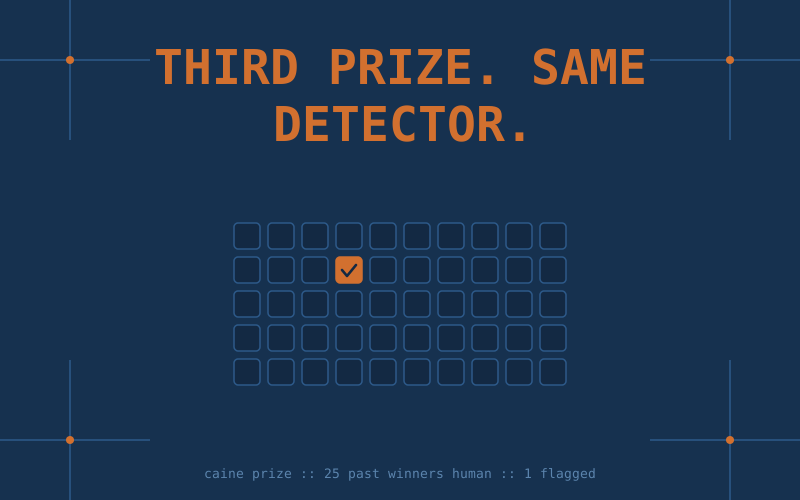
Five days later Vara published her piece. Her method is simple and reproducible: paste the story into Pangram. The tool, she writes, "flags almost the entire story as AI-generated," with one notable exception, the epigraph, which is excerpted from an unpublished poem by Vangile Gantsho. As a control she ran all 25 earlier Caine-winning stories through the same detector. Every one came back 100 percent human-written. So did Kundizeza's earlier story "The Whistleblower," published in Transition in 2021.
Vara also did the thing detectors cannot: she read it. She points to "the proliferation of language that is common in AI-produced writing," specifically "not x, but y" sentence constructions, "the glut of metaphors" and "the platitudinous aphorisms." Former Caine winner Tope Folarin told her the episode would be a "tragedy" if AI was involved, and offered a sharper diagnosis of why a chatbot might produce prize-friendly African fiction: "There are a lot of writers from the global South who feel this extreme pressure to write to expectations so their work is legible to the West, and obviously chatbots have glommed onto that."
What the prize said
The prize's response is unusually candid. Ellah Wakatama, chair of the Caine Prize board, told Vara that AI-generated fiction is ineligible and that an investigation is underway: the prize will interview the judges, reread the story, and talk with the author, possibly asking for earlier drafts. But she drew a hard line on what counts as evidence. "My stance, as the person who leads the prize, is that if there is such an accusation, I want proof that does not come from a machine." She framed her default as belief: ask the author whether he is telling the truth, and if he says yes, believe him, "especially because the accusers are not coming from amongst our own people." She also said: "I am fervently praying that you're wrong."
The prize's public statement, posted on its homepage on 11 October, is shorter. When such claims are made, it says, "it is our responsibility to look into them," and "We have initiated that process in this case." It promises a "human-centred approach" that supports the writers involved, and notes a structural wrinkle: the Caine Prize only considers stories already published elsewhere, so it depends on a "bond of trust" with the magazines that first ran them.
Kundizeza has not commented publicly. His agent, Adrienne Ingrum of Serendipity Literary Agency, told Vara that the agency's CEO, Regina Brooks, would send evidence that the story is his own work. Vara reports that neither followed up before publication. That is the single most important open item in this story: drafts, notes, or timestamped files would settle it far faster than any detector score.
Three prizes, three playbooks
Pangram has now had a busier literary year than most critics. The pattern is the same each time: a detector reading hits a shortlisted or winning story, and the institution has to decide, in public, how much a probability from a classifier is worth. The three big cases of 2026 landed on three different answers.
Commonwealth: uphold
In May, Pangram's own researchers published a case study scanning every regional winner of the Commonwealth Short Story Prize back to 2012. Three of the five 2026 regional winners showed strong signs of AI use, with Jamir Nazir's "The Serpent in the Grove" scoring 100 percent AI-generated in a separate run, and the 2025 overall winner, Chanel Sutherland's "Descend," came back at an 88 percent AI fraction. The Commonwealth Foundation said its judging was "robust" and that the writers had "personally stated that no AI was used." Nazir, who told Slate he dictates his fiction into an Android phone because neuropathy makes a keyboard painful, and uses AI for research only, was named overall winner in July.
Goncourt: remove
On 25 September the Académie Goncourt pulled Thélyson Orélien's novel C'était ça ou mourir from its longlist, saying the book was "in all likelihood, very largely the product of artificial intelligence" and citing plagiarism accusations about his earlier work. The AI claim first surfaced on an anonymous account called "Balance ton Claude." Orélien denies using AI.
Caine: investigate
The Caine Prize is the first of the three to say out loud that the detector's output is not, on its own, admissible. That is a defensible position and also an awkward one, because the control set Vara built (26 human verdicts, one outlier) is exactly the kind of evidence that is hard to dismiss as noise.
How much is a Pangram score worth?
Pangram says its tool mislabels human text as AI about once in 24,000 cases, which matches the 0.0041 percent false-positive rate in the vendor's own Pangram 4 technical report. Those are vendor-measured numbers on vendor-chosen test sets, and the Commonwealth episode shows why institutions remain wary: three flagged writers all denied it, one offered a plausible dictation workflow, and the foundation that reviewed their drafts upheld them.
Think of a detector score as a smoke alarm rather than a fire marshal's report. A very low false-positive rate means the alarm rarely goes off in a clean house, so when it screams while 26 neighbouring houses stay silent, you should go and look. It does not tell you what caught fire, or whether the occupant lit it. Drafts, revision history and the author's account are the inspection. Pangram's own "AI fraction" metric, the share of text segments the classifier assigns to a machine, is a probability over chunks of prose, not a chain of custody.
Why builders should care
If you run anything with a submission pipeline, a contest, a marketplace, a journal, or a hiring funnel, you are already in this business whether you have a policy or not. The literary prizes are a clean case study because the stakes are public and the artefacts are small enough to read. Three lessons fall out.
- Decide the evidentiary status of detector output before you need it. The Commonwealth Foundation ended up defining it after the fact (drafts beat scores). Goncourt treated the score plus a plagiarism history as sufficient. Caine has said scores alone are not proof. All three would have been better off writing that down in the rules in January.
- Provenance is cheap at submission time and expensive afterwards. Asking for a draft history or a short process note when work is submitted costs a form field. Asking for it five days after a public award costs a reputation, possibly an innocent one.
- Controls matter more than the headline score. Vara's 25-winner baseline is the reason this report lands harder than a single red number. If you deploy a detector, run it on your known-good archive first so you know its behaviour on your corpus, not the vendor's.
The uncomfortable part, which Folarin names, is that any detector trained on what "AI prose" looks like is also implicitly trained on what prize-legible prose looks like. Writers coached to sound a certain way for Western juries, and models trained on that same canon, converge. Wakatama's insistence on believing the writer first is not anti-technology sentiment. It is a recognition that the classifier and the jury may share a bias.
Caveats
- Nothing has been decided. The Caine Prize has opened a process, not reached a finding, and Kundizeza has not been shown to have used AI.
- Pangram's false-positive figures are the vendor's own measurements on its own test sets. Independent audits of detectors on literary fiction, as opposed to essays, are thin.
- The agency's promised evidence of authorship had not arrived when Vara published. If it surfaces, it changes the story.
- Vara's prose observations ("not x, but y," aphorisms) are a critic's reading and not a measurement.
Key Takeaways
- The Caine Prize for African Writing said on 11 October that it has started looking into whether its 2026 winner, "The Blue Fighter" by Simbarashe Steyn Kundizeza, involved AI, after Vauhini Vara reported in The Atlantic that Pangram flags almost the whole story.
- Vara's control set: all 25 previous Caine winners and Kundizeza's 2021 story "The Whistleblower" scored 100 percent human on the same detector. Only the story's epigraph read as human.
- Board chair Ellah Wakatama wants "proof that does not come from a machine" and says the prize will interview judges, reread the story and speak to the author, possibly reviewing drafts.
- It is the third major literary prize hit by a Pangram reading in 2026. The Commonwealth Prize reviewed drafts and upheld its winner; the Goncourt removed a longlisted novel; Caine is investigating.
- Pangram's claimed false-positive rate is about 1 in 24,000, vendor-measured. A score is a reason to inspect, not a verdict, and provenance collected at submission time is what actually resolves these cases.
Sources: Caine Prize for African Writing, statement of 11 October, Vauhini Vara, The Atlantic, Brittle Paper on the 2026 winner, Literary Hub, Pangram, AI is Writing Prize-Winning Fiction, Pangram 4 technical report, France 24 on the Commonwealth Prize, Slate interview with Jamir Nazir, France 24 on the Prix Goncourt