H100 Rent Will Trade on the Same Exchange as Crude Oil
TL;DR
On August 19 the Commodity Futures Trading Commission issued release 9286-26, a formal request for comment on listing compute derivatives contracts. It opens a 60-day comment window once it publishes in the Federal Register, and it lands about seven weeks before CME Group plans to list H100 and B200 rental futures on NYMEX. The hourly thing you rent to train models is acquiring a forward curve, a settlement price, and a federal regulator asking who could manipulate it.
What the CFTC actually filed
This is not a rule. It is a request for comment, which is the stage where a regulator admits it does not yet know enough and asks the market to fill in the gaps. The gaps it named are specific: the size and liquidity of compute cash markets, market oversight and manipulation concerns, customer protection, and perpetual compute futures.
CFTC Chairman Michael S. Selig framed it in the least subtle terms available:
America cannot win the AI race without a robust derivatives market for compute. Just as American markets helped establish the gold standard for trading the commodities that powered the industrial economy, we will do the same for the commodity that will power the intelligence economy.
Note the fourth item on that list. Perpetual futures are the never-expiring, leverage-friendly contract structure that crypto venues spent a decade perfecting offshore, largely because US regulators would not touch them. The agency is now asking whether that structure should be pointed at GPU rent. Nobody at your neocloud asked for this, and it is coming anyway.
Why GPU rent needs a hedge in the first place
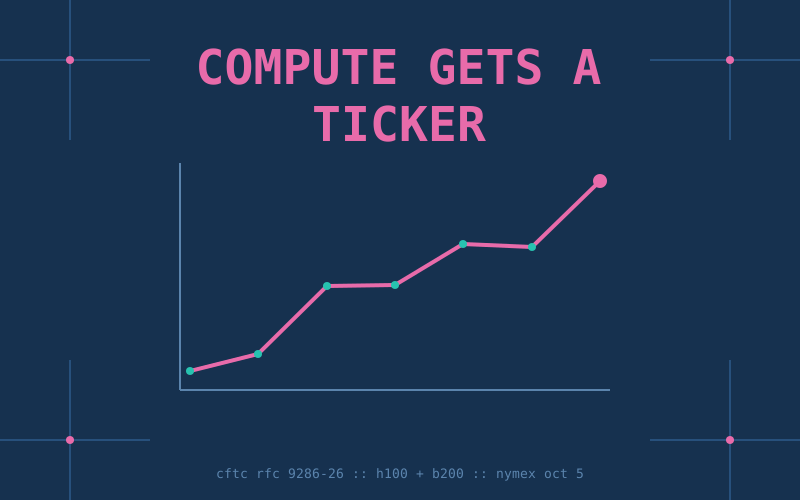
Because the price moves like a commodity, which is the whole argument. SemiAnalysis reported in April that one-year H100 rental contracts ran from a low of $1.70 per GPU-hour in October 2025 to $2.35 by March 2026, roughly 40% in five months, with on-demand capacity sold out across all GPU types and everything coming online through August and September 2026 already booked.
Silicon Data, which publishes a daily H100 rental index under the neo-cloud ticker SDH100RT, logged a 10% move in a single four-week stretch, $2.00 on December 9, 2025 to $2.20 on January 6, 2026. Its public reference page currently puts the index at $2.53. Zoom out further and the same shop puts H100 cloud rates around $8 per hour in early 2024, falling into a $1.50 to $3.00 band by late 2025.
Here is the mechanism, and it is old. You cannot warehouse a GPU-hour any more than an airline can warehouse a seat on next April's flight, so you do not trade the thing, you trade the price of the thing and settle the difference in cash. Airlines have hedged jet fuel this way for decades. Compute is simply the newest input expensive enough, volatile enough, and central enough to somebody's P&L to justify the paperwork.
Three indexes, two exchanges, one commodity
The exchanges got there before the regulator, which is the usual order of operations.
- CME plus Silicon Data, announced August 11: Silicon Data H100 Rental Index Futures and Silicon Data B200 Rental Index Futures, listed on NYMEX, each contract sized to about a month of rent for one GPU, tracking hourly rental indexes Silicon Data publishes. Launch October 5, pending regulatory review.
- ICE plus Ornn, announced May 19: contracts on the Ornn Compute Price Index (OCPI), which tracks live-traded spot prices, covering H100, H200, B200 and RTX 5090, US dollar denominated and cash-settled.
- ICE plus NATIVX, announced at the start of July: the COIL index, which prices tokenized compute and connectivity normalized to a single energy unit, so that regional power-cost differences stop polluting the comparison.
Three indexes means three competing answers to the question of what a GPU-hour costs, and they are not measuring the same thing. Silicon Data reports a like-for-like dollar rate per GPU-hour. Ornn reports live-traded spot across hardware tiers. NATIVX divides out the power. Whichever definition becomes the settlement reference that the largest book of contracts points at is the one that ends up quoted in your vendor negotiations, and none of them is obviously right.
What this actually changes for a builder
Price discovery first. Right now you negotiate GPU capacity essentially blind, against a counterparty who knows the whole market and knows you do not. A public forward curve out several months is the single largest information transfer to the buy side that this market has seen. Silicon Data CEO Carmen Li put it as giving the market "a public, tradable reference price for the resource every AI system runs on," and however self-serving that is coming from the index vendor, it is also true.
Then fixed-price offers. The reason your neocloud will not quote you a flat three-year rate is that it cannot lay off the risk. Once it can, some of them will start quoting one, and the ones that do will win procurement conversations against the ones that do not.
Then the boring finance stuff, which is where this becomes real. CME's Pete Keavey filed compute under his energy and environmental products desk, and the contracts list on NYMEX, the venue where West Texas Intermediate trades. Your H100 hours are about to settle a few tickers away from barrels of crude. That is either a milestone for the industry or the most on-the-nose metaphor of the decade.
The caveats, and they are load-bearing
Nothing has launched. Every product named here is explicitly subject to regulatory review, and a request for comment is the beginning of a process, not the end of one.
The manipulation question is not decorative either. The CFTC is asking about the size and liquidity of the underlying cash market because a futures contract settling against a thin, survey-assembled index is a genuine attack surface. Move the reference and you move everyone's settlement. Regulators put that item on the list for a reason, and the honest answer today is that nobody outside the index vendors knows how deep those cash markets really are.
And cash settlement hedges your bill, not your capacity. If H100s are sold out through September, a profitable futures position pays you money and hands you exactly zero GPUs. Those are different problems, and only one of them is being solved here.
Key Takeaways
- The CFTC issued release 9286-26 on August 19, a request for comment on listing compute derivatives, with a 60-day window after Federal Register publication.
- It explicitly asks about perpetual compute futures, the never-expiring crypto contract structure, applied to GPU rent.
- CME lists Silicon Data H100 and B200 Rental Index Futures on NYMEX on October 5, each contract sized to roughly a month of rent for one GPU, pending review.
- ICE has two competing deals queued: Ornn's OCPI since May 19, and NATIVX's energy-normalized COIL index since the start of July.
- The price justifies it: one-year H100 contracts moved from $1.70 to $2.35 per GPU-hour between October 2025 and March 2026, per SemiAnalysis.
- Contracts are cash-settled, so they hedge the cost of compute and do nothing whatsoever about getting you the compute.
Sources: CFTC Release 9286-26, CME Group and Silicon Data press release, ICE and Ornn press release, ICE and NATIVX press release, Silicon Data H100 Rental Price Index, Silicon Data: H100 Price Spike, SemiAnalysis: The Great GPU Shortage