Workday Report: Basic AI Prompting Demand Fell 25% From January as AI Builder Skills Rose 51%
TL;DR
Workday's October 2026 Global Workforce Report, published October 5, reads skills demand off the job requisitions of more than 550 enterprise employers that run their hiring on Workday. Demand for basic AI skills, the kind the report describes as "simple prompting," rose through late 2025, peaked in January 2026, and fell 25% over the following months. Demand for hands-on skills (building AI tools, automating workflows, AI engineering) climbed 51% between September 2025 and July 2026. Meanwhile 84% of job seekers say they used AI in their search, and the median number of applicants per filled role rose from 58 to 69 in a year. Only 28% of business leaders expect AI to shrink headcount; 40% expect it to squeeze more out of the people they already have.
What Workday measured
This is not a poll of people who like AI. The report, titled The Adaptability Advantage, pulls from four datasets, and the interesting ones are the operational records, not the survey:
- De-identified workforce data from companies running Workday's HR software, limited to active customers with at least 250 employees and matched year-over-year.
- Skills data from the job requisitions of roughly 550 enterprise employers using Workday Recruiting, September 2025 through July 2026.
- A September 2026 global survey of 6,001 employees and business leaders, including about 1,780 decision-makers.
- Workday's AI@Work Pulse survey of 5,944 workers, run in August 2026.
The requisition data is what makes this worth your time. A requisition is what a hiring manager actually writes down when they open a role, so counting skill mentions across 550 employers is a direct read on what companies are paying for, not what they tell a pollster they value.
Prompting peaked in January
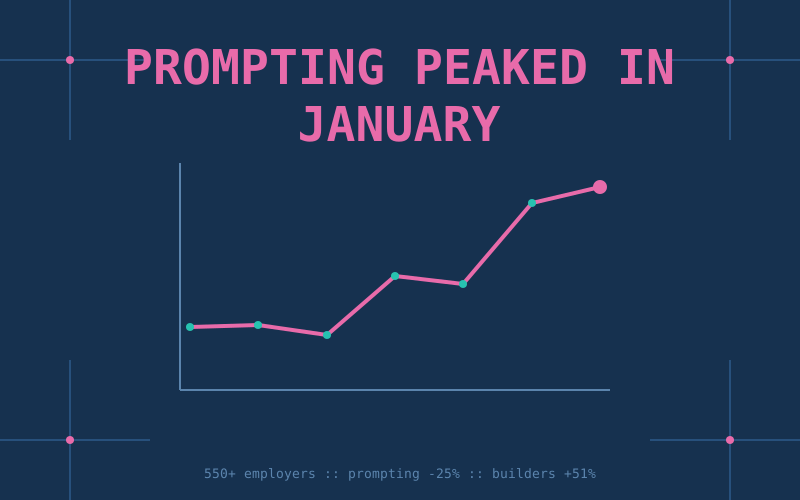
The skills finding is the one AI builders should pin to the wall. Mentions of basic AI skills in requisitions rose through late 2025, peaked in January 2026, and then fell 25% through July. Over the full September-to-July window, mentions of hands-on AI skills rose 51%. Workday's examples of the second bucket are building AI tools, automating workflows, and AI engineering.
Two other categories moved in the wrong direction for anyone hoping employers would help staff through the transition. Mentions of management and leadership skills fell 7%, and mentions of training skills fell 13% over the same window. Companies are asking for fewer of the exact skills that would get the rest of the workforce up to speed.
Read the footnote carefully, because the two headline numbers do not share a baseline. The 51% rise is measured across the whole September 2025 to July 2026 window. The 25% drop is measured from the January peak, so basic AI mentions could still sit above where they started in September 2025. Workday's release does not say, and the full report is gated behind a form. What the data does establish is the direction of travel: "can write a prompt" stopped being a thing employers list, roughly the way "proficient in Microsoft Word" slid off resumes once everyone was. It is not that the skill went away. It became the floor.
Prompt engineering as a job category had a good run, about the length of a gym membership.
69 applicants for every filled role
The second finding is about the other side of the hiring table. In July 2026 the median filled role drew 69 applicants, up from 58 in July 2025. Workday attributes much of that to AI-assisted applying: 84% of job seekers said they used AI during their search, and in the two industries with the largest surges, 53% of financial-services applicants and 57% of technology and media applicants said they used AI to apply to more roles. Median time to fill held at about 60 days, so more applications did not translate into faster hires.
Workday contributing economist Aaron Terrazas breaks the applicant surge down by industry in a companion piece. Technology and media led at 40.4% more applicants per filled role year-over-year, nonprofits were close behind at 37.4%, and financial services rose 27.2%. Retail, the public sector, and education all saw slight declines. Employers in 10 of 12 industries also reported taking longer to fill roles than a year earlier, even though the overall median was flat.
Workday's own five-takeaways post puts the odds plainly: roughly one in 100 applicants is ultimately hired. With 84% of applicants using AI somewhere in the process, and if the first screen on the employer side is a model too, the two humans involved meet at the interview to find out what their respective assistants promised each other.
What leaders say AI will do
The survey side is where the headline "AI is rewriting jobs more than it's cutting them" comes from. Asked what AI will mean for their workforce, 40% of business leaders expect higher productivity from the employees they already have, 34% expect changes to existing roles, and 28% expect fewer employees overall. Those are not mutually exclusive answers, and 28% is not a small number, but the plurality view inside enterprises is "same people, more output."
Employees are already feeling the "same people, more output" version. Among workers who use AI for nearly all of their work, 76% expect it to open new career opportunities and 62% expect it to make their current skills less valuable, and plenty of them believe both at once. Across the whole sample, 79% say they know which skills they need, 65% are confident they can learn them, and only 66% say their employer actually helps them do so. That 13-point gap between knowing and being helped is the number Workday calls the clearest sign that adoption is outrunning support.
Nobody is moving, and nobody is being moved
The report's title finding is that people are staying put. Voluntary turnover runs at roughly 16% a year, and about 70% of employees are still with the same company two years on. But the internal ladder is also stalling. Lateral moves to new roles inside the same company fell at 57% of employers year-over-year, promotions were flat, and nearly four in ten employees said their company went through a reorganization or restructuring in the past year. About half of employees did not even try to move internally, and 27% of those said they simply did not see an attractive opportunity.
In his companion essay, Workday VP Phil Willburn frames the risk as disengagement rather than attrition:
"Employees may not be changing jobs, but their jobs are changing around them. Leaders need to be honest about what's different and give people a way to keep up."
"There's a lot of quiet unease in the workplace right now. Staying isn't the same as buying in, and companies that treat it that way will pay for it in productivity."
That squares with what PwC's 49,364-worker survey found last week from the employee side: AI use at work climbed to 64% while access to learning resources fell. Workday is now showing the same gap from the requisition side, where employers are asking for fewer trainers and managers while asking for more builders.
Caveats
- It is a vendor report. Workday sells HR and recruiting software and has an obvious interest in "adaptability" being a product category. The operational data is real, but the framing is theirs.
- The sample is enterprise. Workforce data is limited to customers with 250 or more employees, and the requisition data comes from about 550 large employers. None of this describes startups, agencies, or the solo-builder economy.
- Mentions are not hires. The skills figures count what appears in requisitions, not who got the job or what they were paid.
- Mixed baselines. The 25% decline is from a January peak; the 51% rise is across the full window. Do not subtract one from the other.
- The full report is gated. The numbers above come from Workday's press release and companion posts, not from a public PDF, so breakdowns beyond those are unavailable.
What this means if you build with AI
If you are hiring, budget for 69 applicants per role and assume most of them had model help getting there. The screening problem is now a dedup problem. If you are the one applying, the requisition data says the premium has moved from "can use the tools" to "can wire the tools into a workflow and own the result": automation, integration, evaluation, the unglamorous plumbing. And if you are inside an enterprise and wondering why your company has an AI mandate but no AI training budget, Workday just measured that: mentions of training skills in job postings fell 13% while demand for builders rose 51%. The gap is not an oversight. It is the plan.
Key Takeaways
- Workday's October 2026 Global Workforce Report draws on job requisitions from 550+ enterprise employers, HR data from customers with 250+ staff, and surveys of 6,001 and 5,944 people.
- Employer demand for basic AI skills such as simple prompting peaked in January 2026 and fell 25% by July; demand for building AI tools, automating workflows, and AI engineering rose 51% from September 2025 to July 2026.
- Mentions of management and leadership skills fell 7% and training skills fell 13% in the same window, while 79% of workers say they know what skills they need and only 66% say their employer helps.
- Median applicants per filled role rose from 58 to 69 in a year; 84% of job seekers used AI in their search, and tech and media saw a 40.4% jump in applicants per hire. Time to fill stayed at about 60 days.
- 40% of business leaders expect AI to get more out of existing staff, 34% expect roles to change, and 28% expect fewer employees.
- Internal moves fell at 57% of employers and promotions were flat, while voluntary turnover held at roughly 16% a year.
Sources: Workday newsroom release (Oct 5, 2026), PR Newswire copy of the release, The Adaptability Advantage report page, Aaron Terrazas, Workday Perspectives, Phil Willburn, Workday Perspectives, Workday blog: five takeaways, People Matters