China Turned AI Tokens Into Airline Miles. 10 Million Cost $1.40.
TL;DR
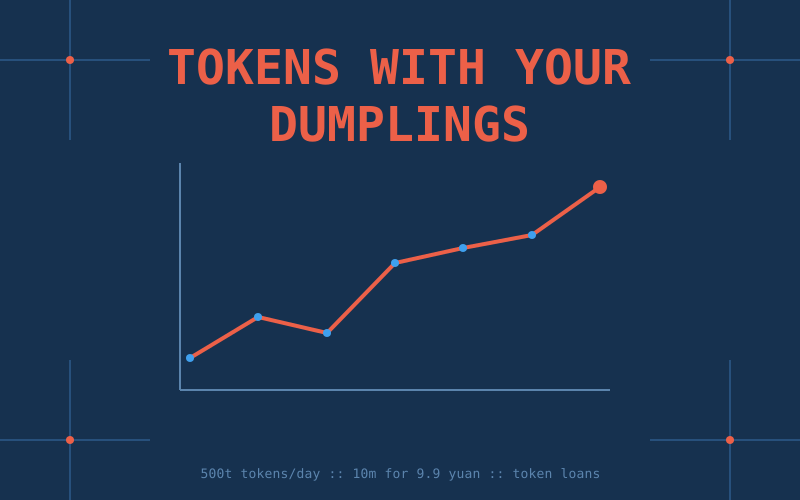
Rest of World published a survey on September 4 of how China is retailing AI inference to ordinary people. The three state carriers sell token plans the way they sell data plans, with China Telecom starting at 9.9 yuan (about $1.40) for 10 million tokens a month. At least five banks have tied tokens to bank cards. A Beijing bar pours unlimited DeepSeek tokens with a 9.9 yuan drink, a dumpling restaurant hands out compute vouchers with the bill, and a Guangzhou district launched a "token loan" that lets banks lend against a startup's token consumption. Behind all of it sits one number: daily token usage in China passed 500 trillion in June, up from 100 billion at the start of 2024. The token is becoming a consumer unit of account, and that matters to anyone who prices software by the million.
The number that makes this possible
Start with the demand curve, because nothing else here makes sense without it. China's National Bureau of Statistics tracked daily token calls at 100 billion in early 2024, 100 trillion by the end of 2025, and more than 140 trillion by March 2026, per CGTN and 36kr. By June the figure had cleared 500 trillion a day, per TechNode citing IT Home. That is a 5,000x increase in about two and a half years. It measures aggregate model processing rather than people, so agent workflows that loop on tool calls and context reads inflate it, but the slope is the point.
The supply side matches. Open-weight Chinese models run 60% to 90% cheaper than the top Anthropic and OpenAI models, according to OpenRouter's Justin Summerville in CNBC's July reporting, and US companies routed more than 30% of their OpenRouter token traffic to Chinese models every week from February 8, peaking at 46%. When the marginal token is that cheap, you can afford to give it away with dinner.
Sold like a data plan
On May 17, World Telecommunication Day, all three carriers switched on token packages through their Shanghai branches. China Telecom's trial plans are priced nationally: 9.9 yuan for 10 million tokens and 49.9 yuan for 80 million on the consumer side, 39.9 yuan for 15 million on the developer side, with the carrier's own TeleChat, Zhipu's GLM-5, and DeepSeek-V3.2 behind the plan. China Mobile priced Shanghai at 400,000 tokens for 1 yuan, payable on the phone bill. China Unicom's Shanghai personal plan is 15 yuan for 6 million.
Work the arithmetic and China Telecom lands at 0.99 yuan per million tokens, the other two at 2.5. An analyst quoted by CGTN made the point that matters: carrier pricing is not cheaper than cloud API rates. What the carriers are selling is packaging. A standardized retail product, bundled with connectivity, that bills to one of what 36kr counts as 1.7 billion existing phone accounts, with no cloud signup and no API key. Distribution, not price, is the product.
The carriers have reasons to try. China Telecom's Xingchen TokenHub aggregates 142 models and more than 420 industry applications behind one API, and the company reported a 95% jump in intelligent computing revenue in the first half of 2026, per the South China Morning Post. China Unicom's computing-power revenue reached 41.9 billion yuan, up 13%, and it now talks about a "token supermarket." The three operators also own the iron: 36kr puts China Mobile at 92.5 exaflops, China Telecom at 91, and China Unicom at 45.
Points, but for inference
The banks followed within weeks. China Merchants Bank upgraded its American Express Engineer card on June 12 with up to 1.8 billion tokens a month on MiniMax models for new customers, the first Chinese card with a token perk, per BigGo Finance. Shanghai Pudong Development Bank's tech elite card offers up to 3 billion Qwen tokens through Alibaba Cloud. Ping An, Bank of Communications, Minsheng, and MYbank shipped their own variants over the following month.
The one that got the headlines is Moonshot AI's Kimi card, issued July 10 with Agricultural Bank of China and American Express. Read the fine print on Kimi's own help page and the reward is memberships rather than raw tokens. Spend 5,888 yuan within about three months of approval and you get two months of Kimi Allegretto (4x the agent quota, 20x the Kimi Code quota), capped at 1,000 recipients. Make three purchases of at least 18 yuan and you get three months of Andante, capped at 5,000. That is a loyalty program with an unusually specific prize, and BigGo's reporting explains why the banks want it: credit-card penetration among AI professionals is under 15%, and those people spend more than 10,000 yuan a year on compute.
Free with the dumplings
Then it gets strange. AGI Bar, on Entrepreneurial Street in Beijing's Zhongguancun, sells a 9.9 yuan foam drink called AGI that comes with unlimited DeepSeek coding tokens over the bar's Wi-Fi, served from two Nvidia DGX Spark boxes on display. Owner Song De, an independent AI developer, says the bar is "completely losing money" and gives away ten drinks for every one it sells, which is a business model in the same sense that a free tier is. It opened a Shanghai branch in June anyway. The registered Chinese name translates to "knowledge distillation," a pun that only lands if your customers are ML engineers, and they are.
Rest of World adds the Jingu Yuan dumpling restaurant in Beijing, which hands out 10 yuan of computing credits after a meal and moves more than 100 vouchers a day, a 24-hour coffee shop in Changsha doing the same with tokens, and a grey market on Alibaba's secondhand app Xianyu where sellers split model allowances into day passes and resell millions of tokens for a few dollars to students and small developers. When a thing gets a resale market, it is a commodity.
The bank will lend against your token bill
The most consequential item is the least photogenic. In August, Guangzhou's Haizhu district launched a financial product called Token Loan, the first in Guangdong province, with Bank of China, CITIC Bank, and Bank of Guangzhou participating. Instead of fixed assets, the credit assessment weighs token consumption, platform credentials, payment-collection progress, and upstream customers. Think of it as inventory financing where the inventory is your API bill: the meter reading is the collateral.
The district has the density to justify it: more than 8,000 AI-related companies, 53 registered large models, and 482 registered algorithms as of August. The same policy package subsidizes up to 1.5 million yuan a year for model-efficiency work, 4 million for industrial platforms, 5 million per application project, and up to 2 million a year toward token consumption in digital marketing and entertainment. The state is not just letting tokens become a currency. It is underwriting them.
A token is a bad yardstick
All of this prices a unit that is not stable. A May paper on arXiv measured tokenizer fertility for ten foundation models across 25 European languages on parallel text and found English costs 1.2 tokens per word while Greek and Maltese cost about 3.1, with Romance languages at 1.5-1.7, Germanic at 1.7-1.9, Slavic at 2.2-2.5, and Ukrainian paying 15-18% more than its Slavic cousins because of thin pretraining data. A token is a unit of measure the way a scoop is: it depends on who is holding the spoon.
The same problem lives inside a 142-model aggregator. Ten million tokens on one model's tokenizer is not ten million on another's, and a plan that bundles TeleChat, GLM-5, and DeepSeek quietly changes what a token buys every time you switch the model ID. Sell tokens as a retail SKU and you inherit questions data plans never had to answer.
What a builder takes from this
Poe Zhao, the Beijing analyst behind the Hello China Tech newsletter, called the packages a "supply-led experiment" and noted that most users still meet AI through an app without ever seeing a token balance. 36kr's own read is that demand for tokens is nothing like demand for data traffic yet, and that adoption hinges on billing becoming transparent enough for people to form pay-as-you-go habits. Both are right, and neither changes the direction.
- Tokens are being priced as a commodity, in public, at retail. 0.99 yuan per million is now a number a consumer in Shanghai can quote. If your margin depends on the customer not knowing what a million tokens costs, that clock is running.
- Distribution beat the model. Nobody here won on quality. Carriers won on the phone bill, banks on the card, a bar on Wi-Fi. If you sell AI, ask who already bills your customer monthly.
- Tokens work as a loyalty currency. A bank found a reward that costs it 60% to 90% less than the American equivalent and that its target customer values at 10,000 yuan a year. Any SaaS with a usage meter can run the same play.
- Usage data is becoming credit data. A district government now treats your inference bill as proof of business. Expect lenders elsewhere to ask for the same dashboard.
Caveats
The carrier plans are trial commercial launches, and nobody has published take-up numbers. The Kimi card rewards memberships, not a token balance, and the 5,888 yuan tier is limited to 1,000 people. The 500 trillion daily figure comes from official statistics as reported by Chinese outlets and measures processing volume, not people. AGI Bar loses money by its owner's own account, the Xianyu resale is a grey market built on splitting accounts, and the token loan is a district-level program with three banks, not national policy. What is real is the direction: every channel that already bills Chinese consumers monthly has now tried bolting tokens onto the invoice.
Key Takeaways
- China's daily token usage went from 100 billion in early 2024 to more than 500 trillion in June 2026, per official statistics reported by CGTN and TechNode.
- All three state carriers have sold token plans since May 17. China Telecom charges 9.9 yuan for 10 million tokens, about 0.99 yuan per million, which an analyst says is no cheaper than cloud APIs.
- At least five banks tied tokens to cards in June and July, including 1.8 billion MiniMax tokens a month from China Merchants Bank and Kimi memberships for 5,888 yuan of spending on the ABC-AmEx card.
- Guangzhou's Haizhu district lends against token consumption through three banks and subsidizes token bills up to 2 million yuan a year.
- A token is not a stable unit: the same words cost 1.2 tokens in English and 3.1 in Greek, and every model on a 142-model aggregator tokenizes differently.
- The builder lesson is distribution: carriers, banks, and a bar all won by attaching tokens to a bill the customer already pays.
Sources: Rest of World: How China is turning AI tokens into everyday consumer rewards, The Next Web, Unite.AI, Kimi help center: ABC co-branded card campaign, TechNode: China Telecom token plans, TechNode: daily token usage tops 500 trillion, CGTN, 36kr, South China Morning Post, BigGo Finance: banks and token perks, BigGo Finance: AGI Bar, Tom's Hardware, Haizhu District: Token Loan announcement, arXiv: The Tokenizer Tax Across 25 European Languages, CNBC