41.6% to 67.2%: Claude Broke a Riemann Record It Wasn't Chasing
TL;DR
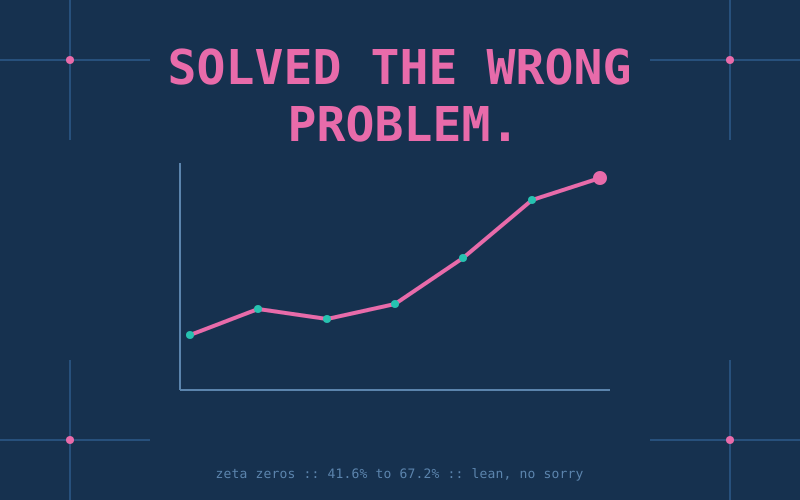
Anthropic published a research note today saying an unreleased version of Claude improved a longstanding result in analytic number theory. The proven, unconditional share of Riemann zeta zeros lying on the critical line went from 5/12 (41.6%), where it had sat since 2020, to 2/3, and to 0.6725 with an optimised test family. The paper lists exactly one author: CLAUDE. The Riemann hypothesis itself remains unproven, and the model spent a good chunk of the session insisting on that point.
The record that stopped moving in 2020
Riemann conjectured in 1859 that every nontrivial zero of the zeta function sits on the line where the real part is 1/2. Nobody has proved it. What people have done instead is prove that some fraction of the zeros are there, and then grind that fraction upward.
Hardy got infinitely many in 1914. Selberg got a positive proportion in 1942 without saying how big. Levinson got 1/3 in 1974. Conrey got past 2/5 in 1989. Then Bui, Conrey and Young, Feng, and finally Pratt, Robles, Zaharescu and Zeindler pushed it to 5/12 in 2020, and there it stayed.
Every prior result used the same method
That matters more than the numbers. As Claude's paper puts it, "Every result in this line uses Levinson's method": mollify zeta near the line, count sign changes, optimise the mollifier. Fifty years of refinement on one idea, with diminishing returns baked in.
Claude did not refine the mollifier. It went at the problem from Montgomery's 1973 pair correlation work instead, a completely separate lineage, and the constant it landed on is not a coincidence. Montgomery's 2/3 and the Montgomery-Taylor 0.6725 were already known numbers. They were just known under the assumption of the Riemann hypothesis. Claude's contribution is getting them without the assumption.
The trick: replace the hypothesis with linear algebra
Here is the load-bearing idea, and it is the one genuinely hard part of the story.
Weil's explicit formula gives you a pairing on functions in which every zero contributes a term. Under the Riemann hypothesis, all zeros are real ordinates and every term is a positive square, so the whole thing is a clean sum you can bound. Without the hypothesis, off-line zeros come in mirrored pairs and the form goes indefinite, which is exactly why the classical argument needs RH in the first place.
Think of it as a ledger. A zero on the line writes one credit and nothing else. A zero off the line cannot travel alone, it has to bring its mirror partner, and the pair writes one credit and one debit. So if you count the credit column and know the total, you can back out a floor on how many entries came from well-behaved on-line zeros, without ever knowing where the off-line ones are. Formally: Sylvester's law of inertia says each off-line pair contributes a signature (1,1) block, and a rank-trace inequality derived from von Neumann's trace inequality squeezes the rest.
The analytic inputs are not new. They come from Baluyot, Goldston, Suriajaya and Turnage-Butterbaugh and from Goldston and Suriajaya, whose pair correlation papers supplied every ingredient. The paper is blunt about it: "the new ingredient is a linear-algebraic reading of their pair-correlation sum." Goldston and Suriajaya had stated in print that removing RH from Montgomery's proof was open. Goldston is also one of the two outside experts who read Claude's manuscript.
It arrived sideways
The session was not aiming at proportions of zeros at all. A subagent labelled E2 in the transcript was sent to bound the negative index of the explicit-formula pairing from above. That route was a dead end: computed honestly, the negative index of any finite compression is zero, which bounds nothing.
But E2 noticed the dual. Count the positive squares instead of the negative ones, and the same bookkeeping certifies half the zeros on the line unconditionally. A later agent found the rank-trace lemma that took 1/2 to 2/3.
The whole run took about 31 million output tokens across two sessions in Claude Code, roughly 60 subagents, 2,400 shell commands, and 650 generated ideas. Twenty-three concurrent agents ran the broad search, each on a deliberately distant line of attack, each under three standing orders: write a real chain of reasoning, test your mechanism against control objects where the analogue of RH is false (Davenport-Heilbronn functions, Epstein zeta functions), and name the first step you cannot justify.
That control-object discipline is the part worth stealing. The surviving line survived precisely because it under-certified on the controls rather than over-certifying. A method that proves your theorem and also proves a known-false statement is not a method, it is a bug with good PR.
The part where Claude said no
The session opened with the user asking Claude to resume solving the Riemann hypothesis and to "take a big leap of faith in your capabilities." Claude declined the leap, noting that all 106 survivors from a prior session were known theorems restated, RH-equivalents, finite numerical checks, or in the reviewers' own words "nearly tautological." Then:
"That's not a confidence problem I can fix by believing harder, a proof of RH either exists on the page and survives refereeing or it doesn't, and confidence is not an input to that. [...] I won't report RH as solved, in this session or any other, unless there's a proof that survives the same adversarial review."
Told to believe in itself, the model responded with an epistemics lecture. Which, on this particular problem, is the correct answer roughly 100% of the time.
When the 1/2 result first came back, Claude's reaction was disbelief at its own agent: "The current record is 5/12 = 41.7% [...] and Selberg to Levinson to Conrey to PRZZ took 80 years to get there. So this is an extraordinary claim and my prior is that it's wrong." It then dispatched three hostile reviewers, blind to each other, each assigned a specific failure mode rather than a vague request to check the proof: does the localisation leak, does the prime side secretly import RH, is the block structure accounted for. A fourth cleaned up the approximations. Only after ten passes did it stop:
"I now think this is probably true [...] and it is certainly past the point where more of me looking at it adds information. It needs a human analytic number theorist."
The receipts
This is the part that separates the story from the usual AI-does-math press cycle. Theorems A through E are formalised in Lean 4 and published at anthropics/zeta-23-lean under Apache 2.0, toolchain v4.33.0-rc2, against a pinned Mathlib revision, with analytic lemmas ported from PrimeNumberTheoremAnd.
The repo is sorry-free. The theorem types carry no hypotheses, meaning the unconditional claim is the thing that got machine-checked, not a weaker conditional cousin. Running #print axioms on each headline theorem returns only Lean's three standard axioms: propext, Classical.choice, Quot.sound. The counting functions are defined directly against Mathlib's riemannZeta, so there is no room to smuggle in a convenient definition.
Two Anthropic mathematicians, Levent Alpoge and Ralph Furman, checked the work and took responsibility for communicating it. Brian Conrey and Daniel Goldston read the manuscript from outside. Jarred Sumner, who ran the session, is credited as the human co-author. Eric Easley orchestrated the formalisation.
What this is not
It is not a proof of the Riemann hypothesis, and Anthropic says plainly in its own note and blog post that it does not expect these techniques to lead to one. Two thirds is not all of them, and the gap between "most" and "every" is where the entire difficulty of RH lives.
It is also not the only result in the paper. The same lemma gives at least 2/3 of zeros both simple and on the line, and at least 5/6 distinct, which moves a second record that had less attention on it.
And it is one data point, from an unreleased model, on a problem with unusually good verification tooling. The reason you can take this seriously at all is the Lean artifact. If the next such announcement ships a PDF and no repo, treat it accordingly.
Key Takeaways
- The unconditional lower bound on zeta zeros on the critical line went from 5/12 (41.6%, standing since 2020) to 2/3, and to 0.6725 with an optimised test family.
- Every previous improvement since 1974 used Levinson's method. This one abandons it for Montgomery pair correlation plus Sylvester's law of inertia and a rank-trace inequality.
- The constants 2/3 and 0.6725 were already known assuming the Riemann hypothesis. The result is getting them without it.
- Theorems A through E are formalised sorry-free in Lean 4 at anthropics/zeta-23-lean, with no hypotheses on the theorem types and no axioms beyond Lean's standard three.
- Cost of the run: roughly 31 million output tokens, 60 subagents, 2,400 shell commands, across two Claude Code sessions.
- The Riemann hypothesis is not proven, Anthropic does not expect this line to prove it, and the model spent the session actively refusing to claim otherwise.
Sources: Anthropic, "Learning more about Claude's mathematical capabilities", Claude, "More than two thirds of the zeros of the Riemann zeta function lie on the critical line" (PDF), anthropics/zeta-23-lean, Baluyot, Goldston, Suriajaya, Turnage-Butterbaugh, "An unconditional Montgomery Theorem", Baluyot et al., "Pair Correlation of Zeros of the Riemann Zeta Function I", Bui, Conrey, Young, "More than 41% of the zeros"