Qobuz Starts Tagging AI Music In-App and Says 60% of AI-Track Streams Are Fraud
TL;DR
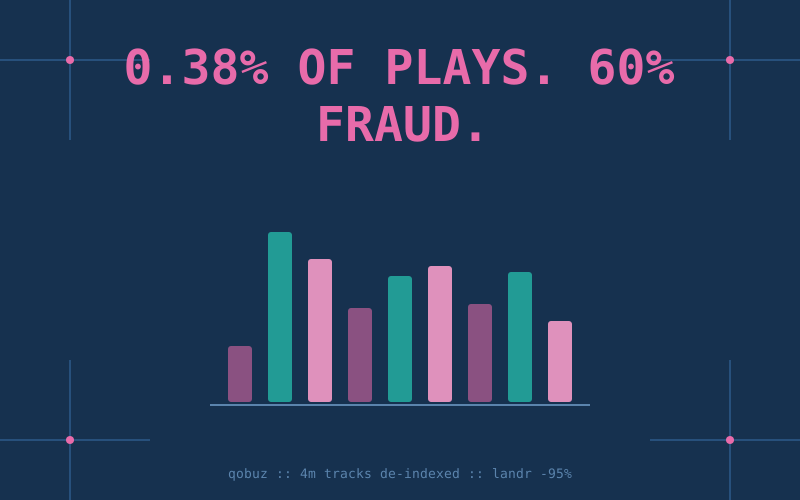
Qobuz, the French hi-res streaming and download service, switched on an in-app label for AI-generated releases on September 24 and, for the first time, published what its detector sees. Tracks it identifies as fully AI-generated account for 0.38% of streams, 60% of those streams are flagged as fraudulent and stripped from royalty payouts, and more than a third of AI-identified albums, about 4 million tracks with zero plays, have been pulled from search. The same week, distributor LANDR said artificial streams flagged by Spotify on the music it delivers fell 95% between Q1 2025 and Q2 2026 after it deployed two fraud models built with the Montreal AI institute Mila. Put next to Deezer's running series (90,000 AI tracks a day, 1-3% of streams, up to 85% of those fraudulent), three companies with independent detectors now agree: the AI music flood is a supply-side fraud problem, not a listening trend.
What Qobuz shipped
The label reads "This release includes AI-generated tracks" and links to an explainer, according to Music Ally. Qobuz built the classifier in-house and announced it on February 26, promising tags "in the coming months." Seven months later they are live, and the scope is deliberately narrow: the system targets content that is 100% AI-generated, not tracks where a producer used an AI stem or a mastering plugin.
The press release pairs the badge with three enforcement moves. Fraudulent streams, "including those generated by industrially produced AI content," are excluded from reporting and royalty payments. AI-identified albums are kept out of editorial picks and algorithmic recommendations. And albums the detector flagged that nobody had ever played, which is more than a third of all AI-identified albums and roughly 4 million tracks, have been de-indexed from search. Per the updated AI Charter (version 2, September 2026), those albums still resolve if you type the exact title; they just stop showing up when you browse.
Four million tracks that no one had ever pressed play on is the streaming equivalent of a warehouse of unopened mail. Qobuz did not burn the warehouse. It took it off the map.
Deputy CEO Georges Fornay framed the release as a shift from detection to disclosure: "Today, the challenge is no longer just detecting AI-generated music but enabling listeners to identify it clearly."
The numbers Qobuz put on the table
Two figures matter. First, AI-identified tracks draw 0.38% of Qobuz streams. Second, 60% of those streams are "currently deemed fraudulent" by its anti-fraud systems and pay the uploader nothing. Qobuz is an audiophile niche with a human-edited front page, so the 0.38% partly reflects that AI tracks never get surfaced there. But the 60% figure is a statement about who is streaming the AI catalog, and the answer is mostly bots.
Deezer's numbers are the closest comparison. In January it reported that up to 85% of streams on fully AI-generated tracks were fraudulent in 2025, against about 8% across the whole catalog, and that AI tracks accounted for 1-3% of total streams. Qobuz's 60% is lower, its 0.38% share is lower, and both companies exclude the same thing from royalties. Two French services with separately built classifiers landing in the same neighborhood is the strongest signal in this story.
Supply keeps climbing, listening does not
Deezer's newsroom is the only public series that tracks the AI flood month by month. In January 2026 it received about 60,000 fully AI-generated tracks a day, roughly 39% of deliveries. By April it was nearly 75,000 a day, or 44%. In June it peaked at 90,000 a day, past half of all new uploads. Across the same stretch the share of streams that land on those tracks stayed pinned at 1-3%.
That divergence is the whole trend. Uploads track how cheap generation has become. Listening tracks whether anyone wants the output. The first curve is steep and the second is flat, so the gap gets filled by fraud: if a track will never earn organic plays, the only way it earns is if someone buys the plays. Deezer said in July it would start taking down AI tracks used for fraud and any AI track unstreamed for six months, which is the same warehouse logic Qobuz applied this week.
LANDR's 95% and how the detector is built
LANDR's announcement is the distributor-side view of the same problem. It says the volume of artificial streams that Spotify flagged across music LANDR distributes fell 95% between Q1 2025 and Q2 2026. That matters to a distributor because Spotify has charged labels and distributors a per-track fee for flagrant artificial streaming since April 2024, per Music Business Worldwide, so every flagged stream is a bill and a strike, not just lost revenue.
The system is more interesting than the headline. LANDR spent six months with researchers at Mila, the non-profit institute founded by Yoshua Bengio, and deployed two complementary models in February 2026. One scores accounts on profile and behavioral data. The other reads listening activity for patterns that do not look like a real audience. Think of it as a bank's fraud desk: one model asks who you are, the other asks whether your transactions look like a person's. Neither is a music-quality judge, and neither cares whether the track is AI.
Around those two models sit the newer signals LANDR listed this week: unusually high release frequency, catalogs that appear overnight, clusters of accounts sharing devices or payout details, and metadata that impersonates established artists. Audio is fingerprinted against commercial catalogs with ACRCloud, and Ircam Amplify checks for sped-up, pitch-shifted, re-recorded, or synthetic recordings. Accounts that release frequently now go through identity verification, and a human reviews every case between detection and enforcement. CEO Pascal Pilon: "We want AI helping our people make better decisions at scale, not replacing judgment."
Two caveats LANDR itself flags. The 95% is attributed to several fraud initiatives rolled out over the period, not to the Mila models alone. And the release gives no absolute counts, so you cannot tell whether the starting point was a flood or a trickle.
Where Spotify sits
Spotify's own numbers are older but larger. In September 2025 it said it had removed more than 75 million "spammy" tracks over the previous 12 months, launched a spam filter against mass uploads, duplicates, and artificially short tracks, and backed a DDEX standard for declaring AI involvement in credits. In August 2026 it added an "AI Persona" badge for artist profiles whose identity may be AI-generated, kept those profiles out of recommendations by default, and said tens of thousands of AI credits were being submitted daily. Qobuz's charter says it is wiring the same DDEX fields into its ingest so rights holders can declare AI content at delivery, with distributors handling any disputed tag.
That is the emerging default across the big services: label at the album or profile level, exclude from discovery, demonetize the fraud, and push the declaration burden up the chain to distributors. Nobody is banning the tool. Everybody is billing the behavior.
Why a builder should care
If you are shipping anything into a royalty pool, an ad-revenue share, or a marketplace with pro-rata payouts, this is your problem too. Three things transfer directly.
- Detect the behavior, not the artifact. Every effective system here scores accounts and consumption patterns first and classifies the audio second. AI-ness is a label for the listener; fraud is what costs money.
- Layer independent signals. LANDR runs an account model, a listening model, a fingerprint check, a synthetic-audio check, identity verification, and a human review. No single classifier is trusted to enforce.
- Kill the dead inventory. Qobuz de-indexed 4 million never-played tracks; Deezer is deleting AI tracks unstreamed for six months. Zero-engagement supply is both fraud surface and index noise, and pruning it costs nothing in listener experience.
Caveats
- Every number here is self-reported by the company that runs the detector. None of Qobuz, Deezer, or LANDR has published methodology, false-positive rates, or audited counts.
- "AI-identified" means whatever each classifier flags as fully AI-generated. Partially AI-assisted tracks sit outside all three measures, and a misclassified human track is handled through a distributor dispute, not a public appeal.
- Qobuz does not disclose its listener count, so 0.38% of streams is a share of an audiophile audience that never sees AI tracks on its front page. It is not a proxy for Spotify.
- Deezer's 85% fraud figure is a 2025 number; its 2026 upload updates carry no matching fraud update.
Key Takeaways
- Qobuz's in-app "This release includes AI-generated tracks" label went live on September 24, backed by an in-house detector that targets 100% AI-generated content.
- AI-identified tracks draw 0.38% of Qobuz streams, and 60% of those streams are flagged as fraud and excluded from royalties.
- More than a third of AI-identified albums, about 4 million tracks, had zero plays and have been removed from search.
- Deezer's series shows uploads rising from 60,000 to 90,000 AI tracks a day in the first half of 2026 while listening stayed at 1-3% of streams, with up to 85% of it fraudulent in 2025.
- LANDR says Spotify-flagged artificial streams on its catalog fell 95% from Q1 2025 to Q2 2026 behind two Mila-built models, fingerprinting, identity checks, and human review.
- The cross-platform default is now: label, exclude from discovery, demonetize fraud, and push AI declarations to distributors via DDEX.
Sources: Qobuz press release (Sept 24, 2026), Shore Fire Media release, Qobuz AI Charter v2, Music Ally, Digital Music News (Feb 2026), Deezer newsroom (Jan 2026), Deezer newsroom (Apr 2026), Deezer newsroom (Jul 2026), LANDR press release, Music Business Worldwide, MBW on Spotify's 75M removals, Spotify newsroom (Aug 2026)