DeepSeek Just Gave AI Tokens a Rush Hour. Its V4 API Now Charges Double at Peak.
TL;DR
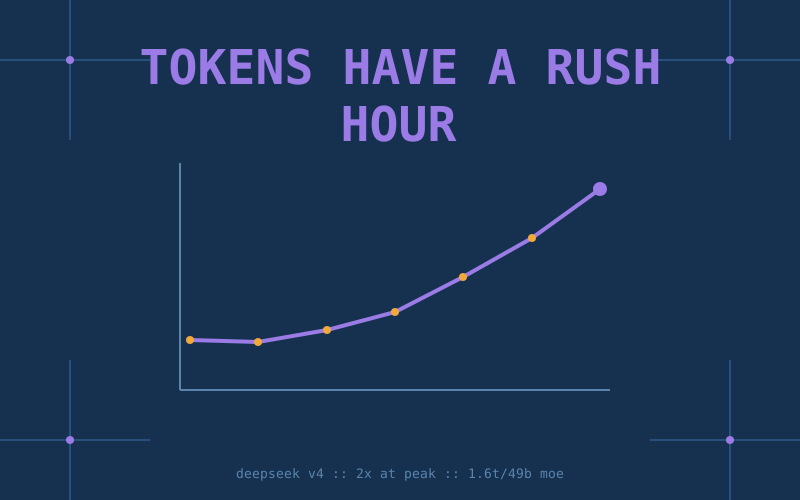
DeepSeek pushed its V4 model out of preview and into official release in mid-July, and buried in the launch is the part builders should actually care about: the first time-of-day surge pricing on a frontier LLM API. Call deepseek-v4-pro or deepseek-v4-flash during two windows of the Beijing workday, 9:00 to 12:00 and 14:00 to 18:00, and both input and output tokens cost exactly double. The model did not get more expensive. The clock did. Your bill now depends on what time it is where DeepSeek's GPUs live.
What Actually Shipped
The V4 family has been floating around as an open-weight preview since April 24, when DeepSeek released the weights under an MIT license. Mid-July is the graduation: the preview label comes off, the API stabilizes, and the older deepseek-chat and deepseek-reasoner endpoints go dark after July 24, 2026, 15:59 UTC. If you have code pointed at those IDs, that is a hard deadline, not a suggestion.
The lineup is two mixture-of-experts models, both with a 1M-token context window as standard:
- V4-Pro: 1.6 trillion total parameters, 49 billion active per token. This is the flagship, the one the UK's safety institute benchmarked on cyber tasks, tuned for agentic work, math, and code.
- V4-Flash: 284 billion total, 13 billion active. The cheap, fast sibling for high-volume, latency-sensitive workloads.
Off-peak, the API is aggressively cheap. V4-Pro runs roughly $0.44 per million input tokens and $0.87 per million output (about 6 RMB out); V4-Flash is around $0.14 in and $0.28 out. Those are the numbers that made DeepSeek a budget favorite. The catch is that "off-peak" is now a load-bearing word.
The Part That Is New: A Rush Hour for Tokens
Metered pricing by time of day is ancient news in electricity and cloud spot markets. It has never once appeared on a frontier language-model API. DeepSeek is the first, and it did not soften the edges: during the two peak windows, prices do not creep up 15%, they flip to 2x, full stop, on both V4-Pro and V4-Flash. Users get an email 24 hours before any billing change, which is polite, but the mechanism itself is blunt.
The windows are 9:00 to 12:00 and 14:00 to 18:00 Beijing time, which is 01:00 to 04:00 and 06:00 to 10:00 UTC. That is six hours a day at double rate, carved into the two chunks when Chinese enterprise traffic is heaviest. The morning coffee spike and the after-lunch grind, priced accordingly.
Why a Lab Would Charge You for the Clock
Surge pricing is a confession. It says the bottleneck is no longer training the model, it is serving it. For two years the scarce, expensive thing in AI was the training run: the clusters, the months, the capital. DeepSeek pricing tokens by the hour is a signal that the constraint has moved downstream, to inference capacity, to the finite number of requests its GPUs can chew through at 10am on a Tuesday.
The clean analogy is your power bill. A utility cannot store much electricity, and it cannot conjure a new power plant for the 6pm dinner-time surge, so it prices peak demand higher to nudge flexible load (dishwashers, EV charging) into the quiet hours. DeepSeek is doing the same thing with GPUs instead of turbines: it cannot instantly grow its serving fleet, so it uses price to flatten the demand curve and push the batch jobs and cron runs into the off-peak trough. Same physics, different watts.
It is also a quietly honest admission that DeepSeek would rather shed some peak traffic than degrade latency for everyone. A price wall is a load shedder that lets you opt back in if you really need the tokens right now.
What It Means If You Build On DeepSeek
Here is the good news for a lot of readers, and it is almost funny: Beijing's rush hour is America's bedtime. The peak windows land at roughly 9pm to 6am US Eastern, so if you run your workloads during your own business day, you are sitting squarely in DeepSeek's off-peak the entire time. DeepSeek invented surge pricing and accidentally handed US daytime builders a permanent discount.
If your traffic does overlap Asia business hours, though, the flat daily-cost mental model is dead. A pipeline that runs 40% of its volume during peak now costs meaningfully more than the same token count spread evenly, and long-context calls make it worse: a single 500K-token input fired off at peak is a genuinely different line item than the same call an hour later. Concretely:
- Batch on a clock. Nightly evals, RAG re-indexing, bulk generation, agent runs that are not user-facing: schedule them into the off-peak trough. This is the cheapest optimization you will ship all quarter.
- Make your gateway time-zone aware. If you route through a proxy, it now needs to track cost by model, date, and hour, not just a daily aggregate, and ideally fail over to a flat-rate provider during DeepSeek's peak when the request is price-sensitive.
- Re-forecast. Any budget model that assumed a single blended token price is now off by up to the full 2x on the fraction of traffic that lands in the window.
The uncomfortable second-order effect is that "what does a token cost" stops being a number and becomes a function of time. If DeepSeek's experiment works, expect the other labs squeezed on inference to notice. Nobody wants to be the first to charge you for rush hour. Being the second is much easier.
Key Takeaways
- DeepSeek moved its V4 models out of preview into official release in mid-July; the legacy
deepseek-chatanddeepseek-reasonerendpoints retire after July 24, 2026, 15:59 UTC. - V4-Pro is a 1.6T-parameter MoE (49B active) and V4-Flash is 284B (13B active), both with a 1M-token context window.
- The headline change is the first time-of-day surge pricing on a frontier LLM API: a flat 2x on input and output during 9-12 and 14-18 Beijing time (01-04 and 06-10 UTC).
- It signals that inference capacity, not training, is now the binding constraint for a major lab, the same logic that drives peak electricity pricing.
- US daytime workloads fall entirely in DeepSeek's off-peak, so American builders largely dodge the surge; teams on Asia hours should batch off-peak and make their gateways time-zone aware.
- Cost forecasting can no longer assume a single blended token price; the effective rate is now a function of the clock.
Sources: DeepSeek V4 release notes (API docs), TechNode: DeepSeek to launch V4 with peak-time pricing, Crypto Briefing: DeepSeek V4 peak-hour pricing, TheRouter.ai: peak-hour pricing and routing, DeepSeek-V4-Pro model card (Hugging Face)