Ditto Survey of 5,039 Indie Musicians: Over-55s Use AI Three Times as Often as 18-24s
TL;DR
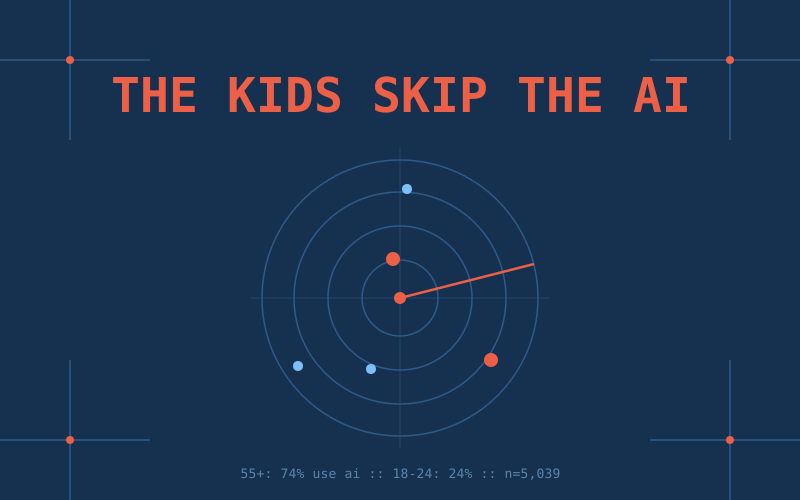
Ditto Music, the independent distribution company, published its Independent Music Report 2026 on September 29, built on responses from 5,039 independent artists across 112 countries. Almost half (47%) already use AI in their music-making. The surprise is who: 74% of artists aged 55 and over use it, against just 24% of 18-24-year-olds. Most of that use is production grunt work (mixing, mastering, vocal tuning) rather than whole AI-generated songs, and it sits inside a grim money picture: 74% of respondents earned under $1,000 from music in 2025.
What the report found
The report is a broad health check on independent music careers, with sections on money, discovery, AI, touring and mental health. The AI section is short, but it carries the most counterintuitive number in the whole document.
In Ditto's own words, musicians aged 55+ are "more than three times as likely as 18-24-year-olds to report using AI" in music-making. The expected story, where digital natives adopt the new tool first and older artists hold out, runs in reverse here.
What they actually use it for
- Production first. Mixing, mastering and vocal tuning are, per the report, "comfortably the most common application."
- Cover art second. "Artists who use AI are also comfortable letting AI make the artwork," the report says, naming cover art as the second most common use.
- Whole songs are a minority. Almost 1 in 4 AI users have made fully AI-generated music. Across the whole sample that is 11%, roughly 1 in 9 artists.
- Business side too. The report says 50% use AI "regularly or occasionally" in their marketing or business strategy.
So the dominant pattern is AI as an engineer, not AI as the artist. That matters for anyone building tools here: the demand sits in the unglamorous back half of the signal chain.
Why the old guard got there first
Ditto does not publish a causal explanation, so treat what follows as reading between the lines rather than a finding. Mixing and mastering are skills that used to cost money: either studio time, a hired engineer, or years of practice. An artist who has been releasing music for decades knows exactly what a finished master should sound like and exactly how much they used to pay for one. An AI mastering chain is a cheap answer to a problem they have priced many times.
Think of it like a veteran home cook buying a stand mixer: they are not outsourcing the recipe, they are outsourcing the forearm workout. Younger artists, who came up with free plugins and bedroom DAWs, may simply never have felt the cost that AI now removes.
There is also an identity angle, and here there is an outside signal. The Uppbeat Creator Report 2026, a separate survey of 1,792 creative professionals fielded in February and March 2026, found that "16- to 24-year-olds are the least likely group to use AI tools." It also found just 6.7% of respondents consider fully AI-generated content acceptable, while almost 60% are happy to integrate AI assistance into their workflow. Two different companies, two different samples, same direction on age.
The money context
The AI numbers make more sense next to the rest of the report, which reads like a cost-cutting brief. Releasing music has never been easier. Getting paid for it has not moved.
- Income. 74% earned under $1,000 from music in 2025. Only 22% consider music their full-time job, and 64% work a full- or part-time job outside it.
- Outlook. 29% think their music income is sustainable for the next three years. 32% considered quitting in the past year, rising to 43% among US respondents.
- Touring. 82% cannot afford touring expenses, even though live is their second-largest income source after streaming.
- Stress. 37% name financial pressure as their main stress, and 23.5% name marketing and self-promotion.
- The content treadmill. 86% create social content to promote their music, 75% say social media success is essential to a viable career, and 49% say TikTok or YouTube is their biggest source of new fans.
Put those together and the AI adoption pattern looks less like a creative movement and more like a budget line. When three quarters of your respondents make under a grand a year, a tool that replaces a paid mastering engineer is not a philosophical question.
When asked what would improve their careers, artists did not ask for more AI. 43% wanted better playlist and discovery tools on streaming services and 41% wanted higher streaming royalty rates, according to Music Ally's write-up of the report.
Read the sample before you quote it
This is not a random sample of musicians. Ditto recruited through its own artist community, and every respondent had released music via Ditto. That skews toward artists who self-distribute, pay for a service, and are active enough to answer a distributor's survey. Asking a distributor's customers about their music habits is a bit like surveying a gym's members about exercise: useful, but not the whole population.
The geography is lopsided too. The US (1,180), UK (1,003) and South Africa (929) account for nearly two thirds of responses. And the headline age cohort is small: only 22% of all respondents were 45 or older, so the 55+ group is a minority slice of the 5,039. The report does not publish the exact cohort sizes in its main text.
Comparisons with Ditto's earlier research need the same care. In April 2023, Ditto reported that 59.5% of 1,200 surveyed artists were already using AI to create music. That is a higher figure than 2026's 47%, but the sample size, question wording and moment are all different, so do not read it as adoption falling. What you can say is that the 2026 number comes from a sample more than four times larger.
What this means if you build for creators
If you make AI music tools, the data points away from the loudest part of the market. Fully generated songs get the headlines and the lawsuits; in this sample they are the habit of roughly 1 in 9 artists. The bulk of real use is finishing work: mixing, mastering, tuning, artwork, marketing copy.
It also suggests your most willing customer may be older than your marketing assumes. A 58-year-old with a back catalogue and a day job is a different buyer than a 20-year-old on TikTok, and per this report the former is far more likely to already be using the tool. Somewhere, a growth team is running Gen Z influencer campaigns for a mastering plugin whose best customers remember DAT tapes.
Key Takeaways
- Ditto's Independent Music Report 2026 surveyed 5,039 independent artists in 112 countries; 47% use AI in music-making.
- Adoption runs by age in reverse of the usual pattern: 74% of over-55s use AI versus 24% of 18-24s, and a separate Uppbeat survey also found 16-24s least likely to use AI tools.
- Most use is production support (mixing, mastering, vocal tuning), then cover art; about 11% of all respondents have made fully AI-generated music.
- The money backdrop is harsh: 74% earned under $1,000 from music in 2025 and 82% cannot afford to tour.
- The sample is Ditto's own customers and skews to the US, UK and South Africa, so treat the percentages as a strong signal about self-distributing artists, not all musicians.
Sources: Ditto Music, The Independent Music Report 2026, Ditto Music press release via Business Wire, Hypebot, Music Ally, Hypebot on the Uppbeat Creator Report 2026, Ditto Music 2023 AI survey