Someone Built a Skynet Countdown for Your Job, and It's a Clickable Pixel Town
TL;DR
A new browser toy called EmptyDesk.ai turns the most anxiety-inducing question in tech, "is AI coming for my job," into a cute 16-bit town you click your way through. Every villager is a real US occupation pulled from the Bureau of Labor Statistics, and each one sweats, panics, or jumps for joy based on that job's actual AI-exposure score. Click a character or a building and a card pops open with the real pay, outlook, and exposure rationale. There's a global "Doom Clock" counting down to a satirical desk-emptying date, an S-to-F survival tier list (S is "AI-PROOF," F is "Already Toast"), and 342 jobs to poke at. It is data journalism cosplaying as a Game Boy Advance cartridge, and it is dangerously fun.
What It Actually Is
Picture a tiny pixel town at dusk, GBA-era Zelda meets Pokémon, except the whole place is having a quiet existential crisis. It is not a game you steer around. It is a living diorama you explore by clicking: fifteen buildings (a hospital, a server farm, a cubicle tower, a diner, a factory, a construction site), each housing a cluster of real occupations, and each occupation a little sprite with a mood. Click a building to see who works there; click a character to open their card.
Find the software tester and they're sweating. Find the roofer and they're whistling, completely chill. That mood is not random. It's a deterministic function of the job's AI-exposure score, on a 0-to-10 scale, mapped straight from a public dataset. The whole thing is a chart you poke at.
The Doom Clock Is the Hook
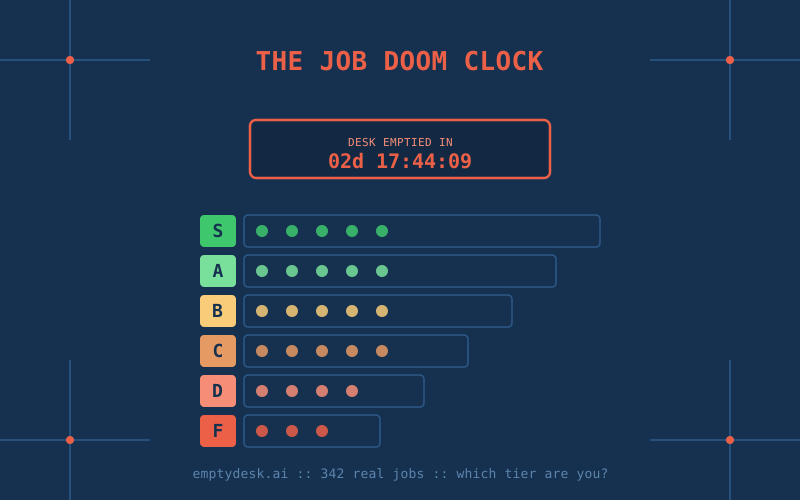
Bolted to the top of the screen is a HUD with a global "AI takeover" meter and a live ticking Takeover Clock. Open any job card and you get a per-job version: a countdown rendered as Dd HH:MM:SS, ticking every second toward that occupation's personal "desk-emptying ETA."
Here's the clever, slightly evil design choice. The countdowns are anchored to a fixed epoch: the public launch of ChatGPT (November 30, 2022). So a job's doom date doesn't drift around depending on when you load the page. The clock just ticks toward the same fixed target every time, which makes it feel uncomfortably real. Higher exposure jobs get a closer date. A bit of projected employment growth buys a job more time; a declining outlook pulls the doom in. The most cooked occupations literally display "DESK ALREADY EMPTIED" in a blinking panel, while the safe ones just show "AI-PROOF · ∞."
The Tier List Settles the Group Chat
If clicking around the town is the experience, the tier list is the screenshot people will actually share. It ranks all 342 occupations from S to F:
- S, "AI-PROOF" (exposure 1-2): the trades and hands-on work. Construction laborers, roofers, grounds maintenance, janitors. The lowest-exposure jobs in the whole dataset.
- A, "Pretty Safe" (exposure 3)
- B, "Hanging On" (exposure 4-5)
- C, "Sweating" (exposure 6)
- D, "Cooked" (exposure 7-8)
- F, "Already Toast" (exposure 9-10): the desk jobs that are mostly language in and language out. The single highest-exposure occupation in the set is medical transcriptionists, sitting at a perfect 10.
The reversal is the punchline. For a decade the narrative was that knowledge work was safe and manual labor was on the chopping block. This chart flips it: the person on the roof is in S tier, and the person at the keyboard is the one sweating.
The Numbers Are Real, the Comedy Is Not a Forecast
This is the part that keeps it from being just doom-bait. The underlying data is genuinely sourced. It rides on top of karpathy/jobs, Andrej Karpathy's project that scrapes the BLS Occupational Outlook Handbook and scores each occupation's AI exposure with an LLM. EmptyDesk consumes that published dataset directly: 342 occupations, roughly 143 million US workers, 25 BLS categories. Each job card shows the real median pay, the real BLS employment count, the real projected outlook, and the LLM's exposure rationale. A daily refresh keeps it current with the upstream source.
The employment-weighted average exposure across the whole workforce lands around the halfway mark, which the global meter shows as a roughly 49% "takeover" reading. That number is doing a lot of comedic work, because the site is very clear about what it is not.
The countdowns are comedy on a real chart, not predictions. Exposure does not equal disappearance. A high-exposure job often gets reshaped rather than deleted, and demand for it can still grow.
That disclaimer lives right in the About panel, and it's the responsible move. "AI exposure" measures how much of a job's tasks an LLM could plausibly touch, not how many humans are about to be fired. EmptyDesk takes that honest, fuzzy metric and runs a deliberately absurd extrapolation off it, then tells you to your face that it's a joke. The satire targets AI hype and the chart itself, never the actual workers.
Why It Works as a Piece of Craft
Plenty of people have made the "AI vs jobs" bar chart. Karpathy's original is a clean treemap. What EmptyDesk gets is that nobody shares a treemap to the group chat, but everyone shares a town where they can click on their own job and watch their tiny avatar sweat. The medium is the marketing.
A few details that make it land:
- Pixel-perfect rendering. The canvas runs with image smoothing off, crisp 1-2px borders, hard shadows, no blur. It commits to the 16-bit look instead of faking it.
- Mood as data. Sprites idle-bob when calm, hop when joyful, and jitter with sweat droplets when panicking. You read the dataset emotionally before you read a single number.
- Districts that make sense. Healthcare jobs live in the hospital, IT in the server farm, transport in the logistics depot. The map is the BLS taxonomy in disguise.
- Search and tier views. Don't feel like hunting through the town? Search your exact job title and jump straight to the verdict.
Go Find Your Job
The honest reason to visit is selfish curiosity: you want to know your own tier. Type in your job title or click around until you find it, watch the little version of you either whistle or break out in pixel sweat, and check the countdown. Then remember the disclaimer, screenshot it, and send it to the one coworker who keeps saying AI is overhyped.
It's a clever reminder that the best way to make a scary dataset go viral isn't a better chart. It's letting people click around inside it.
Key Takeaways
- EmptyDesk.ai is a clickable pixel-art town where 342 real US occupations are characters whose panic is driven by real AI-exposure scores.
- The "Doom Clock" ticks toward a satirical desk-emptying date anchored to the ChatGPT launch, so each job's countdown is fixed and reproducible.
- The S-to-F tier list flips the old narrative: hands-on trades are "AI-PROOF," and language-heavy desk jobs are "Already Toast," with medical transcriptionists at a perfect 10.
- The data is real (BLS Occupational Outlook Handbook via karpathy/jobs, ~143M workers, refreshed daily); the extrapolation is openly a joke.
- Exposure is not destiny. The site states plainly that high exposure means reshaped tasks, not vanished jobs, and the satire never punches at real workers.
Sources: EmptyDesk.ai, karpathy/jobs (BLS + AI-exposure dataset), and the BLS Occupational Outlook Handbook.