An AI Wrote 285 Genomes. 16 of Them Came to Life.
TL;DR
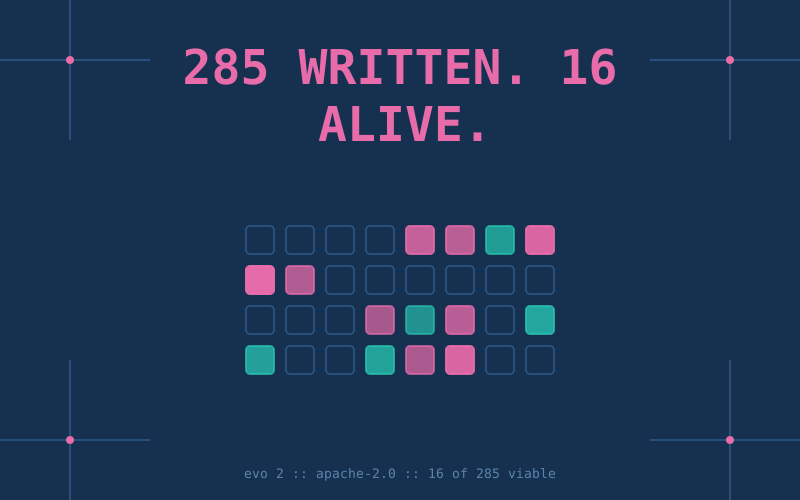
On August 6, Science published "Generative design of bacteriophages with genome language models," the first time a generative model has written a complete, functioning genome from end to end. A team from the Arc Institute and Stanford aimed the Evo genome language models at ΦX174, a 5,386-nucleotide virus that infects E. coli, filtered the output down to 302 candidates, chemically synthesized 285, and recovered 16 viable phages that match nothing in nature. A cocktail of the generated phages rapidly cleared E. coli strains that had already evolved resistance to the natural template. The model that wrote them is Apache-2.0 and downloadable today.
The funnel is the story
Generative biology has been designing single proteins for years. A protein is one component. A genome is the whole machine: genes, promoters, packaging signals, and overlapping reading frames that all have to cooperate or the thing is inert plastic. ΦX174 crams eleven genes into 5,386 nucleotides, partly by encoding some genes inside others, which is exactly the kind of constraint that punishes a model that has learned surface statistics instead of structure.
The pipeline ran thousands of generations, filtered hard, and then did the expensive part: turning sequence files into physical DNA and seeing what happened.
A 5.6% hit rate sounds grim until you notice what the baseline was. Nobody had ever generated a working genome at all, so the honest comparison is not "16 out of 285," it is "16 versus none."
A genome language model is exactly what it sounds like
Evo is an autoregressive model trained on DNA at single-nucleotide resolution. Same recipe you already know: predict the next token, where the vocabulary is A, C, G, T instead of subwords. Evo 2 was trained on over 9.3 trillion nucleotides drawn from more than 128,000 genomes, and it can hold a million nucleotides in context at once, which is what makes whole-genome generation tractable in the first place.
Here is the part worth sitting with. Previous generative protein work was like getting a model to write one correct function. This is asking it to emit an entire repository, including the build config and the linker script, and have the binary boot on the first run, on hardware you cannot attach a debugger to. Sixteen of them booted.
The generated phages were not paraphrases of the template either. Cryo-electron microscopy showed one of them assembling its capsid around a DNA packaging protein borrowed from an evolutionarily distant phage, a swap the model made without being told the part existed in a compatible form. Several designs sit under 95% identity to anything known, which by the usual conventions is a different species.
The experiment that actually matters
Novelty is a demo. The result with teeth is resistance. The team took E. coli strains that had already evolved resistance to ΦX174, then hit them with two cocktails: one built from naturally sourced ΦX174-like phages, one built from the generated designs.
That is the path the authors are pointing at: phage therapy for bacteria that antibiotics have stopped touching. Phage therapy has always had a supply problem, since you need a phage that matches the specific strain in front of you and evolution is not on a release schedule. A model that can generate diverse, viable candidates on demand turns a scavenger hunt into a search problem, and search problems are the kind of thing this industry is good at.
The weights are public
This is not a closed lab result you read about and move on from. Evo 2 shipped openly, with weights, training code, and the OpenGenome2 dataset, under Apache-2.0. The checkpoints are on Hugging Face in sizes from 1B up to 40B, with context windows up to a million nucleotides.
Worth flagging the timeline honestly, since the headlines this week make it sound like it happened yesterday. The preprint went up on bioRxiv in September 2025. What landed on August 6 is peer review, in Science, volume 393. The result has been public and reproducible for months. It just now has the stamp.
The safety question, straight
These are bacteriophages. They infect bacteria and are, as a class, among the most abundant biological entities on the planet already. Arc also states that Evo 2's base dataset excluded pathogens that infect humans and other complex organisms, and that the team tuned the model not to return productive answers about them. Those are real design decisions, not a press release afterthought.
The uncomfortable adjacency is a different paper. In October 2025, Science published "Strengthening nucleic acid biosecurity screening against generative protein design tools" from a team led by Microsoft's Eric Horvitz, which generated roughly 76,000 variant designs of 72 toxic proteins and found that existing DNA synthesis screening software missed many of them. The group worked with vendors for months on patches before publishing, and those patches shipped, but the authors were explicit that coverage remains incomplete.
Put the two results next to each other and the shape is clear. Generative models can now produce biological sequences that no organism has ever carried, and the choke point between a sequence file and physical DNA is a screening layer that was designed to pattern-match against things that exist. That is not a reason to stop the phage work. It is a reason to notice that the filter is the part that needs the investment, not the model.
Why a builder should care
- Domain foundation models are past the toy stage. Next-token prediction over a non-language alphabet, scaled up, produced a functional artifact that had to satisfy dozens of interacting physical constraints simultaneously. That generalizes to any domain with a real grammar and a real verifier.
- The verifier is the bottleneck, not the generator. Thousands of generations collapsed to 302 candidates before anyone touched a pipette, and the wet lab was the expensive oracle. If your generation loop is cheap and your evaluation is expensive, you are in the same regime, and the leverage is all in the filter.
- Open weights keep winning at the frontier of weird. A 7B checkpoint anyone can pull did work that ended up in Science. The gap between "frontier lab result" and "thing on your GPU" continues to be smaller than the discourse suggests.
Key Takeaways
- Science published the first generative design of complete bacteriophage genomes on August 6, 2026, from Arc Institute and Stanford, DOI 10.1126/science.aec2657.
- 302 candidate genomes survived filtering, 285 were chemically synthesized, and 16 produced viable phages, a 5.6% yield against a prior baseline of zero.
- A cocktail of generated phages rapidly cleared E. coli that had evolved resistance to ΦX174, where a comparable natural cocktail could not.
- Cryo-EM confirmed one generated phage assembling with a DNA packaging protein from an evolutionarily distant relative, so these are not template paraphrases.
- Evo 2 is Apache-2.0 with open weights, code, and training data, from 1B to 40B parameters, trained on over 9.3 trillion nucleotides with a one-million-nucleotide context.
- The underlying preprint dates to September 2025. The news on August 6 is peer review, not a new experiment.
Sources: Science: Generative design of bacteriophages with genome language models, bioRxiv preprint, Arc Institute: Evo 2, ArcInstitute/evo2 on GitHub, NCBI: Escherichia phage phiX174 complete genome, Asimov Press: AI-Designed Phages, Stanford Report, Science: Strengthening nucleic acid biosecurity screening against generative protein design tools