Fed Survey: 87% of Market Contacts Now Call AI a Top Financial Stability Risk
On this page 6 sections
TL;DR
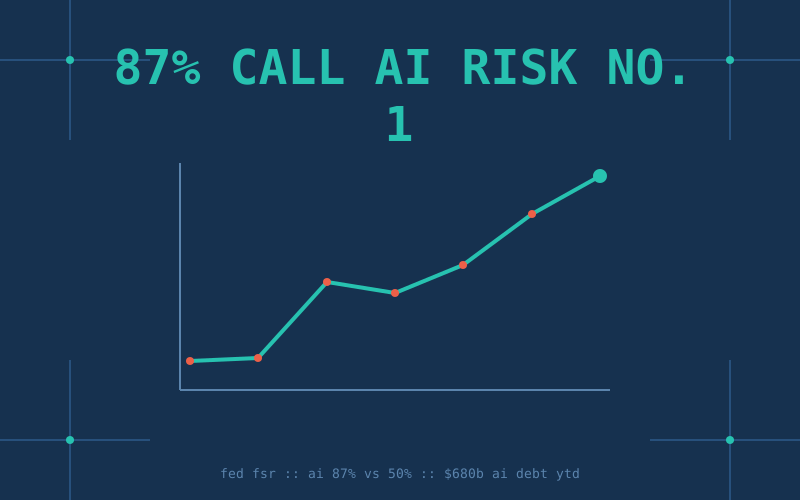
The Federal Reserve's November Financial Stability Report, released Friday Nov 13 with data through Oct 28, finds that 87% of the market contacts it surveyed in September and October now cite AI as a salient risk to the U.S. financial system. Six months ago that figure was 50%. A dedicated box on the data center buildout counts more than $680 billion in advanced-computing debt issued this year, over $1.1 trillion outstanding, and over $3 trillion in leases and guarantees that sit off the balance sheets of the firms promising them. If you build on rented tokens, this report maps the credit underneath your compute prices.
AI pulled away from the rest of the risk list
The Survey of Salient Risks is the Fed's twice-yearly temperature check. Staff at the Federal Reserve Bank of New York collect views from broker-dealers, banks, investment funds and advisory firms; this round heard from 23 of them between September and October. In the spring, AI already led at 50%. By October it led the second-place risk, a broad risk asset correction, by 35 percentage points.
The report splits the AI worry into three: elevated equity valuations that a run of disappointing earnings could correct, cybersecurity damage from state actors or, in the report's words, "damage caused by frontier AI models themselves," and complex forms of AI-related financing. Cyberattacks and fiscal debt were rated the most severe if they materialize. AI is the most widely cited.
On valuations, the report names the driver outright. The S&P 500 forward price-to-earnings ratio sits well above its post-1990 median of about 16, "partly driven by market enthusiasm for super intelligence (SI)." Yes, the Fed has an acronym for it now. Public equities grew 25.3% in the year through June 2026 and total about $93.6 trillion.
The debt box is the part to read twice
Box 2.2, "Leverage in the Data Center Buildout," is where the report stops relaying opinions and starts counting. Advanced-computing debt issuance passed $680 billion for the year by October, roughly five times the $130 billion raised in all of 2023. As a share of investment-grade corporate issuance, advanced computing went from under 6% in 2023 to about 31% this year. The largest investment-grade data center operators alone sold more than $150 billion of bonds year to date, into strong demand.
Outstanding public debt tied to advanced computing now exceeds $1.1 trillion, and the report notes that sizable private-market deals make the true total hard to measure. Then comes what never gets booked as debt: leases that have not commenced, worth over $1 trillion undiscounted, plus take-or-pay contracts and residual value guarantees worth over $2 trillion.
The mechanics run hyperscaler to lender. A cloud provider signs a long-term lease with a data center developer; the developer borrows against that lease to fund construction. GPU makers, for their part, guarantee the residual value of the GPU collateral behind purchases by AI firms, which works like a car lease where the manufacturer promises the buyback price: comfortable while the hardware holds value, less so two GPU generations later.
The Fed compares five hyperscalers' cumulative capital spending and debt issuance since 2020 with the entire telecom industry's broadband cycle that started in 1995. The lines track closely, it says, and advanced-computing investment is accelerating to the point of passing the telecom pace relatively soon. The largest U.S. banks hold close to $1 trillion of exposure across the big tech firms, developers, special purpose vehicles and utilities, and the riskier tranches of the financings sit in high-yield funds, life insurers and business development companies. The report's own summary line: "The complex interlinkages among firms engaged in the data center buildout, public credit markets, private lenders, and special purpose financing vehicles create vulnerabilities that necessitate close monitoring."
Why it matters if you build on rented compute
The report predicts nothing. It documents who owes whom, and the chain runs from the hyperscalers you buy tokens from down to the banks holding the loans behind the buildings the GPUs live in. A credit squeeze anywhere in that chain would reach API prices long before it reached your code.
Two smaller items deserve a builder's attention. Respondents named "circular financing arrangements" and stretched valuations as amplifiers of a correction. And the cyber section states that "reports that agentic systems have been involved in cyber events have increased in frequency since the May report," next to a note that LLMs and agentic systems have improved at finding and exploiting vulnerabilities. If you ship agents, expect that sentence quoted back at you by a customer's compliance team.
Read the small print
The same report grades the system as stable overall. Banks hold regulatory capital near historically high levels, funding risks are moderate, and business debt relative to GDP is drifting down, though the Fed expects large tech issuance to push it back up. CNBC's write-up led with the survey and still summed up the system as fairly stable.
The caveats matter. Twenty-three contacts is a small panel, and the Fed states the survey represents their views, not the Board's. The debt estimates exclude private placements that never file publicly, so the public figures are a floor. Everything reflects Oct 28, before the midterms and before Nvidia's rough stretch.
Key Takeaways
- 87% of 23 surveyed market contacts cited AI as a salient risk to U.S. financial stability this fall, up from 50% in the spring; the next risk, a broad risk asset correction, drew 52%.
- The Fed attributes elevated S&P 500 valuations partly to "market enthusiasm for super intelligence (SI)"; the forward P/E sits well above its post-1990 median of about 16.
- Advanced-computing debt issuance passed $680 billion through October, about five times 2023's $130 billion, and now runs about 31% of investment-grade corporate issuance, up from under 6% in 2023.
- Public advanced-computing debt outstanding exceeds $1.1 trillion, alongside over $1 trillion in leases not yet commenced and over $2 trillion in take-or-pay contracts and residual value guarantees, undiscounted.
- The largest U.S. banks hold close to $1 trillion of exposure to the buildout, and the Fed compares hyperscaler capex since 2020 with the 1995 telecom broadband cycle, with advanced-computing investment accelerating.
- Caveats: the survey reflects respondents' views rather than the Board's, the overall system assessment stayed stable, private debt is undercounted, and the data cutoff is Oct 28, 2026.
Sources: Federal Reserve, Financial Stability Report, November 2026 (PDF), Federal Reserve FSR series page, CNBC, Nov 13, 2026, American Banker, Nov 13, 2026