Google Launches Gemini 4 Hydrogen, Beating Argon and Replacing 3.8 Flash
On this page 8 sections
TL;DR
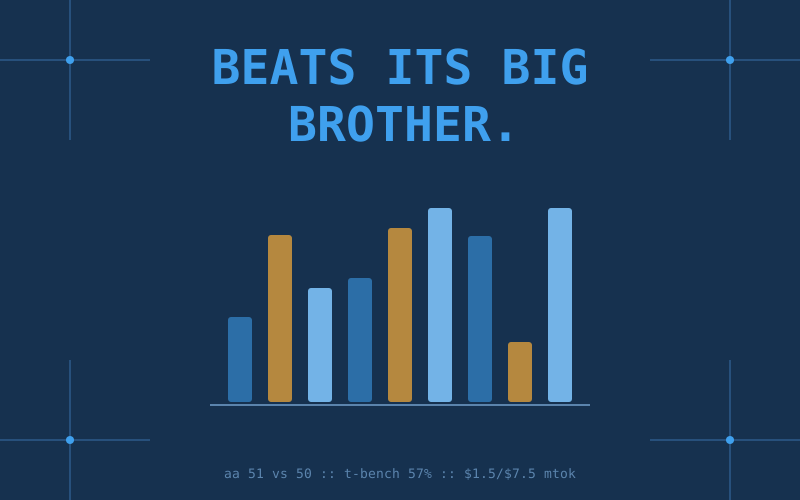
Gemini 4 Hydrogen landed Nov 12 as the volume tier of Google's Gemini 4 family, and it shipped across every surface at once: all tiers of AI Studio, the Gemini API, Gemini for business, the Gemini app, Google Search for all users globally, and Antigravity for paid AI Pro and Ultra subscribers. At its default high thinking level it scores 51 on the Artificial Analysis Intelligence Index, one point past its frontier sibling Gemini 4 Argon, and Google says it finishes tasks 2.5 times faster than Gemini 3.8 Flash, the model it replaces. The rate card is the catch: $1.50 per million input tokens and $7.50 per million output, twice Flash's introductory price through the end of December.
One family, three elements, three jobs
Google names its tiers after elements, and the jobs split along the same line. Gemini 4 Carbon and Argon handle deep, long-horizon reasoning. Hydrogen, the lightest element in the family, gets the volume work: writing code, running tests, chewing through documents and driving agents that take many steps. Google's own phrase for it is the "daily driver for agentic workflows."
Search is the loudest part of the rollout. The upgrade post describes better intent handling on messy multi-part queries, more visual responses, and a wider fan-out of links. It reaches every Search user globally; if you searched on Friday, you already met it. Free Gemini app users get Hydrogen through automatic model selection, and on Google Cloud gemini-4-hydrogen is listed as generally available.
The scores, checked independently
Google's headline number holds up outside the building. Artificial Analysis's v5.0.1 index blends nine evaluations and puts Hydrogen at 51 on high and 54 on the new xhigh setting, versus 50 for Argon at high and 31 for 3.8 Flash. Drop Hydrogen to medium and it still clears the cheap tier at their maximum settings: 41 against 36 for both Claude Haiku 5.5 and Meta's Muse Ember, and 28 for GPT-6 Luna. Kimi K3.1 Pro sits between at 46 on Moonshot's $2/$10 rates.
One caution from the same dataset: on Terminal-Bench 4.0, xhigh scored exactly what high scored, 54%, while estimated cost per task across the index rose from $1.87 to $3.16. Extra reasoning bought nothing there. Turn the dial up only when a task shows it pays.
Terminal numbers
Agentic terminal work is where the Flash gap is widest. On Google's Terminal-Bench 4.1 evaluation, Hydrogen completes 57% of tasks against Flash's 18.2%. Google's own table still has Claude Sonnet 5.5 ahead at 63.9%, so Hydrogen closed most of the gap to the frontier without closing it. Independent Terminal-Bench 4.0 runs by Artificial Analysis tell the same story: 54% for Hydrogen against 40.9% for Ember, 32.8% for Haiku and 12.6% for Luna.
Google also claims a cut of more than 5x in fabricated claims, and cleaner recovery when a tool call fails or a search comes back empty, which is the failure mode that usually kills long agent runs. Early-access partners reported 2x to 2.8x faster runs with 12% to 23% fewer tokens versus Flash on complex graphs, SQL and data-heavy workflows. Box went from 74% to 79% accuracy on its internal Complex Work Eval, in less than half the time and on about 12% fewer tokens, per the chart its CEO Aaron Levie posted.
The safety numbers are unusual for a speed tier: overreach on agentic tasks down up to 81%, under-service down up to 79%, misaligned actions and task shortcutting cut by 12x, a 94% honesty rate on Google's internal agent honesty evaluation, and 2.3x better resilience against indirect prompt injection on the Gray Swan IPI benchmark. Google also kept 99.9% chain-of-thought legibility across more than 200,000 audited turns. The model card has the methodology.
The rate card
Hydrogen costs $1.50 per million input tokens and $7.50 per million output tokens, flat across the whole 1M-token context, with cached input at $0.075. That is double Flash's introductory rate, and it matches exactly the standard rate Flash was already scheduled to move to on Jan 1, 2027. The discount was always going to end on Dec 31; switching to Hydrogen just starts you at the post-discount price now.
Against the cheap tier, the per-token gap is 15x. Per task it narrows, and sometimes inverts, because Hydrogen finishes jobs in fewer output tokens. Artificial Analysis estimates $1.87 per index task at high, $0.80 at medium and $0.29 at low, against $0.41 for Haiku, $0.14 for Ember, $3.68 for Kimi K3.1 Pro, and $7.77 for Flash at high on its introductory rates.
Cached input at $0.075 is the quiet lever. You pay full fare the first time Hydrogen reads a document and pennies on every reread, so an agent that re-feeds the same context all day cares more about that line than about the sticker price.
Migrating is more than a model-name swap. The migration guide lists the traps: Hydrogen defaults to high reasoning where Flash defaulted to medium, the old thinking_budget parameter and the MINIMAL setting are rejected, automatic caching now starts at 4,096 tokens instead of 6,144, explicit caching is unavailable at launch, and the 1M-token window is shared between input and output, reasoning tokens included. A naive port burns more tokens than your old defaults did.
Orchestrator, one model handing work to another
The other launch is Orchestrator in Antigravity, which switches between Carbon and Hydrogen mid-session instead of committing to one model for a whole job. Carbon acts as the coordinator; Hydrogen powers worker and verifier agents that build and test changes in parallel, isolated workspaces. On Terminal-Bench 4.0, Google says the pairing landed near Carbon's success rate while finishing 19% faster on 24% less quota.
Should you move
For teams already on Google's stack the switch is low drama: Flash's own prices converge to Hydrogen's on Jan 1, and Hydrogen at low or medium is cheaper per task than Flash at high ever was. Teams on the cheap tier have less reason to move; pure volume work still favors $0.10/$0.50 rates, and Hydrogen medium's index lead costs roughly double per task.
Key Takeaways
- Gemini 4 Hydrogen launched Nov 12 across AI Studio, the Gemini API, Gemini for business, the Gemini app, Search for all users globally, and Antigravity for paid tiers; it replaces 3.8 Flash as Google's volume model.
- It scores 51 on the Artificial Analysis Intelligence Index at its default high setting, past Argon's 50, rising to 54 at the new xhigh; Flash scored 31.
- Terminal-Bench 4.1 went from 18.2% on Flash to 57% on Hydrogen in Google's table, still behind Claude Sonnet 5.5 at 63.9%.
- Pricing is $1.50/$7.50 per million tokens flat across the 1M context, twice Flash's introductory rate and equal to Flash's scheduled Jan 1, 2027 standard rate; cached input runs $0.075.
- Migration has breaking changes: reasoning defaults to high,
thinking_budgetandMINIMALare rejected, automatic caching starts at 4,096 tokens, and the context window is shared with output and reasoning tokens. - Antigravity's new Orchestrator mixes Carbon and Hydrogen in one session, hitting near-Carbon Terminal-Bench 4.0 results 19% faster on 24% less quota.
Sources: Introducing Gemini 4 Hydrogen, Google (Nov 12, 2026), VentureBeat (Nov 12, 2026), Ars Technica (Nov 13, 2026), Artificial Analysis model page, Gemini 4 Hydrogen model card, Google Antigravity blog