Kling 4.0 Goes Global With 30-Second Video, 10 Keyframes and Agent Access via MCP
TL;DR
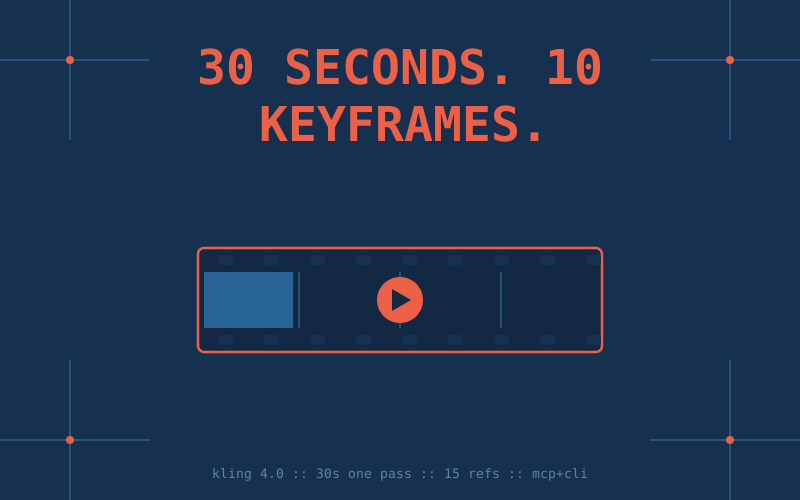
Kling 4.0, the new video model from Kuaishou's Kling AI unit, launched on October 15 and was announced globally on October 19. It generates up to 30 seconds in a single pass, takes up to 10 keyframes and 15 reference assets per job, and reads prompts up to 8,000 tokens long. It also plugs into Kling's MCP server and CLI, so an agent can drive it. A lighter Flash variant caps out at 720p and 20 seconds. 4K, 10-bit HDR, two-minute extensions and the developer API are all still listed as coming soon, and in The Decoder's side-by-side comparison it matches Wan 3.0 and Seedance 2.5 without beating them.
What shipped
Kling's pitch for 4.0 is control. Kuaishou's launch release groups the upgrades into three buckets: steadier large-scale motion and camera work, native 30-second single-pass generation, and an expanded Omni Reference system.
- 30 seconds per pass. One generation can now hold a long take, so action, a scene change and an emotional build can play out without stitching.
- Up to 10 keyframes. You pin specific visual moments (a character's state, a scene transition, a story beat) and the model fills in between them.
- Omni Reference, up to 15 assets. Per The Decoder, that means up to 10 images, up to 5 videos with a combined maximum of 30 seconds, and up to 7 elements, all inside the 15-asset total.
- 8,000-token prompts. Long enough to paste a real shot description instead of a haiku.
- Stereo audio and lip sync in 10+ languages. Kuaishou lists English, Japanese, Korean, Spanish, Portuguese, German, French and Hindi, plus American, British and Indian English accents.
The reference types are the interesting part for anyone who already works in a pipeline. Kling accepts three-view character sheets, image grids, storyboards and wireframes as image references, and it takes white-model videos (untextured 3D blockouts) and depth-map videos as motion references. You can previs a shot with grey boxes in your 3D tool and hand the camera move to Kling.
For comparison, ByteDance's Seedance 2.5 accepts up to 50 references (30 images, 10 video clips and 10 audio clips), and Alibaba's Wan 3.0 also renders 30 seconds in one pass. Kling's reference budget is smaller, and it puts its effort into keyframes and structured references such as blockouts, depth maps and character sheets.
Creative recreation: the ad-agency feature
The feature most likely to make money is Creative Recreation. You give Kling an existing video as a template, and it keeps the pacing, shot composition and style while you swap out the product, the character or other assets. The Decoder reports you can also change one element, such as a facial expression, a body movement, a camera angle or a background, without touching the rest of the clip.
Kuaishou says outright who that is for: product ads, viral social content, fashion and beauty, and consumer electronics. If you run a small shop that makes performance creative, this means one winning ad can become 40 variants by lunch. Whether the platforms reward 40 near-identical variants is a separate problem.
Who has already made something with it
Kling's launch materials lean on named productions.
- Worm Train. Korean director Kim Sung-soo, who made 12.12: The Day, used AI for the first time on this short film, inspired by Kafka's The Metamorphosis: an office worker turns into a giant insect and still has to commute. He recreated a subway scene with the Kling 4.0 Preview in September, when beta testing began. "It was the very scene I had given up back then," Kim said. BigGo Finance reports he presented the film at the Busan International Film Festival's Asian Contents & Film Market.
- Minibots. Evolutionary Films is making the animated feature with Kling as its exclusive "Technological Brand Partner." Co-founders John Adams and Diane Shorthouse say their artists still design sets and characters the usual way, then combine them through Omni Reference and direct action and camera by description. "It feels increasingly like directing a film rather than prompting an AI," they said.
- Cannes Lions. Kuaishou says two works made with Kling AI won Gold Lions this summer, the first year the festival used AI in its judging framework.
Adobe is also lining up distribution. In the global release, Adobe's Meg Donovan says Kling 4.0 and Kling 4.0 Flash are "coming soon to Firefly," with the full model aimed at "rich, cinematic stories" and Flash at "high-volume, everyday content."
Agents can drive it
The release also says Kling 4.0 is integrated with Kling MCP and CLI, so creators can reach Omni Reference and keyframe-to-video generation through AI agents. In practice an agent that speaks the Model Context Protocol can call Kling the way it calls a file search tool.
Think of it as hiring a camera crew that takes orders over walkie-talkie. Your agent writes the 8,000-token shot brief, picks the reference images, sets the keyframes, and sends the job. You review the dailies.
The catch is the API. Kuaishou says Kling 4.0 will reach enterprise customers and developers through API access "soon," and Kling's API pricing page has no 4.0 price yet. For now the agent route runs through Kling's own MCP and CLI tooling, with no published per-clip API price to budget against.
Flash vs. full
Kling 4.0 Flash is the cheap, fast tier. The Decoder reports it tops out at 720p and 20 seconds, against 30 seconds for the full model. Flash was the first piece to reach users: Atlas Cloud and other early reports put limited Flash access at September 28, mostly for top-tier annual subscribers.
Use Flash for drafts, thumbnails and social volume. Spend full 4.0 generations on the shots you will actually keep.
What is still "coming soon"
A good chunk of the spec sheet is not live. The global release says Kling 4.0 "will soon support" 10-bit HDR at 4K and 1080p and a 21:9 ultrawide format. The Decoder, reading Kling's release notes, lists HDR at 4K and 1080p and the two-minute video extension as coming soon too.
Kuaishou's corporate release is less careful and says 4.0 "supports output of up to 10-bit HDR." Plan around SDR until HDR files show up in your downloads folder.
Is it better than the competition?
Not clearly. The Decoder's comparison of Kling 4.0 against Wan 3.0 and Seedance 2.5 found that it "holds its own but doesn't pull ahead," with weak spots in logical shot sequencing, physics and natural-sounding dialogue. The Decoder suggests AI video progress may be leveling off, though it adds that the next Wan and Seedance releases will tell.
All three Chinese leaders now make 30-second single-pass clips, so length no longer separates them. Control surfaces do: how many references, what kinds, how many keyframes, and whether your tooling can reach the model at all. Kling has the strongest agent story of the three today. Seedance has the biggest reference budget.
The business behind it
Kling is big enough that this launch matters for its distribution alone. The global release claims more than 100 million users and more than 50,000 enterprise customers across advertising, film and TV, and gaming, figures BigGo Finance also reports. Briefs, citing Bloomberg, reports Kling's annualized revenue passed $500 million in March. With that much subscription money at stake, the launch materials are written for paying professionals and the "key shots" they need to deliver.
Key Takeaways
- Kling 4.0 launched October 15 and went global October 19, and Kling AI says it is fully available on the Kling AI website now.
- One job can produce 30 seconds of video, with up to 10 keyframes, up to 15 references (10 images, 5 videos, 7 elements max per type) and an 8,000-token prompt.
- White-model and depth-map videos work as references, so a 3D blockout can direct the camera.
- Kling MCP and CLI support lets agents drive Omni Reference and keyframe-to-video. The paid developer API and its pricing are not out yet.
- Flash runs faster and cheaper at up to 720p and 20 seconds. 4K, 10-bit HDR, 21:9 and two-minute extensions are still listed as coming soon.
- The Decoder's comparison puts it level with Wan 3.0 and Seedance 2.5.
Sources: Kling AI global launch release (via MarTech Series), Kuaishou launch release (via MarTech Series), The Decoder, Kling AI release notes, Kling API pricing, BigGo Finance, Briefs Finance, Atlas Cloud, ByteDance Seed: Seedance 2.5, Alibaba Cloud: Wan 3.0