McClatchy Tells Staff Local News Is No Longer Viable and Rebuilds Around AI Agents
On this page 8 sections
TL;DR
Audio of a 6 November staff town hall, obtained by Nieman Lab, records McClatchy executives telling employees that the local journalism powering the 169-year-old newspaper chain is no longer a viable business model. Paid digital subscribers fell 17 percent over the last year and unique visitors 39 percent, they said, and the fix is Project Catalyst: an "AI-native operating model" that embeds agents across the company, plus four new AI-built lifestyle and commerce sites. The meeting happened two months after McClatchy laid off more than 90 journalists.
What the recording says
The virtual meeting on 6 November was off the record until the audio reached Nieman Lab. CEO Tony Hunter told staff: "We cannot continue to do the same things because the marketplace has changed." Chief operating officer Jeff Dorsey walked through Project Catalyst, an "AI-native operating model" that takes "repeated tasks off of humans" and puts agents "directly into the daily workflow," to automate "non-core as well as core functions" and, in his words, "provide cash, frankly, to keep the business afloat."
Hunter has pushed the same direction for months. At a contentious May meeting he told skeptical journalists to get on board or find another job, and at the town hall he described a company-wide effort to "agentify the entire enterprise." CFO Joe Settineri tied the pivot to the balance sheet: most profitability is "already spoken for" by debt, and "like a loan on a house, we have to pay it down or you lose the house." The hedge fund Chatham Asset Management has owned McClatchy since it exited bankruptcy in 2020.
The numbers execs put on screen
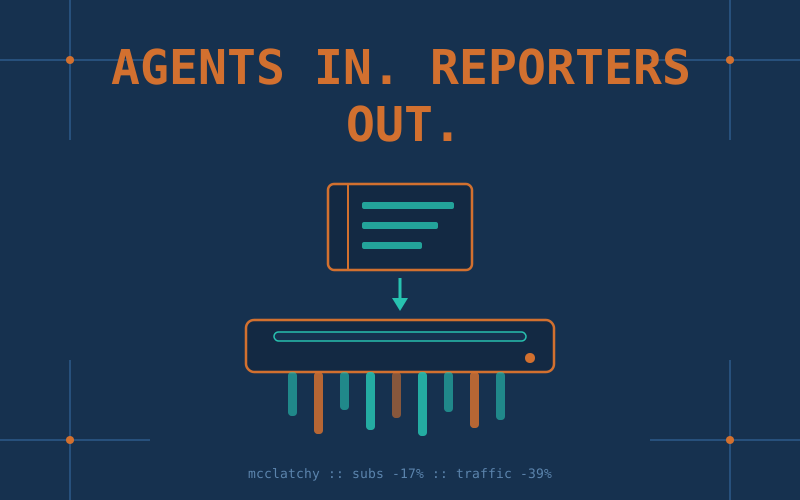
McClatchy is private, so a town hall slide is as close to a quarterly report as outsiders get. Paid digital subscribers down 17 percent in a year, unique visitors down 39. Pivot News reports the same figures from the recording; the company itself did not respond to multiple requests for comment. The 39 percent line is the search-referral cliff local publishers have described all year, arriving at a chain that still operates 29 daily newspapers across 14 states.
Project Catalyst: agents write, check, sell
The content pipeline is already built. McClatchy's "content scaling agent," a chatbot that repackages a reporter's story at several lengths for different audiences and publishes it under the reporter's name, runs on Anthropic's Claude, per CJR. It is one of roughly a dozen AI tools in daily use: agents that detect trending topics, write articles, fact-check headlines, and match stories to each reader's habits. On the business side, agents score subscribers by cancellation risk, forecast revenue, and surface likely advertisers. Chief product and engineering officer Rajiv Pant says anyone at the company can now build such tools, with "humans at the command center" who "set the direction, make the calls and own the results."
Four lifestyle brands and a storefront
The rebrand's public face is four sites aimed at obsessive niches: Crime Hunter for true crime, Saltwater South for the coastal South, Camp & Country for the outdoors, and Student Section for college sports. Each is powered by Trend Hunter, the consumer-trend firm McClatchy bought in 2024, whose shop sells $33.91 rosemary hair oil, a $249 red light therapy cap, and $34.99 "MAGIC Mushroom Coffee." A newspaper conglomerate's turnaround plan now has a shopping cart.
Patrick Stiegman, a 20-year ESPN digital veteran hired to run the Content Innovation Lab, told staff the goal is "cultivating passionate fans" in monetizable niches. Ariel Storch, hired to rebuild video, put it more plainly: "Nobody tunes in to be informed, they tune in to laugh." Trend Hunter material already runs inside the legacy brands: winter barn jackets in the Miami Herald, Texas college football in the Kansas City Star, and one Scarlett Johansson magnesium-supplement story pushed across numerous local papers at once. Each article carries a disclosure that it was "created by content specialists using various tools, including AI." The corporate homepage, meanwhile, still describes McClatchy as "a catalyst for informed engagement."
The newsroom's side of the ledger
Guild leadership heard the same meeting differently. Kristine Sherred, chair of the Washington State NewsGuild and a food reporter at The News Tribune in Tacoma, said attendees were left wondering "why we were even invited," and that "the future McClatchy appears to be building does not seem to be aligned with the mission of journalism." Tacoma no longer has a city reporter. A Kansas City Star reporter, granted anonymity, summed up the output as "city reporters out, shitty reporters in."
The layoffs landed on 10 September: more than 90 journalists across at least 13 papers in eight states, per Poynter, with some newsrooms losing upward of 40 percent of staff. The Miami Herald, which had roughly 300 journalists in 2000, came out of the round with fewer than 50. Deputy investigations editor Carol Marbin Miller: "Right now we are circling the drain, and that scares the hell out of me."
Labor pushed back before the pivot was public. Journalists at the Sacramento Bee and the Miami Herald withheld their bylines in May from Claude-written repackagings of their own stories. Washington and Idaho papers struck for a day over wages and "ethical limits" on AI; the contract floor at the time was $48,000, and about a third of guild members earned under $50,000. In July those papers ratified contracts barring the company from using AI to replace staff, impersonate journalists, or discipline members for a chatbot's mistakes. Two months later the layoffs arrived anyway. A person close to the decision told The New York Times they were about "business performance in some areas," and the Sacramento Bee's clause says AI implementation cannot "directly" lead to layoffs, a word the guild expects to test in arbitration.
Why this matters if you build with AI
- Watch the 17 and the 39 together. McClatchy is a large, public test of spending a legacy publisher's accumulated trust on programmatic AI content plus affiliate commerce, with traffic estimates anyone can read monthly. Trust is the battery: 169 years to charge, and the new operating model is a metered drain.
- Your AI share is a public number. Originality.ai estimated that as much as 20 percent of recent McClatchy articles were AI-generated, detectors being imprecise. Ad markets, search engines, and readers can run the same checks on any site, including yours.
- Agent buyers look like this. Dorsey's pitch, agents automating "non-core as well as core functions" to "provide cash, frankly," is what agent vendors will sell into every debt-loaded mid-market company next year. The motive is debt service.
- Contracts are arriving before laws. Ship agents into a unionized industry and you inherit clauses like no-AI-replacement and no-impersonation on day one, with arbitration as the enforcement path. Read the CBA before the rollout plan.
- Local attention is being repriced into commerce. The residual asset, readers in specific cities, is being pointed at rosemary oil and college sports content because affiliate margins beat subscription economics at a 39 percent traffic decline.
Key Takeaways
- Audio from a 6 November town hall, reported 18 November by Nieman Lab, records McClatchy executives calling the local journalism behind the 169-year-old chain no longer viable: paid digital subscribers down 17 percent in a year, unique visitors down 39 percent.
- Project Catalyst is the response: an "AI-native operating model" embedding agents in daily workflows, automating core as well as non-core functions, to "provide cash, frankly, to keep the business afloat."
- The content stack already runs: a Claude-powered content scaling agent republishing reporters' work under their bylines, plus roughly a dozen tools for trend detection, writing, headline checks, and personalized serving. Agents also score churn risk, forecast revenue, and identify advertisers.
- Four Trend Hunter-powered lifestyle sites carry the growth plan: Crime Hunter, Saltwater South, Camp & Country, and Student Section, backed by a consumer-products storefront.
- More than 90 journalists were laid off in September across at least 13 papers in eight states; the Miami Herald newsroom fell from about 300 in 2000 to fewer than 50.
- Originality.ai estimates up to 20 percent of recent articles are AI-generated, and union contracts now restrict AI replacement and impersonation, with arbitration the likely enforcement path.
Sources: Nieman Lab, Pivot News, Poynter, Columbia Journalism Review, KUOW, Crime Hunter, Camp & Country, Saltwater South, Student Section, Trend Hunter, McClatchy, Originality.ai, Anthropic