Meta's New Model Types What You Think at 61% Accuracy, No Brain Surgery Required
TL;DR
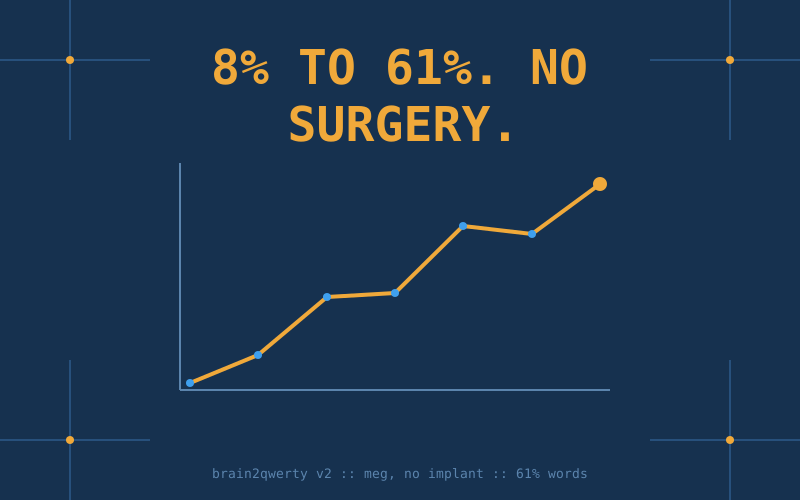
Meta just published Brain2Qwerty v2, a deep-learning pipeline that reads brain activity and reconstructs the sentences a person is typing, without cutting open anyone's skull. It hits 61% word accuracy on average and 78% for the best participant, a leap from the roughly 8% word accuracy that prior non-invasive methods managed. The work, published in Nature Neuroscience by Meta AI and the Basque Center on Cognition, Brain and Language, ships with open training code for v1 and v2 under a non-commercial license. The honest catch: it reads brains with a magnetoencephalography (MEG) scanner, a room-sized, magnetically-shielded machine that costs millions and weighs as much as a car. So no, you are not typing emails with your mind by Friday. But the accuracy curve just moved a lot.
Why a Builder Should Care About a Neuroscience Paper
Because the interesting part is not the neuroscience, it is the recipe. Reading language out of brain activity used to be the domain of invasive implants: electrodes placed directly on or in the cortex (the approach behind most high-accuracy brain-computer interface demos you have seen). Those work well and require neurosurgery. The non-invasive alternative, sticking sensors outside the skull, has always been the safe-but-useless option, stuck near single-digit word accuracy because the signal is so smeared by the time it crosses bone and scalp.
Brain2Qwerty v2 closes most of that gap with the same trick that has been eating every other domain: throw out the hand-crafted signal-processing pipeline and learn end to end from raw data, then lean on a language model to clean up the mess. The brain signal is genuinely noisy, but a language model knows that "the quick brown fox" is far more probable than "thaquick brawn focks," and that prior does a lot of work. It is the autocorrect-on-steroids principle, applied to neural static instead of fat-finger typos.
How the Pipeline Works
There is no magic single network here, it is a small assembly line. Raw MEG signals go into a convolutional encoder that compresses the firehose of sensor data into useful features. A transformer models the temporal structure (what came before predicts what comes next, the same intuition that powers every LLM). A character-level language model then constrains the output toward text that is actually spellable, and a fine-tuned large language model adds the semantic context that nudges the decode toward sentences that make sense.
The data is the unglamorous heroine of the story. The team recorded nine volunteers, each for about 10 hours wearing a MEG cap while typing, producing roughly 22,000 sentences of paired brain-and-text data. MEG, importantly, beat EEG (the cheaper electrode-cap method) by at least 2x back in v1, because it picks up cleaner magnetic signatures of neural activity. Cleaner input, better decode.
The Number That Should Make You Sit Up
Meta reports that decoding accuracy improves log-linearly with data volume. In plain terms: every time you multiply the training data, you get a roughly constant bump in accuracy. That is the same scaling shape that turned language models from party tricks into products, and it is the line in this paper that matters most. It implies the remaining gap to surgical implants might be closeable with more recording hours alone, no architectural miracle required.
That is a genuinely big "if true," so hold it loosely. Nine participants in a controlled lab is a long way from a population, and a log-linear curve eventually meets a ceiling somebody has not found yet. But if the trend holds even partway, the strategic picture flips: the path to a usable non-invasive interface becomes a data-collection problem, the kind of thing that is expensive and tedious rather than scientifically blocked. Builders know which of those two is easier to throw resources at.
The Caveats, Straight
Three things keep this in the lab for now. First, the hardware: MEG is not a wearable. It is a cryogenically cooled scanner inside a shielded room, and the subject has to hold their head still inside it. Nobody is mind-typing on the bus with this. Second, the 61% average means a 39% word error rate, which is still well short of invasive implants and short of anything you would want narrating your private thoughts unsupervised. Third, the participants were healthy volunteers actively typing, not the patients with paralysis or brain lesions who are the eventual point of this research, and decoding intended-but-unexecuted typing is a harder problem the paper does not solve.
And the obvious one, since someone always asks: this reads deliberate typing, not your inner monologue, and it needs ten hours of your cooperation in a multimillion-dollar magnet first. The dystopia is not at the door. The research milestone, though, is real.
What's Actually Shipping
For builders and researchers, the tangible artifact is the code: full training pipelines for both v1 and v2, released under CC BY-NC 4.0 (non-commercial, so read the license before you get ambitious). The v1 Spanish dataset from BCBL is on Hugging Face; the v2 dataset is embargoed until publication clears. You will need MEG recordings to do anything with the training code, which most people do not have lying around, but the architecture and the recipe are now public, and the convolutional-encoder-plus-transformer-plus-LM pattern generalizes well beyond brains.
Key Takeaways
- The release: Meta's Brain2Qwerty v2, a non-invasive brain-to-text pipeline, published in Nature Neuroscience with open v1 and v2 training code.
- The result: 61% average word accuracy (78% best participant) from MEG scans, up from roughly 8% for prior surgery-free methods.
- The method: end-to-end deep learning (conv encoder, transformer, character-level LM) plus a fine-tuned LLM for semantic context, instead of hand-built signal pipelines.
- The scaling clue: accuracy improves log-linearly with data, hinting the gap to surgical implants could narrow through more recordings alone.
- The reality check: MEG is a room-sized, multimillion-dollar machine, the error rate is still 39%, and subjects were healthy volunteers, not the patients this is meant to help.
- Why it matters: the recipe and code are public, and the problem just shifted from "scientifically stuck" toward "needs more data."
Sources: Meta AI blog, Nature Neuroscience, Brain2Qwerty on GitHub, MarkTechPost