Nikkei Found $1.65 Trillion in AI Debt Hiding Off Big Tech's Books
TL;DR
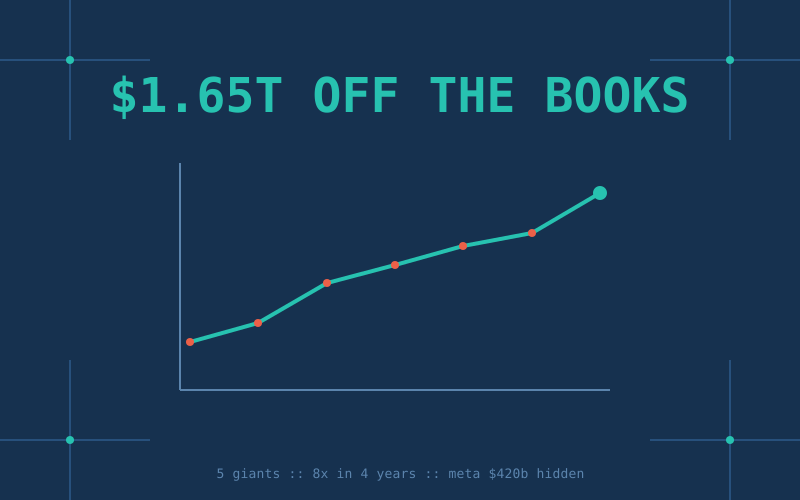
Nikkei went through the financial statements of five U.S. tech giants, Alphabet, Microsoft, Amazon, Meta, and Oracle, and added up the AI-related commitments that do not appear on their balance sheets: data center leases that have not started yet and multi-year GPU and server contracts for hardware that has not been delivered. The total came to $1.65 trillion, an eightfold increase in roughly four years.
For scale: the same five companies report about $1.35 trillion of actual debt. The obligations you cannot see on the balance sheet are now larger than the ones you can. The footnotes have become load-bearing.
What Nikkei actually counted
This is not a leak or an estimate pulled from a hedge fund deck. Nikkei's analysis, published July 21, is built from the companies' own disclosures: the contractual-obligation and commitment tables that sit in the footnotes of quarterly and annual filings, where lawyers put things that are binding but not yet, in accounting terms, debt.
Two categories dominate. First, long-term leases on data centers that are signed but not yet operational. Second, purchase obligations for GPUs and servers that are contracted but not yet delivered. Both are real, multi-year, committed spending. Neither lands on the balance sheet until the lease commences or the hardware ships.
How $1.65 trillion hides in plain sight
None of this is fraud, and none of it is even unusual accounting. Under lease rules like ASC 842, a lease only gets capitalized onto the balance sheet when it commences, meaning when you actually take possession of the building. A data center you signed a 15-year lease on last quarter, but that finishes construction in 2028, is a footnote today. The same logic applies to purchase obligations: a contract for GPUs arriving over the next three years is disclosed, not booked.
Think of a lease you signed on an apartment you have not moved into yet. Your bank statement looks untouched and your credit report is clean, but the next five years of your income are already spoken for. Now multiply that by a few hundred data centers and several million accelerators.
The consequence is that the standard leverage metrics investors screen on, debt to equity, net debt to EBITDA, are quietly missing the majority of the AI buildout's committed cost. The spending is disclosed, but you have to go digging in the commitments footnotes and add it up yourself. Which is exactly what Nikkei did.
Meta is at 2.8x. Oracle grew 30-fold.
The aggregate hides how uneven this is. Meta's off-balance-sheet obligations stand at roughly $420 billion, about 2.8 times the debt it actually reports. Oracle's hit $273.3 billion as of the end of May, more than 30 times its level four years earlier. A 30x-in-four-years growth curve is the kind most startups would kill for, just preferably not in deferred liabilities.
Oracle's number is the least surprising once you remember what its AI business is: leasing enormous amounts of data center capacity to train and serve other people's models, with the buildout contracted years ahead of the revenue. Meta's is a pure bet on itself, capacity for models it has not trained yet.
The ratings desks noticed first
This is not just a journalist with a spreadsheet. Morgan Stanley has flagged the growth in data center lease contracts as a major risk factor in investor research, and Moody's has warned that the expansion of pre-operation lease commitments could increase these companies' financial burdens. The Bank for International Settlements spent part of its June annual report worrying about how much of the AI capex wave is debt-financed.
The pattern rhymes with every capex supercycle: the obligations are assumed at the peak of confidence, and they come due on a schedule that does not care whether the demand forecasts held up.
Why you should care if you just rent GPUs
You do not own Oracle stock (probably). But if you build on rented compute, this number is upstream of your bill in both directions:
- Capacity is coming regardless of demand. These are contracts, not plans. If AI demand softens, the GPUs and the halls still arrive on schedule, which historically ends in a glut and cheap spot capacity. That is the good scenario for you.
- Or your prices service the debt. The alternative is that committed costs get pushed into cloud pricing. The recent 20% hikes on reserved GPU capacity suggest the providers are not planning to eat it.
- Counterparty risk is now a real input. If your inference vendor's obligations are 30x what they were four years ago, its pricing stability and long-term viability belong in your vendor evaluation, next to tokens per second.
- The bubble debate finally has a denominator. "Is AI capex sustainable" was vibes. Now there is a committed-obligation figure, $1.65 trillion, to hold revenue up against, and you can recompute it every quarter from the same footnotes Nikkei used.
The caveats, straight-faced
Be precise about what this is not. It is not hidden in the criminal sense: every number Nikkei used is publicly disclosed, and treating pre-commencement leases and undelivered purchase obligations this way is standard accounting applied to every company. It is also not all debt-equivalent: some commitments have exit clauses, some purchase obligations flex with delivery schedules, and these five companies generate operating cash flow at a scale that makes the numbers survivable in most scenarios.
The story is the trajectory and the asymmetry: an eightfold jump in four years, concentrated in assets that depreciate fast (GPUs) and buildings that only pay off if demand keeps compounding, while the headline leverage metrics most investors screen say everything is fine.
Key Takeaways
- Nikkei's July 21 analysis puts AI-related off-balance-sheet obligations at Alphabet, Microsoft, Amazon, Meta, and Oracle at $1.65 trillion, up eightfold in roughly four years.
- That exceeds the $1.35 trillion of debt the five companies actually report, by about $300 billion.
- The obligations are mostly data center leases that have not commenced and GPU/server contracts not yet delivered, disclosed in footnotes but absent from standard leverage metrics.
- Meta carries about $420 billion off books, roughly 2.8x its reported debt; Oracle's $273.3 billion is more than 30x its level four years ago.
- Morgan Stanley, Moody's, and the BIS have all flagged the pattern; the commitments come due whether or not AI demand keeps up.
- For builders, this is the upstream of your GPU bill: it either ends in a capacity glut and cheap compute, or in cloud pricing that services these obligations.
Sources: Nikkei Asia, Telecompaper, Seoul Economic Daily