Japan Bought 27,500 GPUs for a Robot Brain That Stops at the Border
TL;DR
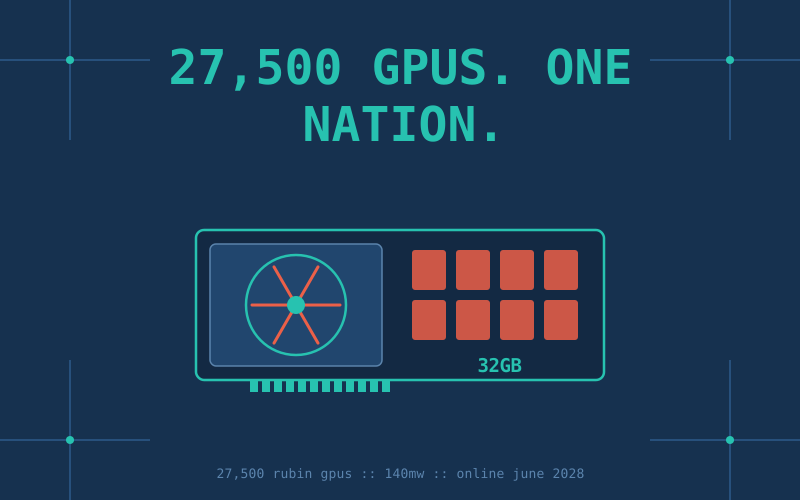
At a Tokyo event on July 16, Nvidia, Japan's industry ministry METI, and the SoftBank-led Noetra consortium announced what Nvidia is calling the world's first national AI infrastructure: a single AI factory built on 27,500 Rubin GPUs and 13,750 Vera CPUs, delivering 140 megawatts of capacity for Japan's FRONTia Project, the government program to build multimodal foundation models for robots and physical AI. The same day, Fanuc, Yaskawa, Fujitsu, and Kawasaki Heavy Industries joined Nvidia's physical-AI coalition. The part builders should read twice: the pretrained weights will be "made broadly available," but to domestic model developers and enterprises. Open weights now come with a passport check.
The Order: A Country as a Single Customer
Two weeks ago Japan committed up to 1 trillion yen to Noetra, the SoftBank, NEC, Sony, and Honda consortium building a physical-AI foundation model. Today we learned what the first tranche buys. Per Bloomberg, Noetra's 387.3 billion yen (about $2.4 billion) government grant funds a data center packed with 27,500 of Nvidia's next-generation Rubin GPUs, paired 2:1 with 13,750 Vera CPUs in Vera Rubin NVL72 racks on the NVIDIA DSX platform, wired with Spectrum-X Ethernet and BlueField DPUs.
Nvidia's press release calls it "the world's first national AI infrastructure," a superlative doing quite a lot of work given how many sovereign-AI deals Jensen Huang has signed this year. But the shape is genuinely new: not a cloud provider buying GPUs to rent out, but a state-chartered company buying them to train one national model family. Huang's framing: "Japan invented modern manufacturing. Now, it is building the AI factories that will power the next industrial revolution."
For scale, the same announcement day included two new RIKEN research supercomputers, RIKYU and ROQUO. They are rounding errors next to the Noetra machine.
The Robot Heavyweights Signed On
The compute is half the story. Per Reuters, Fanuc and Yaskawa Electric, two of the largest industrial robot makers on the planet, are partnering with Nvidia on physical AI, alongside Fujitsu and Kawasaki Heavy Industries. Bloomberg frames it as Japan's robot makers joining Nvidia's Cosmos coalition, the world-model and Isaac GR00T stack Nvidia has been assembling around robotics all year.
That matters because of what Fanuc and Yaskawa own: decades of real robot telemetry from automotive plants, electronics fabs, and logistics floors. The FRONTia thesis, like the Noetra funding announcement before it, is that this proprietary physical-world data is the moat no web crawl can cross. Huang put the sales pitch plainly at the Tokyo event: "With AI, robots will become smart, easily adaptable and accessible."
The wider ecosystem blast radius, per Nvidia's own roundup, includes Toyota building L2++ driver assistance on DRIVE AGX, Kawasaki developing surgical and nursing robots on Holoscan, and Mizuho standing up an on-prem DGX B200 AI factory. Nvidia has now managed to sell one country the picks, the shovels, the mine, and the geological survey.
The Timeline Has a Hole in It
Now the caveats, which are load-bearing. Per Honda's Noetra release, construction of the data center starts in April 2027 and operations begin in June 2028. Nothing announced today computes anything for almost two years.
Meanwhile Noetra's own model roadmap targets a reasoning foundation model with Japanese-language strength in fiscal 2026-2027, an omni-modal model (text, image, video, audio) in fiscal 2028, and a "Real-world Native AI" with spatial awareness around fiscal 2030. Japan's fiscal 2026-2027 ends in March 2028. Read those dates side by side: the first model is due before the factory that justifies the factory turns on. Early training will have to run on compute that already exists, presumably rented, which is a quietly funny footnote to a sovereignty project.
Open Weights, With a Passport
The most consequential line in the press release is about distribution, not silicon. The pretrained weights of Noetra's foundation models "will be made broadly available to domestic model developers and enterprises." Not on Hugging Face for the world. Domestic.
Think of it as a municipal library: genuinely free, genuinely open shelves, but you need a local address to get a card. The precise mechanism is unstated (license terms, a gated registry, or something softer), and staged external releases are promised as R&D progresses, so the border may end up porous. But the stated design is a national open-weights commons, and that is a new object in the ecosystem.
It also rhymes with what is happening one sea away. Beijing has been weighing restrictions on overseas access to its own open-weight models. The era when "open weights" implicitly meant "open to everyone on Earth" is ending on both sides of the East China Sea, and the wall is being built by the people releasing the models, not the ones banning them.
Why Builders Should Care
First, the sovereign-AI pattern is now Nvidia's flagship product, and this is its most complete expression: a government-chartered buyer, a national data moat, a 140MW factory, and a stated goal of over 30% of a global AI robotics market Nvidia's release sizes at $133 billion by 2040. Expect this template to be pitched to every G20 capital.
Second, if you build robotics or embodied AI, the stack just consolidated further. Fanuc and Yaskawa adopting Cosmos and Isaac GR00T means the training data, simulators, and deployment targets for industrial robotics are converging on one vendor's toolchain. Betting against that stack now means betting against the installed base.
Third, watch the weights-with-borders precedent. If national funds keep buying "open" models that are only open inside the funding jurisdiction, the global open-weights commons you currently take for granted (Qwen on your homelab, GLM in your harness) starts to look like a policy accident rather than a stable equilibrium. Plan accordingly.
Key Takeaways
- Nvidia, METI, and Noetra announced a national AI factory: 27,500 Rubin GPUs, 13,750 Vera CPUs, 140MW, on Vera Rubin NVL72 racks with Spectrum-X and BlueField.
- It is funded by a 387.3 billion yen (~$2.4B) government grant to Noetra, the SoftBank, NEC, Sony, and Honda consortium backed by 44 companies.
- Fanuc, Yaskawa, Fujitsu, and Kawasaki Heavy joined Nvidia's physical-AI push, folding the world's densest industrial-robot data into the Cosmos and Isaac GR00T stack.
- Construction starts April 2027 and operations begin June 2028, yet the first reasoning model is due by March 2028: early training must happen on existing compute.
- Pretrained weights will be "broadly available" to domestic developers only. Open weights are acquiring borders, in Japan by design and in China by restriction.
- Japan's stated target: over 30% of a $133B global AI robotics market by 2040.
Sources: Nvidia press release (GlobeNewswire), Honda/Noetra press release, Bloomberg (Rubin purchase), Bloomberg (robotics coalition), Reuters, Nvidia Japan ecosystem blog