Watches Everything, Stores Nothing: OpenAI's Answer to Anthropic's 30 Days
TL;DR
On August 19, OpenAI committed to keep offering Zero Data Retention for frontier-model API traffic and previewed Private Safety Processing, an automated system meant to catch misuse patterns that span multiple related interactions without retaining customer data and without letting OpenAI personnel read any of it. When the system fires, OpenAI receives what it calls a narrowly defined safety signal about the type of activity, not the prompts or outputs themselves. Early customers are testing it now; a broader rollout and a technical white paper are promised for September. The subtext is not subtle: since June 9, Anthropic has retained 30 days of prompts and outputs for its covered models, Claude Fable 5 and Mythos 5, and that policy overrides zero-data-retention agreements. The two frontier labs are now running opposite answers to the same question, and enterprises in regulated industries get to pick a side.
What OpenAI actually announced
The announcement has two halves. The first is a recommitment: Zero Data Retention, the arrangement where eligible API customers' prompts and responses are not stored after a request is processed, stays available for frontier models. Under ZDR, customer content is not available to OpenAI staff for review, and per OpenAI's enterprise privacy terms, business data is not used for training unless a customer opts in. Per Axios, OpenAI also says customer data can stay on customer-controlled infrastructure entirely, or sit with OpenAI under encryption keys the customer holds.
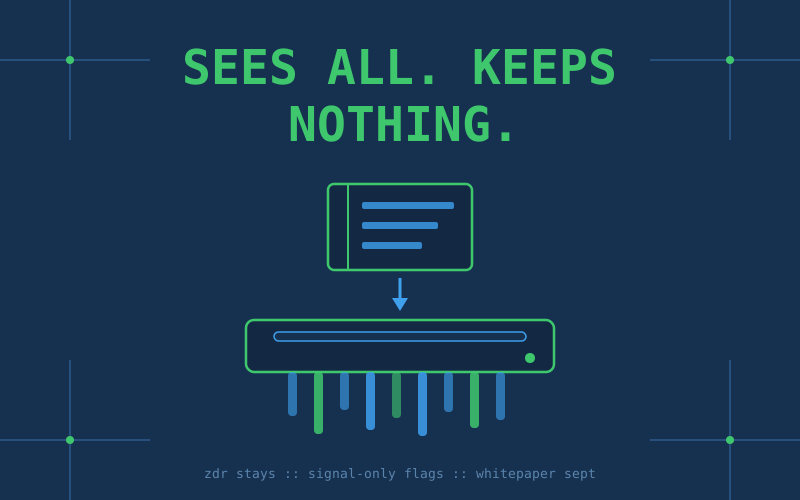
The second half is the new thing. As agents run longer and more autonomously, the interesting abuse no longer lives inside a single request: it is spread across sessions, each of which looks innocent on its own. Anthropic's answer to that problem was retention. OpenAI is claiming it can get the same visibility with none of the storage, via Private Safety Processing.
How you police misuse without keeping the evidence
Per TechCrunch, Private Safety Processing runs automated analysis over related interactions to identify misuse patterns, with no human review of the underlying conversations. If a pattern trips a threshold, the system emits a narrowly scoped signal to OpenAI describing the category of suspected activity, and nothing else. Customers can voluntarily share more context with OpenAI if they choose to; nothing is exposed by default.
It is the difference between a security camera and a smoke detector. The camera keeps footage that someone can later pull and rewatch; the detector stores nothing at all and just yells when a specific pattern crosses a threshold. OpenAI is betting that a smoke detector is enough to run a safety program on, even for its most capable models.
The policy OpenAI is positioning against
None of this makes sense without the June backdrop. Anthropic's covered-models policy, effective June 9, 2026, retains prompts and outputs for 30 days on Mythos-class models, on every platform where they are offered, AWS Bedrock and Google Cloud included. Existing zero-data-retention agreements do not extend to that tier: organizations with ZDR contracts must enable retention to use Fable 5 at all. Anthropic frames it as safety-only, with no staff access by default, a controlled review path when its automated systems flag content, and every access recorded in a tamper-proof log. Data auto-deletes at day 30 unless it has been flagged or is under legal hold, and for flagged content the policy states no ceiling.
Neither position is lazy. Anthropic's argument is that models capable enough to matter for national-security-adjacent misuse need retained context to investigate sophisticated, multi-session abuse, and it has wrapped that retention in real controls. OpenAI's argument is that the investigation can be done by machines in the moment, so the archive never needs to exist. TechCrunch reports the Anthropic policy has deeply concerned enterprises handling sensitive data, which is exactly the audience OpenAI published this post for.
Why builders should care
If you are building on frontier models in medicine, law, or finance, retention windows are not an abstraction: they are the difference between an architecture your compliance team signs off on and one it does not. HIPAA counsel and attorney-client privilege do not care how tamper-proof the reviewer log is; they care whether a third party holds the transcript at all. As of this week, the two leading closed-model vendors give you structurally different answers at the top capability tier, which makes data handling a real selection criterion rather than a checkbox both vendors tick.
There is also the subpoena math. Data that exists can be compelled: in January, a federal judge affirmed an order for OpenAI to hand plaintiffs 20 million de-identified consumer ChatGPT logs in the New York Times copyright litigation. OpenAI is happiest telling you about the data it does not keep, while a court spent January discussing the tens of billions of consumer logs it very much does. The honest lesson cuts in OpenAI's favor on the API side, though: ZDR traffic that was never stored is the one thing a discovery order cannot reach.
Two practical footnotes before you re-architect anything. ZDR at OpenAI is gated, negotiated through sales for eligible API customers, not a toggle in the dashboard. And Private Safety Processing is a preview: the thing that would let outside researchers evaluate the privacy claims, the technical white paper, does not exist yet. Until it lands, trust us, it is private is doing the load-bearing work, a sentence with a mixed track record in this industry.
Caveats, straight-faced
- Private Safety Processing is in testing with early customers. The September rollout and white paper are plans, not shipped artifacts, and the technical mechanism has not been independently evaluated.
- What exactly a narrowly defined safety signal contains has not been specified publicly. The privacy guarantee lives or dies in that definition.
- OpenAI's ZDR has always required eligibility approval, and nothing in this announcement changes who qualifies.
- Anthropic's retention policy has stated safeguards: default no human access, approved reviewers only, tamper-proof access logs, automatic deletion at 30 days absent a flag or legal hold. This is a disagreement about method, not a morality play.
- Zero retention is not zero risk. Prompt data still transits and is processed by the vendor; ZDR governs storage, not the request itself.
Key Takeaways
- OpenAI committed on August 19 to keep Zero Data Retention available for frontier models and previewed Private Safety Processing, automated cross-interaction misuse detection that stores nothing.
- When it detects a pattern, OpenAI gets a narrowly defined signal about the activity type, with no access to prompts or outputs; customers choose whether to share more.
- Broader rollout and a technical white paper are slated for September; until then the privacy claims are unverifiable.
- The contrast target is Anthropic, which since June 9 retains 30 days of prompts and outputs for Fable 5 and Mythos-class models, superseding ZDR agreements on every platform.
- For regulated-industry builders, frontier vendor choice now includes a structural data-handling difference: zero retention with machine-only monitoring versus 30-day retention with audited human review.
- Retained data is subpoenable data: a court ordered 20 million consumer ChatGPT logs produced in January. What is never stored cannot be compelled.
Sources: OpenAI announcement, OpenAI on X, TechCrunch, Axios, Anthropic Help Center, Bloomberg Law