OpenAI Overtakes Anthropic in OpenRouter Spending for the First Time Since 2024
TL;DR
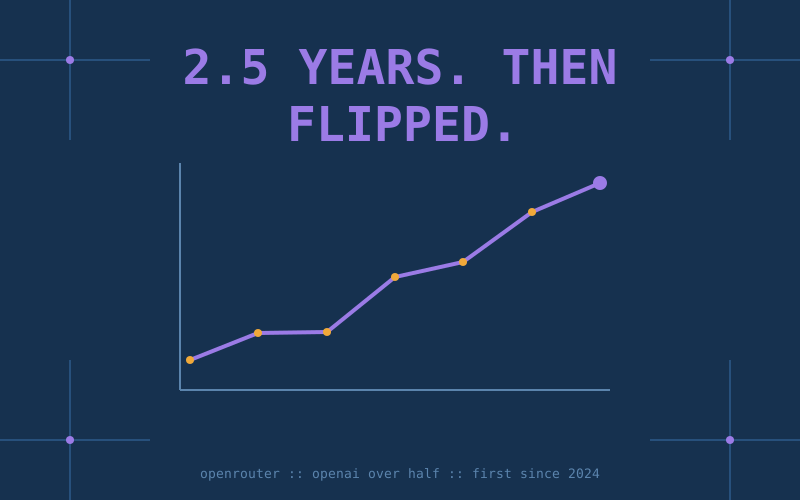
For two and a half years, one fact about developer AI spending held steady: when people paid per token on OpenRouter, most of the money went to Anthropic. In the week of September 7, 2026, that stopped. OpenAI models took just over half of the combined dollar spend between the two labs, the first such week since February 26, 2024. A second, completely unrelated dataset, Ramp's corporate card index, points the same way. And on September 14, Claude Code weekly limits fell 17%. Three signals, three sources, one direction.
What actually flipped
The number comes from OpenRouter's own weekly wallet-share data, the chart that tracks dollars rather than tokens. Through most of 2024 and 2025, Anthropic sat in the 75-80% range of the two-lab pool, which is a boring way of saying it was not close. By the week of August 10, 2026, that had slid into the high 50s. Four weeks later it went under half.
The breakdown of the chart credits two things. OpenAI's GPT-5.6 line, split across Luna, Terra and Sol, climbed steadily through July. Then GPT-6 Astra landed and, by that reading, took roughly 19% of all spend on the platform by itself.
Why dollars and not tokens
This distinction matters more than it sounds. Token share counts how many drinks got poured. Wallet share counts what the bar actually rang up. A cheap open-weight model can rack up enormous token counts and move almost no money, so the two charts routinely disagree.
The methodology behind the wallet-share work is public. Nosey Parker Research, which has been tracking this series, pulls daily per-model token counts off OpenRouter and multiplies them by list pricing to get spend. Anthropic's models carry premium prices, so losing wallet share is a sharper signal than losing usage share: it means paying customers moved, not just free-tier tire-kickers.
The same analyst was blunt about the caveat back when the chart still pointed the other way and had Anthropic at 67.2% of wallet. OpenRouter is "a small slice of the total market," but it captures "the most price-sensitive, least loyal audience in AI." That is a fair description of both the platform's weakness as a proxy and its value as an early-warning system. These are the users who switch first because switching costs them a config line.
The second dataset says the same thing
If this were only OpenRouter, it would be a curiosity. It is not. Ramp, which sees corporate card spend across tens of thousands of US businesses, publishes a monthly AI index, and its September edition from chief economist Ara Kharazian tells a compatible story from a completely different vantage point.
In August, Anthropic still led on the headline metric: 43.8% of US businesses paying for AI subscriptions or tokens used Anthropic, against 39.8% for OpenAI. Anthropic was up 0.34 points month over month, OpenAI up 0.09. That is a lead, but it is a lead measured in rounding errors.
At the model level, Ramp's read is harsher for Anthropic. Per Kharazian's mid-September update, Astra pulled ahead of Claude Fable on enterprise takeup within roughly two weeks of launch, despite Fable arriving with the stronger benchmark story. Benchmarks are a press release. Card spend is a decision someone had to defend.
The part nobody in the spend fight wants to say out loud
Ramp's index also carries a fact that quietly undermines every wallet-share chart, including the one at the top of this post. The effective price per million tokens has fallen 41% from its March 2026 peak of $1.15 to $0.68. Frontier models accounted for 45% of token share in the latest reading, down from a 53% peak in August, as buyers moved work onto cheaper standard models.
Median monthly AI spend per employee among the top 1% of spenders dropped 9.7%, from $7,976 to $7,205. If prices are collapsing and buyers are trading down, a dollar-denominated market share chart is measuring two things at once: who won the customer, and who happened to be more expensive that week.
The 17% that is also a 25% increase
One week after the OpenRouter flip, Anthropic tightened the thing its heaviest developer users care about most. Its own support page lays out the timeline plainly: from May 13 through September 13, 2026, the weekly usage limit in Claude Code was 50% higher than normal. From September 14, limits are 25% higher than they were before the promotion started.
Both numbers are true, which is rather the point of having two of them. Measured against the pre-promotion baseline it is a permanent 25% increase. Measured against what you had last Sunday it is a cut, and Anthropic said so itself in the announcement quoted by implicator.ai: "Compared to today, this works out to a 17% reduction in weekly limits on Claude Code." It applies to Pro, Max and Team plans, plus legacy seat-based Enterprise users.
Resist the causal story
The tempting narrative is that Anthropic squeezed Claude Code and developers walked. The dates do not support it. The OpenRouter crossover happened in the week of September 7. The limit change landed September 14. The money moved before the cut, not after.
The end date was published in advance, so heavy users could see it coming, but the cleaner reading is that the cut arrives into a market that was already moving, which is the worse position to be in. Anthropic's stated reason across this year's limit changes has been the same one everybody has: not enough compute to keep the generous number permanent.
Two more caveats before anyone declares a winner. OpenRouter is one marketplace, and a small, unusually mobile one. And the flip is a single week, not a trend line: Anthropic's share has bounced before, including a partial recovery after the August dip.
What to do with this
- Stop hardwiring one provider. The reason this crossover was even possible is that switching on OpenRouter costs a config change. If your production stack cannot do the same, you are paying a loyalty premium you never agreed to.
- Budget against the promo, not the baseline. Anyone who sized a Claude Code workflow against summer limits is now 17% short. Temporary capacity boosts are marketing, and they expire on the vendor's schedule.
- Watch token prices, not spend share. With effective prices down 41% since March, dollar-share charts flatter whoever is most expensive. Measure your own cost per completed task instead.
- Treat OpenRouter as a leading indicator, not a verdict. Its users churn first because churning is free for them. That makes the chart early, not authoritative.
Key Takeaways
- In the week of September 7, 2026, OpenAI models took just over half the combined OpenAI and Anthropic dollar spend on OpenRouter, the first time since the week of February 26, 2024.
- Anthropic sat at 75-80% of that pool through most of 2024 and 2025, slid to the high 50s by the week of August 10, then went under half.
- Ramp's independent corporate card data has Anthropic at 43.8% of paying US businesses in August against OpenAI's 39.8%, a four-point gap moving by fractions a month.
- Claude Code weekly limits dropped 17% against the promotional level on September 14, which is also a permanent 25% increase on the pre-May baseline. Both framings are accurate.
- The spend flip predates the limit cut by a week, so the cut did not cause it.
- Effective token prices are down 41% from March's $1.15 peak to $0.68, which makes any dollar-based market share chart partly a pricing artifact.
Sources: OfficeChai, OpenAI Surpasses Anthropic On OpenRouter Spend For First Time In 2.5 Years, Nosey Parker Research, OpenRouter and Vercel AI: Market Share by Cash, Nosey Parker, Anthropic Annihilates Open Models On OpenRouter, Ara Kharazian, September 2026 Ramp AI Index: Cracks in the AI thesis, part 2, Ramp AI Index, OfficeChai, Enterprises Are Spending More On OpenAI's Astra Than Anthropic's Fable, Says Ramp Data, Anthropic Support, Claude Code May-August 2026 Weekly Limits Promotion, implicator.ai, Anthropic Cuts Claude Code Weekly Limits 17% on Sept. 14, OpenRouter Rankings