The Ponytail Plugin Writes 94% Less Code. It Does Not Save 94% of Your Tokens.
TL;DR
Ponytail is a Claude Code plugin (also a skill for Codex, Copilot, and others) that makes your agent behave like the laziest senior dev in the room: do not over-build, reuse what exists, prefer stdlib, write the fewest lines that work. The marketing says 94% less code and up to 77% lower cost. Its own more careful benchmark on a real repo says 54% less code but only 22% fewer tokens. That gap is the whole story: cutting the code you write does not cut your bill by the same amount, because writing code is a small slice of where agent tokens actually go.
What ponytail actually is
Built by DietrichGebert and sitting at around 50,000 GitHub stars, ponytail is a small ruleset you install that forces the agent down a "laziness ladder" before it writes anything: skip the code entirely if you can (YAGNI), reuse an existing pattern in the repo, use a stdlib or native feature, lean on a dependency you already have, write a one-liner, and only then build something new. The canonical example: ask for a date picker and a normal agent installs a library, writes a wrapper component, adds a stylesheet, and starts a thread about timezones. Ponytail writes 23 lines.
It ships intensity levels (/ponytail lite | full | ultra | off) plus useful audit commands: /ponytail-review scans your current diff for over-engineering and hands back a delete-list, and /ponytail-audit does the same across the whole repo. As a "stop gold-plating" default, it is genuinely handy.
The marketing number vs the measured number
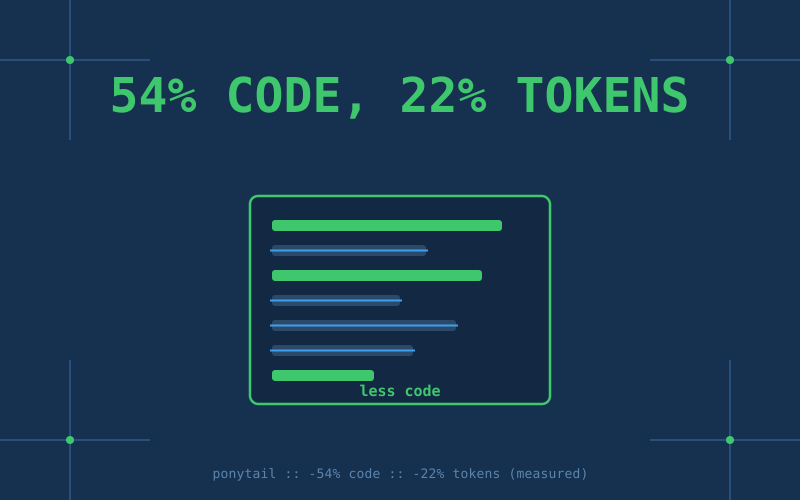
The viral figures come from single-shot tests: feed a prompt, count the lines, and ponytail produces 80 to 94% fewer than baseline. The catch, which the authors themselves flag, is that the baseline in those tests was padded with prose, which inflates the delta. Their more defensible result is an agentic benchmark: real Claude Code sessions on a FastAPI and React repo, 12 feature tasks, four runs each. That is the chart above: 54% less code, 22% fewer tokens, 20% lower cost, 27% less time, and safety held at 100% on adversarial tests. Credit where due, the team publishing the smaller, honest number next to the flashy one is rare.
So the answer to "how many tokens do you really save" starts at about 20% on a real, over-building-prone project, not 94% and not half.
Why lines saved is not tokens saved
This is the part the headlines skip. In an agentic coding session, the tokens you pay for are dominated by input, not the code the model emits: the system prompt, the tool definitions, every file the agent reads, every tool result it gets back, and the running conversation history, plus the model's own reasoning. The code it actually writes is a minority of the total. Halve that minority and the total only moves a fifth.
Three things drag the real savings below the line-count savings:
- Reading dwarfs writing. The agent spends most of its tokens looking at your repo and tool output. Ponytail does not shrink that.
- Ponytail costs tokens too. The skill's instructions and its plan-before-you-code step add input and reasoning tokens on every task, an overhead that eats into the gains, especially on small jobs.
- No over-build, no savings. The authors are explicit: the cut is huge where there is a real over-build trap (a 404-line color picker becomes 23) and "near zero on code that is already minimal." On a lean codebase you may save almost nothing.
It depends heavily on your model
The savings are not a fixed property of the plugin, they scale with how verbose your model is. A more capable, chattier model over-builds more, so ponytail has more to claw back. One third-party evaluation put cost savings around 20 to 25% on Haiku 4.5 but roughly 53% on Opus 4.8, because Opus tends to recreate from scratch things that already exist.
Treat that 53% as directional, it is one evaluator with limited methodology, but the direction is believable: the more your model loves to gold-plate, the more a laziness skill is worth.
The honest verdict
Budget for roughly 20% token savings on real projects, more if you run a verbose model or your tasks invite over-engineering, close to nothing if your code is already tight. The 94%-less-code and half-the-cost banners are real only as best-case, output-only, single-shot numbers. The deeper truth is that ponytail mostly encodes discipline you could prompt yourself: "use the simplest solution, reuse what exists, add no new dependencies." If you already prompt that way, the gain is small. If you do not, it is a near-free default, and the review and audit commands are worth installing on their own. Just do not put "cut my Claude bill in half" in the budget.
Key Takeaways
- Real token savings are about 20%, not 94%. Ponytail's own agentic benchmark: 54% less code, 22% fewer tokens, 20% lower cost.
- Lines saved is not tokens saved. Most agent tokens are input (reading files, context, tool results), so halving the code you write only dents the total.
- It adds overhead. The skill's instructions and planning step cost tokens, which is why tiny or already-lean tasks save little or nothing.
- Savings scale with model verbosity. Roughly 20 to 25% on Haiku, around 53% on Opus in one test, because chattier models over-build more.
- Still worth it as a default. It encodes YAGNI discipline for free, and the diff and repo over-engineering audits are genuinely useful, even if the headline numbers are not.
Sources: ponytail on GitHub (project and benchmarks), Ponytail for Claude Code: Hype or Real Savings? (skeptical review), Alphamatch: the AI coding skill that saves tokens by writing less code