Llama Made Open Weights Mainstream. Qwen Gets 9x the Downloads.
TL;DR
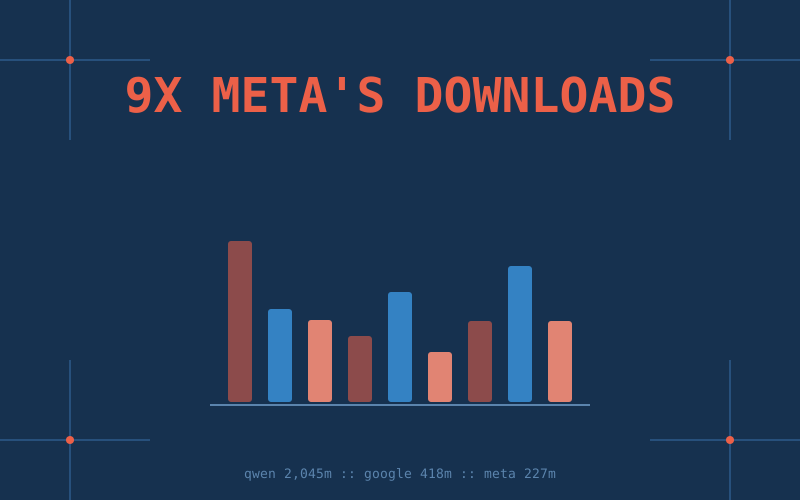
Qwen, Alibaba's open-weight model family, pulled 2,045 million downloads on Hugging Face so far in 2026, against 418 million for Google and 227 million for Meta. That comes from the Hub's own State of Open Models: Summer 2026 report, published August 14. A day later Alibaba added its own number: 3 billion downloads globally in six months, counting Hugging Face plus its in-house ModelScope hub. Pick either figure and the ordering holds. The company that turned open weights into a mainstream engineering choice with Llama now sits about nine times behind the leader in its own genre.
The scoreboard
The Hugging Face report covers January through August 2026 and counts downloads across repositories that declare a parameter count. On that basis Qwen is not narrowly ahead. It is ahead of Google and Meta combined by more than 3x.
Moonshot is in that chart for contrast, not for shame. The report frames it as a portfolio strategy difference: Moonshot's frontier-only lineup recorded 37M downloads over the year, while Qwen's spread across every size class reached 2,045M. One lab ships the biggest thing it can build. The other ships the thing that fits on whatever hardware you already own, in nine different flavors of it.
About that 3 billion
Alibaba's own figure and the Hub's figure are not the same measurement, and you should not mix them. The 3 billion is company-reported, spans six months, and aggregates Hugging Face with ModelScope, where Alibaba is both the publisher and the landlord. The 2,045 million is a third party counting downloads on its own servers over seven months. Alibaba also says it has released more than 460 open-source models and that its ecosystem has produced over 300,000 derivative models. Treat the self-reported numbers as directionally real and the Hub numbers as the ones you can audit.
Derivatives are the part that compounds
Downloads are a flow. Derivatives are a stock, and they are the number that actually predicts next year. The report counts 151,448 Qwen-based derivatives on the Hub, which it puts at 2.6x Meta's total footprint and 4.7x the Llama repositories specifically. Google follows at 82,506. The third-largest publisher of derivatives is not a lab at all: it is Unsloth, a community account shipping quantized and fine-tuning-ready builds, many of which extend Qwen further.
This is the same dynamic that decides programming languages. Nobody picks a language on syntax; they pick the package registry they get to borrow from. Once 151,448 fine-tunes, quantizations and merges assume a Qwen tokenizer and a Qwen chat template, the cheapest next model for a solo builder to start from is another Qwen, and the flywheel spins itself.
The local-inference tell
If you run models on your own hardware, the more useful chart is GGUF pulls, the quantized format that llama.cpp, Ollama and LM Studio all consume. That is not enterprise procurement or a CI cache. It is people putting weights on a machine they own.
The report's own summary of how that workload has changed is worth quoting: "Local inference used to mean an 8B model on a laptop. It now means a trillion-parameter mixture-of-experts spread across a few consumer machines."
Nobody is downloading the big ones
Here is the finding that should recalibrate anyone reading launch-day benchmark charts for a living. Among models that declare a parameter count, models under 1B take 83% of all-time downloads, and everything above 100B takes 1%. Restrict to downloads accumulated in 2026 only and it barely moves: 3% of the volume goes to models above 70B.
Which reframes what Qwen actually won. It did not win by having the best model on any given Tuesday. It won by having a checkpoint at every size a real deployment needs, under a license most legal teams wave through, on the day you went looking.
What the number does not say
Downloads measure adoption, not quality. A download is a decision to try something, often by a script, sometimes by a CI runner pulling the same weights forty times a week. The report itself is careful about this, and so should you be: nothing here says Qwen beats Gemma or Llama on your eval set, only that far more people start from it.
Two caveats worth holding onto. Licensing across the Qwen line is not uniform, so read the card for the specific checkpoint you plan to ship rather than assuming Apache 2.0 across 460 models. And download counts are a hub-side metric that neither Alibaba nor Hugging Face audits for you.
One more line from the report is quietly the most consequential thing in it: "In almost every month of 2026, the largest and most performant open model from a Chinese lab was larger than anything an American lab released." The Hub is growing to match, from 2.43 million model repositories in January to 2.96 million in August. And the two organizations publishing the most new open models this year are AMD and Nvidia, which is either admirable vertical integration or the hardware vendors quietly deciding they had better seed the software themselves.
Key Takeaways
- Qwen hit 2,045M downloads on Hugging Face in 2026, against 418M for Google and 227M for Meta, per the Hub's Summer 2026 report published August 14
- Alibaba's separate claim is 3 billion in six months, self-reported and spanning both Hugging Face and its own ModelScope hub, so do not mix it with the Hub-only figures
- 151,448 Qwen derivatives now live on the Hub versus 82,506 for Google, which is the number that makes the lead self-reinforcing
- Local inference tracks the same way: 39.6M GGUF pulls a month for Qwen, 20.8M for Gemma, 7.5M for Llama
- Sub-1B models take 83% of all-time downloads and 100B-plus models take 1%, so frontier-size releases are a rounding error in actual pull volume
- Downloads are adoption, not quality: benchmark your own workload before treating the leaderboard as a recommendation
Sources: Hugging Face: State of Open Models, Summer 2026, Bloomberg via Yahoo Finance: Alibaba AI Models Hit 3 Billion Downloads, Passing Meta, Google, Free Press Journal: Alibaba's Qwen AI Models Cross 3 Billion Downloads, Qwen on Hugging Face