Snorkel AI Raises $350M at $3.5B After Its Data Service Grew 18x to a $375M Run Rate
TL;DR
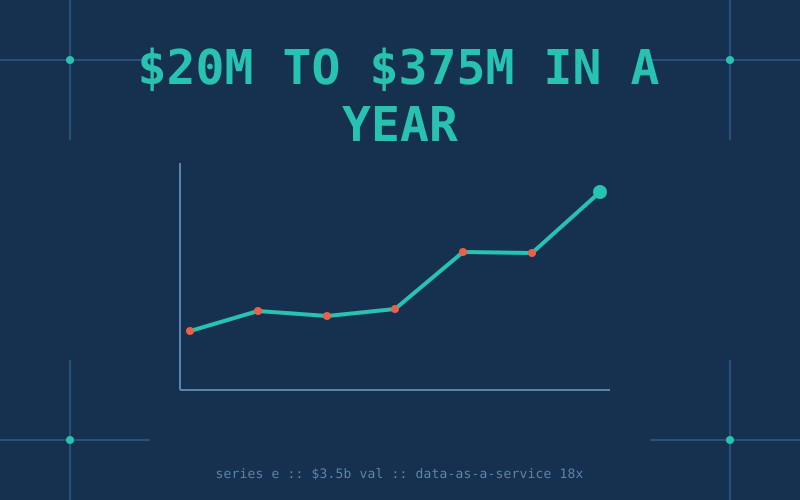
Snorkel AI announced a $350M Series E on September 22 at a $3.5B valuation, co-led by Insight Partners and S32. The number that matters is not the round. It is the business underneath it: about a year ago Snorkel stopped mainly selling data-labeling software and started selling finished datasets and reinforcement-learning environments. CEO Alex Ratner says that data-as-a-service line has grown more than 18x and crossed a $375M annualized revenue run rate this week. Reuters puts the year-ago figure at roughly $20M. And Snorkel went out of its way to tell TechCrunch that its expert payments sit in cost of goods sold, a not-so-subtle shot at rivals whose headline revenue includes money that flows straight through to contractors.
The round
Per the official press release, Insight Partners and S32 led, with new money from Third Point Ventures, March Capital, Blumberg Capital, Allegis Capital, Standard and Frontline. Existing backers Addition, Greylock, Lightspeed, GV, Factory, Prosperity7, Walden Catalyst and Wells Fargo also came back in.
The last price tag was $1.3B, set by a $100M Series D in May 2025 led by Addition. So the valuation roughly tripled in about 16 months. Reuters reports the company expects to be profitable this year and will spend the money on researchers and engineers, enterprise and government expansion, and third-party model evaluations.
The pivot: from tooling to finished goods
Snorkel came out of the Stanford AI Lab in 2019 with a research program on programmatic labeling: write labeling functions, let the software combine the noisy votes, skip a lot of hand annotation. It sold that as a platform. The company says its research has produced 250+ peer-reviewed papers and more than 25,000 citations, which is a strange thing to list in a funding release and also exactly why frontier labs take its calls.
The problem with selling the tool is that the labs buying the most data do not want a tool. They want the data, delivered, verified, and ready to train on. So Snorkel's Expert Data-as-a-Service became the main product. The company first announced the offering alongside its Series D in May 2025, and dates the real business launch to September 2025. It now builds datasets and RL environments with what Reuters describes as tens of thousands of specialists in fields like coding, law and medicine, with coding the biggest demand area.
Ratner's pitch is that this is "Data 2.0." In his telling, Data 1.0 was a volume and staffing problem: recruit a crowd, push tasks through it. Data 2.0 is a research problem, because the data that still moves frontier models is complex, specialized and hard to verify. His blog claims Snorkel's specialized quality-control agents deliver "50%+ acceleration in QC efficiency" and a "15+ accuracy point improvement" over humans working with an off-the-shelf LLM. Those are the company's own numbers with no public methodology, so file them under marketing until someone else measures them.
The real story: whose revenue is revenue
Here is the part worth your attention if you build or invest in anything with contractors inside it. The AI data market is full of big run-rate numbers. TechCrunch notes that Mercor's gross annualized revenue has climbed to $2B, Handshake hit $1B earlier this year, and Micro1 has scaled to $500M. On the headline, Snorkel's $375M is the smallest of the four.
Snorkel's counter, via TechCrunch: because it sells RL environments and complete datasets rather than human labor, payments to its experts are booked in cost of goods sold, not netted out of a gross figure that mostly belongs to someone else. TechCrunch adds that these marketplaces pay roughly 60% to 70% of their top line directly to the specialists doing the work, so their net revenue is "substantially lower" than the gross numbers.
Think of it as the difference between a restaurant and a food-delivery app. The restaurant pays its cooks and reports what diners paid. The app reports the whole order value, then hands most of it to the restaurant and the courier. Both are legitimate businesses. Only one of those top lines is mostly other people's money.
Do not over-read the chart
The net ranges above are simple arithmetic on a generic 60-70% payout estimate, not figures any of those companies has reported. Mercor, Handshake and Micro1 may have different take rates, and principal-versus-agent accounting is a judgment call auditors argue about for a living. Snorkel also has not published its gross margin, so you do not know how much of that $375M survives COGS either. The fair comparison is "Snorkel's number is less inflated by pass-through than a marketplace's gross," not "Snorkel is secretly the biggest."
There is also a small discrepancy to note: Reuters' exclusive reported a run rate above $350M, while Ratner's post, published the same day, says it crossed $375M that week. The company figure is the newer one.
Why the labs keep paying
Ratner's line to Reuters sums up the thesis: for the foreseeable future, "100% of the data that labs will get value out of will have some human input," and 100% of it will also need synthetic and automated approaches. His blog is sharper: data made with no humans in the loop is "tantamount to abdicating human oversight and alignment entirely."
You can read that as principle or as a data vendor explaining why you still need data vendors. Both readings can be true. What the numbers say is that the labs agree with the conclusion, at least with their wallets. Snorkel lists frontier labs, hyperscalers, neolabs, vertical AI companies, enterprises and US government agencies as customers, and every competitor named above has posted its own giant growth curve in 2026. Nobody is running out of demand for expert-verified coding traces and RL environments yet.
What this means if you are building a business
- Sell the artifact, not the hours. Snorkel's software business was a tool. Its service business is a deliverable with a price, and that is what grew 18x. If your customers want outcomes, packaging your tooling plus people as a product can be worth more than selling either alone.
- Your revenue definition is part of your pitch. Snorkel is using accounting as positioning. If you run a marketplace or anything with contractor pass-through, expect sophisticated buyers and investors to ask for net revenue before they take your gross seriously.
- Research credibility is a sales channel. A company that lists paper citations in a funding release is selling trust to buyers who cannot easily inspect quality. In markets where the product is hard to verify, reputation is the moat.
Key Takeaways
- Snorkel AI raised a $350M Series E at $3.5B, up from $1.3B in May 2025, co-led by Insight Partners and S32.
- Its data-as-a-service line grew more than 18x in about a year to a $375M annualized run rate, from roughly $20M.
- Snorkel books expert payments in cost of goods sold and argues rivals' gross run rates (Mercor $2B, Handshake $1B, Micro1 $500M) overstate net revenue.
- TechCrunch estimates those marketplaces pass 60-70% of the top line to specialists; Snorkel has not published its own gross margin.
- The QC efficiency and accuracy gains in Ratner's post are company claims without a published methodology.
- For builders: packaging people plus tooling as a finished product, and being precise about revenue definitions, is the transferable lesson.
Sources: Snorkel AI (Alex Ratner), Data 2.0 and the research era of AI data, Snorkel AI press release (PR Newswire), TechCrunch, Reuters via Yahoo Finance, Insight Partners, Snorkel AI Series D release (Business Wire, 2025)