Stack Overflow Survey: 55% of Daily AI Users Log 2+ Hours a Day, 7% Trust AI for Big Decisions
TL;DR
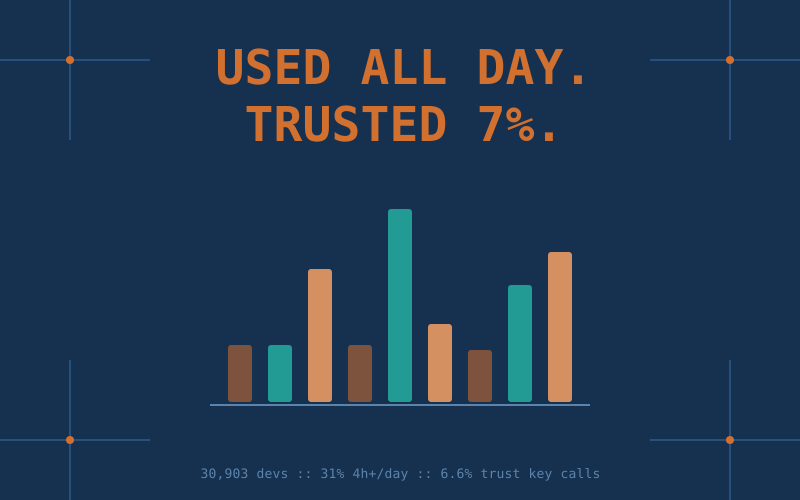
Stack Overflow's 2026 Developer Survey, its sixteenth, counts 30,903 valid responses from 169 countries, collected between June 23 and August 5. Among the 10,926 respondents who use AI daily, 55% spend at least two hours of their workday in it and 31% spend four or more. Yet only 6.6% trust AI output for important work decisions, 48% trust it only when they can easily verify it, and six in ten name a reason they avoid AI at work. Claude Code is the most used coding agent at 65.5%, ahead of GitHub Copilot at 58.7%, and Anthropic edges OpenAI on usage (74.6% to 74.3%) and by a wide margin on who wants to keep using it (60.5% to 41.5%).
Heavy use, thin trust
The results went live on October 6, and The Register put the headline numbers in front of a wider audience on October 10. Usage first: 65.9% of respondents use AI coding assistants or agents at work, 62.5% use general-purpose chat tools, 26.2% use agents or automated workflows, and 17.2% use no AI tools at all. Of those using coding assistants, 73% use them every day.
The hours question is where it gets stark. Daily users were asked how much of their workday they spend with AI tools. 30.9% said four or more hours, 24.1% said two to four, 25.3% said one to two, and only 7.0% said under an hour and not every day.
Then the trust question, asked of 14,304 respondents: "How much do you trust the output from AI tools or AI agents as part of your workflow?" The answers: 48.0% trust it when they can easily verify the output, 16.3% trust it for many tasks but not important work decisions, 16.3% trust it for low-risk tasks only, 12.3% do not trust it for most work tasks, and 6.6% trust it for many tasks including important work decisions.
Stack Overflow's own summary rolls the first four into "more than 87% have some level of trust in AI outputs, up from 31% last year." Treat that trend line with care. The 2025 survey asked about trusting the accuracy of AI on a highly/somewhat/distrust scale (33% trusted, 46% distrusted). The 2026 question is about conditions, not degree, so a developer who checks everything now counts as trusting.
Verification is the workflow
The conditional-trust number makes sense once you see what developers do next. Asked what they do after getting an AI answer (n=13,162, multi-select), 76.5% run it locally, 63.9% compare it against their codebase, 53.0% inspect tests or security implications, and 38.0% read the official docs. Only 9.6% use it as-is, and 6.9% ask a coworker.
It is the newsroom model applied to code. The model is the stringer who phones in copy fast; the developer is the desk editor who checks every fact and still puts their own byline on it. That is why 93% say citing sources is important when deciding whether to trust an AI technical answer (52% very important, 27% important, 14% somewhat).
On complex tasks, the verdict is mixed: 16.0% say AI handles them very well, 38.8% say good but not great, 16.0% say bad and 8.0% very poor. Over half of respondents, in other words, sit in "good but not great," which is exactly the zone where checking the output is the job.
Where it is used, and where it is not
By task (n=12,547), AI is most used for generating code in a familiar area (69.3%), debugging or refactoring (63.8%), answering straightforward technical questions (59.4%), writing tests (58.1%) and generating code in an unfamiliar area (56.0%). Production systems sit at 19.9%, with 36.0% saying they do not use AI there and do not plan to. Emails and summaries are at 23.5%, with 45.9% not planning to go there.
Usefulness tracks the same shape. Implementation is rated useful or very useful by 74.6%, debugging by 72.6% and documentation by 65.7%. Design gets 49.2% and communication 35.0%. Stack Overflow's results page describes those last two as "slop" territory, which may be the first time that word has appeared in an official survey writeup from a company that licenses its Q&A corpus to AI labs.
Claude Code at 65.5%, Anthropic edges OpenAI
Among the 12,255 respondents who used a coding agent in the past year, Claude Code leads at 65.5%, GitHub Copilot is at 58.7%, OpenAI Codex at 29.5%, Cursor at 25.5%, Google Antigravity at 16.0%, Gemini Code Assist at 14.6%, OpenCode at 13.6% and JetBrains AI at 12.8%. Windsurf (6.5%), Warp (5.2%), Cline (4.5%) and Pi (4.4%) trail.
The year-over-year comparison needs a caveat because the question changed. In 2025 the "out-of-the-box" list mixed chatbots and agents: ChatGPT 81.7%, Copilot 67.9%, Gemini 47.4%, Claude Code 40.8%. On that reading Claude Code gained roughly 25 points and Copilot lost about 9, directionally consistent with JetBrains' August research, which put Claude Code at 39% of all developers, a different base.
At the model-vendor level (n=11,895, "used for work in the past year"), Anthropic is at 74.6% and OpenAI at 74.3%, a statistical tie. Google AI is at 54.5%, Microsoft 26.4%, DeepSeek 18.9%, Alibaba Qwen 10.1% and Mistral 9.8%. The spread opens on the "admired" measure, the share of a vendor's users who want to keep using it next year: Anthropic 60.5%, OpenAI 41.5%, Google 44.5%, DeepSeek 43.6%, Qwen 52.5%.
Switching is common and driven by quality, not price. 33.7% have not switched tools; among the reasons given by those who did, 25.1% cite better output quality, 10.6% an organizational mandate, 7.4% better integration, and just 6.4% lower cost. Most developers run a small stack: 34.4% use two AI tools a week and 40.5% use three to five.
Further down the stack, the long tail is fragmented. Among 4,400 orchestration-framework users, LangChain leads at 30.2% and the OpenAI Agents SDK at 23.8%. In workflow automation (n=4,173), Make is at 38.9% and n8n at 32.7%. In agent memory (n=1,392), Mem0 leads at just 20.0%, and in observability (n=2,277) Sentry is at 26.0% ahead of LangSmith and Langfuse at 17.3% and 15.2%. No category below the coding agents has a clear winner.
Six in ten have a reason to avoid it
Asked why they avoid AI at work or school (n=13,857), 41.3% said they do not avoid it. The rest named a reason: 17.1% fear losing job skills or training their replacement, 15.2% have moral or ethical concerns, 13.0% cite privacy or security, 8.2% environmental concerns, and 2.6% a lack of training. Stack Overflow's summary: "6 out of 10 users cite a reason to avoid using AI at work or school."
Employers are mostly hands-off. 29.7% say AI use is optional and up to individuals, 24.0% have approved tools and guidance, 11.5% say it is expected for certain work, and 10.2% say it is measured in performance reviews. When choosing a model, 75% prioritize quality and 38% cost, and 38% of organizations limit usage.
The survey also quietly documents its host's own problem. 64% of respondents visit Stack Overflow less for simple questions because of AI, 69.9% now ask an AI agent when they hit a new challenge, and 16% say they visit more to check the sources behind AI answers, a figure the blog notes is down from last year. One more structural number: the share of respondents who are freelance or self-employed rose from 3.9% to 10.5% in a single year.
Caveats
- Self-selected sample. The survey was promoted through stackoverflow.com, the blog and an opt-in email list. 30,903 of 39,266 rows passed validity rules, and the methodology page mentions no weighting.
- Bases differ per question. Hours-per-day is among 10,926 daily users; trust is among 14,304 respondents; tool shares are among users of that tool category, not all developers.
- No clean trust trend. The 2026 trust question changed wording and scale from 2025, so "87% up from 31%" is not a like-for-like comparison.
- Fieldwork closed August 5. Tool and vendor shares predate the autumn model releases.
Key Takeaways
- 55% of daily AI users spend two or more hours a day in the tools, and 31% spend four or more.
- Only 6.6% trust AI output for important decisions; 48% trust it when they can verify, and 76.5% run every answer locally first.
- Claude Code leads coding agents at 65.5% vs. Copilot's 58.7%; Anthropic and OpenAI tie on usage, but 60.5% of Anthropic users want to keep using it vs. 41.5% for OpenAI.
- Six in ten respondents name a reason to avoid AI at work, led by fear of losing skills (17.1%) and ethics (15.2%).
- Below coding agents, no tool category has a clear winner: LangChain 30%, Make 39%, Mem0 20%, Sentry 26%.
- Source attribution is the trust currency: 93% say it matters when judging an AI technical answer.
Sources: Stack Overflow 2026 Developer Survey (overview), AI section, full data, AI daily hours, AI trust, LLM vendors, desired and admired, Methodology, Stack Overflow Blog: The results of the 2026 Developer Survey are here (Oct 6, 2026), Stack Overflow 2025 Developer Survey, AI section, The Register (Oct 10, 2026), JetBrains Research: AI Coding Agents, Adoption Trends (Aug 2026)