Tailwind Is Everywhere. Its Revenue Fell 80% Anyway.
TL;DR
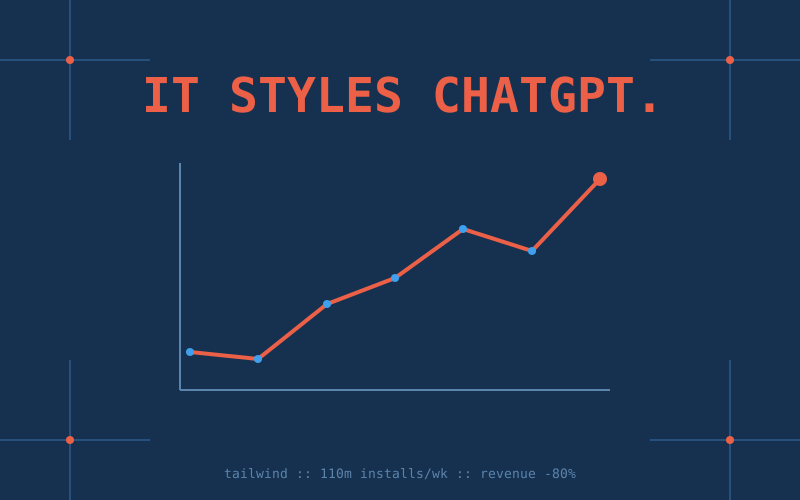
On September 9, Tailwind Labs announced it is joining Shopify. Tailwind CSS is installed more than 110 million times a week and, by its own founder's account, styles ChatGPT, X, Cloudflare, and Reddit. The company behind it still ran out of money. In January, Adam Wathan posted the numbers in a GitHub thread: docs traffic down about 40 percent from early 2023, revenue down close to 80 percent, three of four engineers gone. The open source stays MIT licensed. The business that paid for it just closed to new customers.
What was announced
Wathan's post is short and unusually plain. Tailwind Labs is joining Shopify. Terms were not disclosed. Tailwind CSS and the rest of the open-source line, including Headless UI and Heroicons, stay MIT licensed and stay maintained by the same team.
The commercial half does not survive intact. In his words: "we'll no longer be trying to grow the business around Tailwind." Existing customers keep access to Tailwind Plus and ui.sh. New signups are closed. That was the template and component business, and it was the thing that paid salaries for nine years.
Nine years is also the framing Wathan uses for scale: the framework is "installed over 110 million times per week and is trusted by many of the world's biggest companies to style products like ChatGPT, X, Cloudflare, Reddit, and Shopify." That claim checks out against the registry. The npm downloads API reports 110,850,620 installs of tailwindcss for the week ending September 6, 2026.
The disclosure that explains it
To understand why a project at that scale needed a buyer, you have to go back to a pull request. On tailwindlabs/tailwindcss.com#2388, a contributor proposed adding an llms.txt endpoint: a plain-text, LLM-optimized dump of the entire documentation, stripped of JSX and ready for a model to swallow whole. A reasonable, community-minded ask.
Wathan closed it, and explained why in a comment that has been quoted ever since. Traffic to the docs was down about 40 percent from early 2023 "despite Tailwind being more popular than ever." Revenue was "down close to 80 percent." And the line people keep screenshotting: "75% of the people on our engineering team lost their jobs here yesterday."
The layoffs landed on January 6, 2026. Three of four engineers. Wathan has since said that holiday forecasts showed the company roughly six months from being unable to meet payroll if nothing changed.
The docs were the funnel
Here is the mechanism, and it is worth sitting with because it generalizes badly for a lot of people reading this.
Tailwind Labs did not sell the framework. It gave the framework away and sold components and templates on top. The only place a developer ever learned those products existed was the documentation site, which Wathan describes as "the only way people find out about our commercial products." Free docs pulled in enormous search traffic, a slice of that traffic saw the Plus upsell, and a slice of that slice paid.
Language models severed the first link in that chain. A developer with a Tailwind question now types it into a chat window and gets an answer that was trained on those docs, without the round trip. Utility delivered, page never loaded, upsell never rendered.
It is a toll bridge problem. You built the bridge, everyone still crosses the river, and now they all fly. The traffic statistic and the usage statistic have quietly stopped describing the same thing, and only one of them was ever attached to a payment.
The part that stings
Wathan's own post says Tailwind styles ChatGPT. The framework is literally the CSS layer of the product category that dismantled the funnel underneath it. If you were designing a parable about open-source economics in 2026 you would reject that detail as too on the nose.
And the request that surfaced the whole thing was a pull request to make the docs easier for models to consume. The contributor was not wrong about the technical merit. That is the trap: every individually reasonable step toward machine-readable documentation is also a step away from the human pageview that funded it.
Why Shopify, specifically
Wathan gives a product reason rather than a rescue narrative. He wanted Tailwind "developed in service of a real product" instead of a template business, and names Shopify's surface area: merchant storefronts, an admin area, checkout, the Shop app. He also flags Shopify's "explorations into agentic commerce" as where interfaces are heading.
Read that against Shopify's position and it is coherent. If shopping increasingly happens through agents rather than pages, whoever owns the styling primitives for storefronts owns something structural. Buying the team that maintains the web's most-installed utility CSS framework is a cheap way to sit at that table. Terms were not disclosed, which usually means the number was not large enough to brag about.
What a builder should take from this
The Hacker News thread ran to 930 points and 371 comments, split roughly between "soft landing" and "corporate capture." Both readings miss the operational lesson, which is narrower and more useful.
- Audit whether your funnel is a content page. If discovery for your paid product happens on a docs site, a tutorial, a comparison page, or a blog, that surface is now competing with a model that answers the same question for free and never shows your pricing link.
- Popularity is not a leading indicator anymore. Tailwind's install count went up the entire time revenue fell 80 percent. Installs, stars, and downloads have fully decoupled from anything you can invoice.
- Sponsorship did not close the gap. Tailwind Labs had sponsors and still hit a payroll cliff. Sponsor income scales with goodwill, not with usage, and goodwill has no billing relationship.
- The value that survives sits behind an account. Hosted state, private data, workflow, support contracts. Anything a model can restate from public text is now a lead magnet with no leads attached.
The caveats worth keeping straight
Some of this predates AI. Selling static component templates was a business with a natural ceiling, and several commenters argued Tailwind Plus was always more of a tip jar with good design than a durable product line. Falling docs traffic is also partly a general search story, since Google's AI summaries suppressed referrals across the entire web, not just here.
The revenue and traffic figures come from Wathan's own public statements rather than audited filings, and Tailwind Labs never disclosed absolute revenue. What is independently verifiable is the install count, the layoffs, the closure of new signups, and the acquisition itself.
Key Takeaways
- Tailwind Labs is joining Shopify as of September 9, 2026. Terms undisclosed. Tailwind CSS and the other open-source projects remain MIT licensed and maintained by the same team.
- Tailwind Plus and ui.sh are closed to new signups. Existing customers keep access. That commercial line funded the framework for nine years.
- In January 2026 the founder disclosed docs traffic down about 40 percent from early 2023, revenue down close to 80 percent, and three of four engineers laid off, while the framework was more popular than ever.
- npm confirms 110,850,620 weekly installs for the week ending September 6, 2026, roughly 20 times Bootstrap's. Adoption never dipped.
- The failure mode was distribution, not product: models answer from the docs, so the page carrying the upsell stopped being visited.
- If your paid product is discovered through free content, treat that funnel as actively depreciating and move the value behind an account.
Sources: Tailwind CSS blog, tailwindlabs/tailwindcss.com PR #2388, npm registry downloads API, DevClass, BetaKit, PYMNTS, Hacker News discussion