Temporal Is Now Worth $12.55B. Its Customers Doubled Their Bills.
TL;DR
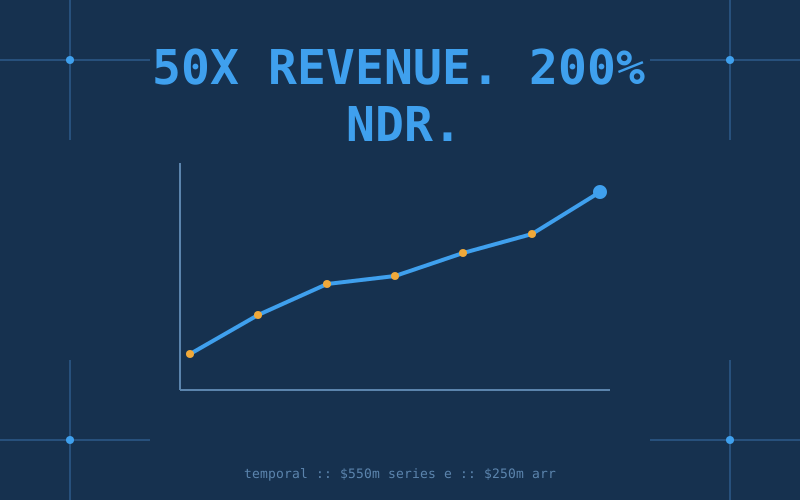
Temporal, the open-source durable execution platform, raised a $550 million Series E at a $12.55 billion valuation on Monday, led by Lightspeed. That is 2.5 times the $5 billion price of its February round. Temporal says its annualized revenue run rate recently passed $250 million, up more than 200% year over year, and that net dollar retention has stayed above 200% since February, meaning existing customers more than doubled what they spend. Its Cloud service processed 1.9 trillion billable actions in August, and OpenAI's use of Temporal grew 60-fold in under a year. The pitch: agents crash mid-task, and Temporal is the layer that lets them resume where they fell over. The price is roughly 50 times run-rate revenue, and the per-action math says the biggest users pay far below list.
The round and the numbers
The announcement landed on September 14 in a press release, a company blog post, and a letter from CEO Samar Abbas. Lightspeed led. Wellington Management, Growth Equity at Goldman Sachs Alternatives and Tiger Global co-led, T. Rowe Price and SV Angel participated, and a16z, Sequoia, Index, GIC, Sapphire Ventures and Amplify came back for more.
- Run-rate revenue: "recently surpassed $250M, growing more than 200% year-over-year," per the release.
- Net dollar retention: above 200% since February. The CEO letter says it held there "every single month this fiscal year."
- Usage: 1.9 trillion billable Temporal Cloud actions in August, up more than 350% year over year. The letter puts the growth at 368%.
- Customers: more than 4,300 paying.
- Open source: 43,141,638 installs, up 134% since the start of 2026, from 450,000 developers.
- Headcount: doubled to 570 in a year.
The climb is steep even by 2026 standards. Temporal's Series C in March 2025 valued it at $1.72 billion. A $105 million secondary led by GIC set $2.5 billion in October 2025, and the a16z-led Series D doubled that to $5 billion in February.
What Temporal actually sells
Temporal descends from Cadence, the workflow engine co-founders Samar Abbas and Maxim Fateev built together at Uber starting in 2015, according to the company's about page. Before that, Fateev led the Amazon messaging work that became SQS, and Abbas worked on Amazon's Simple Workflow Service. The server is MIT-licensed open source; Temporal Cloud is the hosted, paid version.
The product is durable execution. You write a workflow as ordinary code, and every step that touches the outside world (a database write, an API call, a model call) runs as an Activity. The Temporal service persists each command and result in the workflow's Event History. When a worker crashes, the next one "uses the Event History to replay the code and recreate the state of the Workflow Execution to what it was immediately before the crash," then resumes as if nothing happened.
Think of a chess game with a scoresheet. If someone knocks the board over, you do not phone your opponent and ask them to replay every move; you set the pieces back up from the sheet and play the next one. Completed Activities are the moves on the sheet, and your model provider is the opponent you do not have to call back.
Why agents turned plumbing into a growth story
An agent run is the workload this was built for: long, multi-step, and full of slow, expensive calls whose results you cannot cheaply reproduce. If a pod restarts twenty tool calls into a task, the naive choices are to start over and pay for the tokens again, or to hand-roll checkpointing. Temporal's integration for the OpenAI Agents SDK runs the agent loop, tool selection and handoffs inside the workflow, while model calls run as Activities that "retry durably and are not repeated during Workflow replay."
Abbas's letter says that integration reached general availability in March, and Temporal has since shipped one for Vercel's AI SDK for TypeScript developers. Lightspeed partner Anoushka Vaswani summed up the thesis in the release: "the demo is easy, production is hard, because the systems around the models can't handle real-world execution."
The customer list leans AI. The release names Cursor maker Anysphere, Lovable, Scale AI and NVIDIA, and the blog says OpenAI's use of Temporal "has grown 60-fold in under a year." The older anchors are still there: Snap moves 414 million Stories a day on Temporal, which is a lot of durability for posts designed to disappear in 24 hours.
200% net dollar retention is the number to stare at
Net dollar retention compares what a group of customers pays now with what the same group paid a year earlier, leaving new customers out. Above 100% means existing accounts expand faster than churn shrinks them. Above 200% means every dollar that cohort paid a year ago has turned into more than two.
That is what usage-based pricing does when customers put agents into production. Temporal Cloud bills by the Action: starting a workflow, starting or retrying an Activity, a heartbeat that reaches the server, a timer, a signal, a query. An agent whose 40 model and tool calls each run as Activities generates at least 40 billable Activity starts per task, plus one for every retry. Replay is free: the docs say actions during workflow replay do not count.
The pricing math Temporal didn't publish
The price list starts at $50 per million actions beyond a plan's included allotment, steps down to $25 per million for the tier covering the next 100 million, and switches to "Contact Sales" above 200 million. Plans start at $100 a month for Essentials and $500 for Business.
Do the division. A $250 million run rate is about $20.8 million a month. Spread across 1.9 trillion actions in August, that is roughly $11 per million actions, and that assumes every dollar comes from actions rather than storage or support.
The public tiers never go below $25. The simplest reading is that most of those trillions run on negotiated contracts for very large accounts, well under the lowest price anyone can see on the website.
For you, the useful lesson is about your own bill, not Temporal's margins. Count actions per agent run the way you count tokens: a retry-happy Activity around a rate-limited model API multiplies them, and heartbeats on long tool calls add more. Self-hosting the MIT server trades the per-action bill for your own ops time.
About 50 times revenue, in a crowded lane
At $12.55 billion on a run rate just past $250 million, investors are paying roughly 50 times revenue. The quoted growth has cooled: in February Temporal said revenue was up more than 380% year over year, and now it says run-rate revenue is up more than 200%. Those are not identical metrics, but the direction is clear, and the valuation still went up 2.5 times.
Competition sits right next door. The Next Web, covering Bloomberg's August report of the round talks, named Cloudflare, Vercel and Restate as rivals chasing the same category. Cloudflare Workflows and Vercel Workflows both sell durable steps as a platform feature. Vercel is the awkward one: Temporal just shipped an integration for Vercel's AI SDK, while Vercel's own product promises to "resume across crashes and deployments." Frenemies, with durable state.
The caveats
Every operating figure here is self-reported by a private company, and none is audited. Temporal's own documents disagree at the edges: the release says August actions grew more than 350% while the CEO letter says 368%, and the blog dates the 134% install growth from December 2025 while the release says January 2026.
"Recently surpassed $250M" does not say when, so the per-action estimate mixes a run rate with one month of volume and is a ballpark, not a price. Temporal does not break out how much revenue comes from AI workloads, and "60-fold" is Temporal's description of OpenAI's usage, not a figure OpenAI published.
Key Takeaways
- Temporal raised $550 million at a $12.55 billion valuation, led by Lightspeed: 2.5 times its February price and about 7.3 times its March 2025 Series C.
- The company says run-rate revenue passed $250 million, up more than 200%, with net dollar retention above 200% since February.
- Agents are the driver: model calls run as Activities that survive crashes and are not re-sent on replay, and OpenAI's usage grew 60-fold in under a year.
- Run-rate revenue spread over August's 1.9 trillion actions works out to roughly $11 per million, under half the lowest published $25 tier.
- If you run agents on Temporal Cloud, budget in actions: every Activity start and retry bills, replay does not.
- The price is about 50 times run-rate revenue while the quoted growth rate has slowed from above 380% to above 200%, with Cloudflare, Vercel and Restate in the same lane.
Sources: Temporal press release, Temporal blog on the Series E, Samar Abbas's Series E letter, NYSE via PR Newswire, Temporal Series D, Temporal secondary, Temporal Series C, Temporal about page, Temporal Cloud pricing, Temporal docs: Actions, Temporal docs: Event History, Temporal docs: OpenAI Agents SDK integration, The Next Web, Vercel Workflows docs.