TSMC Just Printed the Biggest Quarter in Foundry History. Thank AI.
TL;DR
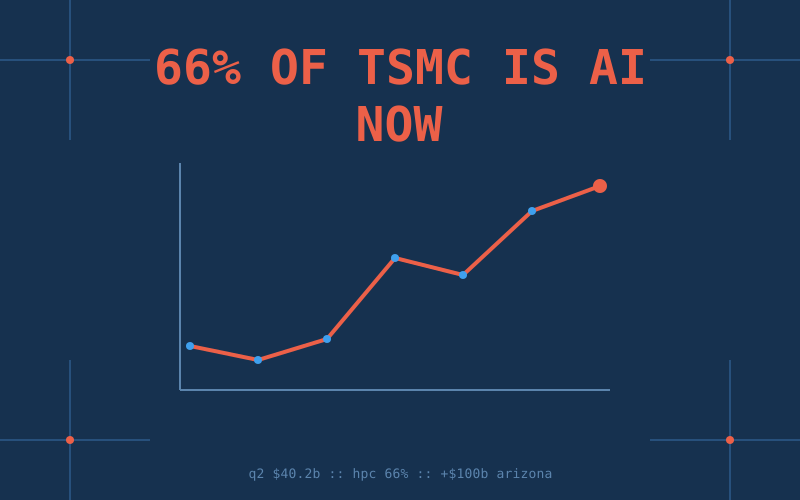
On July 16, TSMC reported second-quarter revenue of $40.2 billion, up 33.7% year over year in US dollar terms, with net income of NT$706.56 billion (about US$22 billion), up 77.4%, per its official earnings release. High-performance computing, the bucket where AI accelerators and server CPUs live, is now 66% of revenue. Management raised full-year 2026 growth guidance to slightly above 40% in USD terms, hiked capital spending to $60-64 billion, and announced an additional $100 billion for Arizona, bringing the committed US total to roughly $265 billion. Every flagship AI chip on earth is fabbed by this one company, so this earnings report doubles as the supply-side scoreboard for the entire AI buildout. The score says: still accelerating.
The Quarter Is an AI Demand Report
The raw numbers first, all from the earnings release: NT$1,270.38 billion in revenue ($40.2 billion), a 67.7% gross margin, a 60.3% operating margin, and a 55.6% net margin. That is a gross margin most SaaS companies would envy, produced by the most capital-intensive manufacturing process humans have ever run. The product is measured in atoms and the margins are measured in software.
The composition matters more than the size. Per the earnings call, the HPC platform grew 20% quarter over quarter and now accounts for 66% of total revenue. Smartphones, the business that built this company, are down to 22%.
CEO C.C. Wei's read on where that demand comes from is worth quoting, because it is not just GPUs anymore:
"The emergence of agentic AI is leading to a resurgence in the role of CPUs in AI data centers, which drive more silicon demand in addition to AI accelerators."
Agents burn general-purpose compute (orchestration, sandboxes, tool calls, browsers) alongside the accelerator doing inference. TSMC sells the wafers for both sides of that transaction.
The Guidance Is Where the Story Lives
A record quarter tells you about the past. The guidance is the bet on the future, and TSMC raised all of it:
- Full-year 2026 revenue growth: now "slightly above 40% year over year in US dollar terms," up from the roughly 30% guided earlier this year.
- 2026 capital spending: raised to $60-64 billion, from the $52-56 billion range set in January.
- Q3 revenue: $44.6-45.8 billion, which at the midpoint is another 12% sequential jump on top of a record.
Foundry capex is the most honest forward indicator in AI, because it is spent years before the revenue it enables. Model labs can hype. Cloud providers can bundle. TSMC has to pour concrete against real purchase orders. An $8 billion raise in July says the order book through 2027 got materially bigger in the last three months.
The 2nm Ramp Has Started, and It Eats Margin
Buried in the wafer mix is the datapoint builders should watch: 2-nanometer shipments hit 3% of wafer revenue, their first meaningful showing. 3nm contributed 30%, 5nm 33%, and everything at 7nm or better made up 77% of wafer revenue. CFO Wendell Huang says Q3 will be supported by "the steep ramp-up of our 2-nanometer technology."
Wei told analysts the 2nm ramp will dilute gross margin by about 3 to 4 percentage points. That is normal node economics, not a warning sign: a brand-new leading-edge fab is like a restaurant that opens with a full kitchen brigade and half the tables empty. The fixed costs all arrive on day one; the yield-mature volume that pays for them shows up quarters later. TSMC is choosing to absorb that hit now because 2nm is the node the next generation of accelerators and server CPUs is queued up for.
Another $100 Billion for Arizona
The headline announcement outside the financials: an additional $100 billion for TSMC's Arizona site, lifting total committed US investment to roughly $265 billion. Wei said the money goes to "several more" wafer fabs for 2nm-and-below technologies plus advanced packaging fabs, with reports citing four or more new facilities. The schedule, he noted, depends on market conditions and customer demand. A hundred billion dollars used to be the size of a national semiconductor strategy. Here it is a mid-year addendum.
The packaging half of that sentence deserves the attention. Advanced packaging, the step that stitches compute dies and high-bandwidth memory into a finished accelerator, has repeatedly been the binding constraint on AI chip supply, and until now the leading-edge version of it lived almost entirely in Taiwan. Putting both 2nm logic and advanced packaging on US soil means a complete leading-edge AI chip could eventually be built end to end in Arizona.
What It Means If You Build on GPUs
Nvidia and AMD GPUs, Google's TPUs, Amazon's Trainium line at AWS, and Apple silicon all come out of TSMC fabs. That concentration cuts three ways for anyone whose bill scales with compute:
- Your cost floor has a landlord. A 67.7% gross margin at the sole supplier of leading-edge wafers means pricing power is being exercised. Cheaper tokens will have to come from efficiency above the foundry, not from the foundry.
- Relief is years out, not quarters. Capex raised today becomes wafer starts in two to three years. The $8 billion bump does nothing for 2026 GPU availability; it is a bet on demand holding through 2028 and beyond.
- This is the cleanest demand signal there is. When two-thirds of TSMC's revenue is one theme, its guidance is effectively an audited measurement of AI demand. The company just measured it at 40%-plus growth and rising.
If you have been waiting for the supply side to blink first and drop your inference costs, this report is the opposite of that. The most informed company in the supply chain looked at the order book and wrote a $100 billion check.
Key Takeaways
- TSMC posted record Q2 results: $40.2 billion revenue (+33.7% YoY in USD), NT$706.56 billion net income (+77.4%), and a 67.7% gross margin.
- HPC, the platform carrying AI accelerators and server CPUs, grew 20% quarter over quarter and is now 66% of total revenue; smartphones are down to 22%.
- Full-year 2026 guidance was raised to slightly above 40% revenue growth in USD terms, and 2026 capex went from $52-56 billion to $60-64 billion.
- 2nm reached 3% of wafer revenue in its first ramp quarter, with a "steep" Q3 ramp ahead that costs 3 to 4 points of gross margin.
- An additional $100 billion goes to Arizona (about $265 billion total US commitment) for 2nm-and-below fabs plus advanced packaging, the historic AI supply bottleneck.
- For builders: compute costs stay anchored by one supplier's pricing power, new capacity lands in years not quarters, and the best-informed company in the chain is betting the boom runs through 2028.
Sources: TSMC Q2 2026 earnings release (SEC 6-K), TSMC investor relations, Motley Fool earnings call transcript, Yahoo Finance, Investing.com