Universal Music Says Its Streaming Deals Must Change to Stop Paying AI Slop Pro-Rata
TL;DR
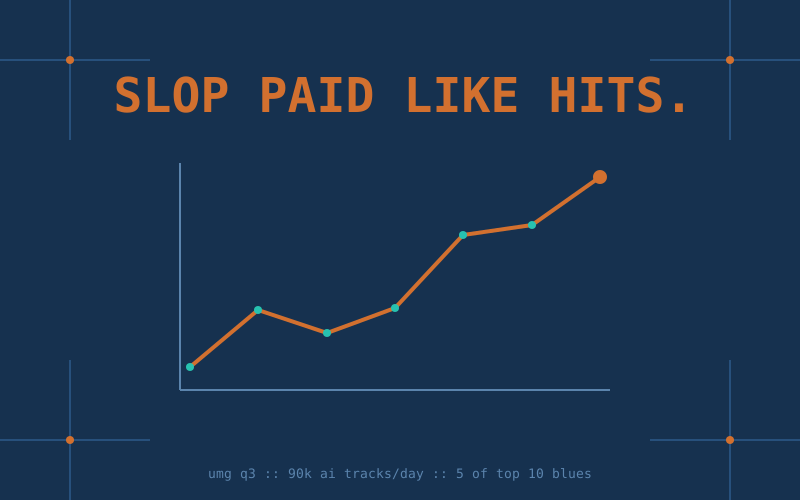
Universal Music Group used its Q3 2026 earnings call on October 29 to tell streaming services that the pro-rata royalty pool has to go, at least for fully AI-generated tracks. CEO Lucian Grainge said "the uniform application of pro-rata payments makes the problem worse" and that "the structure of our DSP agreements has to change." He backed it with Deezer's count of more than 90,000 fully AI-generated tracks uploaded a day, up from about 10,000 in early 2025, and a claim that on some services' blues charts as many as five of the top ten albums belong to AI acts with no disclosure. UMG wants contracts that keep fully AI-generated music out of the royalty pool its artists are paid from, and it expects its own licensed AI partnerships to start producing revenue in fiscal 2027. The quarter itself came in at 3.39 billion euros, up 12.3%.
What Grainge said
The call covered the quarter ended September 30, 2026, and the AI section was unusually blunt for a document read to analysts. Grainge: "AI slop degrades the fan experience and diverts value from real artists." He went on: "The uniform application of pro-rata payments makes the problem worse."
Pro-rata is the default royalty model on most services. Every subscription dollar goes into one pot, and the pot is split by each track's share of total streams. Picture a potluck where the bill is divided by how many plates each guest grabbed, and a bot arrives with ten thousand plates: nobody at the table did anything wrong, and everybody still pays for the bot. A track prompted and uploaded in a minute earns the same per-stream rate as a song that took a year.
Grainge's position is that "unethically generated AI tracks should never be compensated on the same basis as music that creates real and lasting demand," followed by a question he already knows the answer to: "And why would a music service even want to host them?" (The answer, per Deezer's own numbers below, is that on peak days they are more than half of what arrives.) He also said "this isn't an argument against AI," and the rest of the call made clear where UMG wants AI money to flow instead.
The numbers behind the complaint
Grainge's upload figure is Deezer's. In Music Business Worldwide's write-up of Deezer's detection data, the service was receiving roughly 10,000 fully AI-generated tracks a day when its detector launched in January 2025, about 10% of daily deliveries. By January 2026 it was 60,000 (39%), by April about 75,000 (over 44%), and by June nearly 90,000, more than 50% of all new music delivered on peak days. Grainge put it as "In early 2025, roughly 10,000 AI-generated tracks were arriving each day. Today, more than 90,000 fully AI-generated tracks are uploaded daily."
The second number is UMG's own. Grainge said that on the blues charts of some large streaming services, "as many as five of the top 10 albums are attributed to AI-generated acts without clear labelling or disclosure." He did not name the services or the acts. That is a lot of robots singing about hardship.
What UMG wants written into the contracts
Chief digital officer Michael Nash listed the protections UMG already negotiates into platform deals: "AI models can't be trained on our artists' work without consent," and "AI recordings trained on our content without authorization have to be removed." The new ask is the royalty pool itself. UMG wants contracts stating "that fully AI-generated music doesn't dilute our artist royalties."
Grainge framed this as the start of "the next phase of our transformation, which will run through to the end of 2028," covering how UMG negotiates, prices and executes platform agreements. The leverage he cited: "UMG artists produced nearly half of the 900 music tracks streamed more than one hundred million times in the U.S. just last year." A service that wants the hits renews with UMG, and the renewal is where the AI clauses go. As of this writing, no service has publicly answered the pro-rata demand.
The platforms moved first, and UMG says it is not enough
Nash gave the services credit for what they have done. Spotify said in October it had taken more than 50 million tracks it identified as AI slop and spam out of recommendations. Deezer announced on October 13 an opt-in toggle that hides fully AI-generated tracks from search, due worldwide before the end of 2026; Nash called it "a kill switch feature." Apple Music reported earlier this year on its efforts against the flood of AI uploads. Then: "But this is not sufficient." His description of the state of play was "the ecosystem is damaged by this flood of infringing content," with dilution and fraud threats "growing."
That is a shift in tone. Music Ally notes that in March 2026 Nash said AI revenue dilution was not giving UMG sleepless nights, a line a Suno-backed lobbying group later quoted back at the company. On this call Nash said the earlier data covered fiscal 2025 and that "our comments today describe what is happening to the ecosystem around us three quarters later." Grainge's version: "the scale of the problem is still outpacing the guardrails."
Where UMG wants the AI money to go instead
The same call put dates on the licensed lane. Grainge: "We are moving from principles to products, and from products to revenue." ElevenLabs, Spotify, Udio and Klay are "developing new licensed forms of fan creativity," while Stability AI and Splice are "developing professional tools for artists." UMG "expect[s] these partnerships to begin generating incremental revenue in FY 2027." No figures were attached.
The two halves of the argument fit together. Fully AI-generated uploads from outside the licensing tent should earn less or nothing from the pool; AI products built inside it, on licensed catalog, are the ones UMG plans to book revenue from. Whether you find that principled or convenient probably depends on which side of the tent you are standing on.
The quarter underneath
Revenue was 3.39 billion euros, up 12.3% year on year, with Downtown Music contributing 195 million euros that was not in the year-ago quarter. Strip Downtown out and the constant-currency growth was 5.3%. Recorded-music subscription revenue grew 19.2%, or 9.5% without Downtown, which UMG attributed to wholesale price increases and subscriber growth.
What this means if you build with AI music
The demonetization of fully AI-generated tracks on major services is being negotiated as contract language, not legislated, and the party with the hits is the one writing it. If your product uploads prompt-generated songs to streaming services, expect that content's per-stream rate to be on the table at every major-label renewal through 2028, whatever the courts decide about training.
Labelling is the hinge. The pool exclusion only works if services can tell which tracks are fully AI, which is why Grainge said UMG will "insist on clearer labelling across the ecosystem." Deezer's detector and its search toggle both target fully AI-generated tracks and leave AI-assisted ones alone, and UMG's contract ask uses the same word, "fully." A product that keeps a human in the chain, with evidence of it, lands on the better side of that line.
The alternative UMG is pointing at is the licensed one. Udio, Klay, ElevenLabs and Stability AI all have UMG deals behind them, and UMG has a fiscal 2027 revenue target riding on those products working. If you want label catalog in an AI product, the terms of that lane are now being set in public.
Caveats
The 90,000-a-day figure is Deezer's measurement of its own inbound deliveries, not an industry total. The blues-chart claim is UMG's, with no services, acts or dates named. Grainge's "unethically generated" category was not defined on the call, and no streaming service has agreed to change pro-rata terms. Year-on-year revenue growth includes Downtown, which was not in the year-ago quarter; the ex-Downtown figures are the cleaner read.
Key Takeaways
- On its October 29 Q3 call, UMG said pro-rata payouts treat AI slop like the biggest hits and that "the structure of our DSP agreements has to change."
- Deezer now receives nearly 90,000 fully AI-generated tracks a day, up from about 10,000 in January 2025, and over half of deliveries on peak days.
- Grainge said as many as five of the top ten albums on some services' blues charts are undisclosed AI acts; he named no services.
- UMG wants contracts stating that fully AI-generated music does not dilute its artists' royalties, in a renegotiation phase it says runs through 2028.
- Spotify's 50 million-track purge and Deezer's search kill switch earned credit from UMG and the verdict "not sufficient."
- Licensed AI partners (ElevenLabs, Spotify, Udio, Klay, Stability AI, Splice) are expected to produce incremental revenue in fiscal 2027.
Sources: Investing.com: UMG Q3 2026 earnings call transcript, Music Ally: "The volume is growing faster than the safeguards", Digital Music News: Universal Music Q3 2026 results, AI Musicpreneur: Grainge on AI slop and pro-rata, Music Business Worldwide: Deezer's 90,000 synthetic tracks a day, TechCrunch: Deezer AI filter, Spotify newsroom: prioritizing human artistry