A90 Asked 65 AI Assistants 128,000 Questions: Same Book, Same Fund, Same City
On this page 9 sections
TL;DR
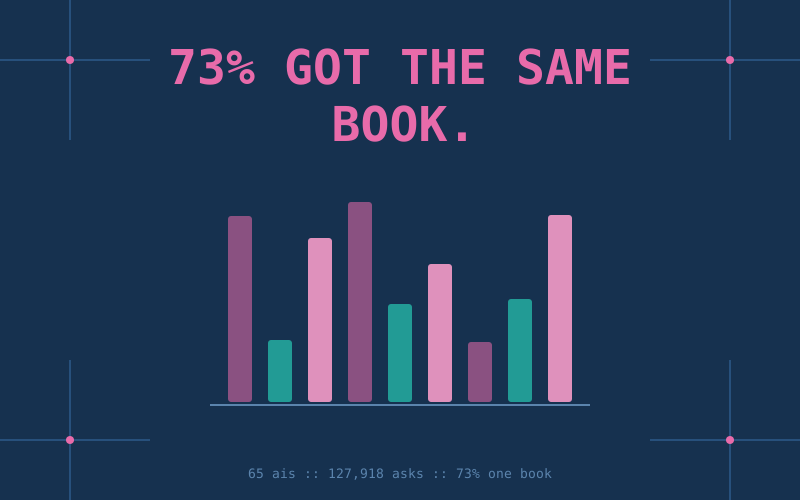
The same-advice experiment at a90, published November 20 by Cody Collier, asked 65 AI assistants from 30 companies the questions people actually bring them, 127,918 times, at default settings with no system prompt. The advice collapsed. Ask for one book that will change your life, and 73 of every 100 askers get Man's Search for Meaning. Ask where to put $10,000, and 98 of 100 are told to buy a broad index fund. Ask the models to invent a random person, and 69% of the 3,151 people they invent are exactly 34 years old. The experiment traces the habit to a single training step, and two prompts undo most of it.
Advice collapses, trivia does not
Every model got every question ten times, and the methodology sits under each chart on the page. Questions with a genuine answer space stayed healthy: a movie, a dinner, a baby name, no single answer reaching a third of replies. The convergence shows up exactly where people take recommendations. One book: Man's Search for Meaning, 73%. One business idea: a subscription box, 76%. A gift for dad: a leather wallet, 47%. A 3-day trip in Europe: Lisbon, 46%. A name for your tech startup: Nexora, 37%, with 69% of all suggested names starting in "Nex", which should worry your trademark lawyer.
The models have no idea they do it
After each answer, Collier asked one follow-up: what share of people who ask this get that same answer? For the US city question the middle guess across models was 15%. The models actually named the same city 80 times in 100. For what to study, they guessed 34% while naming the same major almost every time.
Two escape hatches fail. Turning on the model's own thinking mode made the top answer more common in four of eight money and life questions, made no difference in four, and changed the answer in zero. Adding one line about yourself ("I'm a nurse in Ohio") just sorts you into a lane: every nurse then gets the same city, country, and major, with Canada at 82% and Nursing at 46%.
The 34-year-old marine biologist
Ask a model to invent a random person and you meet the same woman. Of 3,151 invented people, 69% are exactly 34, the oldest is 67, 81% are women, 46% live in Portland or Seattle, and 15% are marine biologists, a job held by fewer than one in five thousand American workers. Real US adults have a median age of 47 and are 51% women.
Each lab also keeps a consistent signature. Three of four Claude models invent someone named Marisol; four of five Gemini models invent an Elena. Turn eleven harmless questions (a color, a city, a name, two numbers) into a fingerprint, and 59% of models land nearest a sibling from their own lab, against 4% by chance. In a blind test on 23 open models with a known parent, the fingerprint named the right family 22 times. It also caught three family secrets: Grok 4.7 sits closer to OpenAI's GPT-6 Luna than half of all models sit to their own siblings, Alibaba's Qwen4 Max answers most like Claude Opus 5.5, and NVIDIA's Nemotron landed next to Qwen, which fits, because NVIDIA says it trained Nemotron on Qwen3 answers.
Where the habit comes from
AllenAI publishes OLMo checkpoints at every stage of training, so Collier measured the answer distribution after each one, using "pick a random number between 1 and 100" scored in bits of entropy. A fair 100-sided die scores 6.64. Straight out of pretraining, OLMo 2 1B scored 6.51, nearly fair. After supervised fine-tuning, where the model learns to copy example answers, it scored 4.95 and a favorite number had appeared. Later tuning barely moved it. It is as if a whole generation learned its manners from one etiquette manual, and the manual was written by the previous generation's best student.
The smoking gun is in the fine-tuning data, which AI2 also publishes. Collier read all 866,138 examples in the Tülu 3 SFT mixture. The favorite number and the age 34 appear nowhere in it. The names do: the second most common invented name in the examples is Elara, and 3,233 of its 4,269 mentions come from real ChatGPT conversations recorded in WildChat. Of 573 Vances and 136 Marisols in the set, 556 and 132 were written by ChatGPT.
It leaks out of the chat window
These defaults are already in the wild. Collier searched GitHub for the invented names in READMEs: Elena Vance, Gemini's person, appeared in no new projects for six years and then in 684 new projects in 2026 alone. Maya Chen, the person GPT-6, Grok, and Kimi invent, appeared in 1,847. The academic version is worse: a June 2026 study, The Ghost Couple, identified 1,655 ghost-authored records on Zenodo claiming nonexistent journals, and Nature covered the ghost-name problem in September. The bookshelf version predates all of it: Max Read traced "Elara Voss" to 62 Amazon books in August 2025.
Builders should read the password section twice. Ask for a strong password and the models draw from the same few pieces: 25% of the generated passwords contain the substring "vL", against 0.21% by chance, and Mistral Medium 3.5 repeated one identical password 19 times in 30. In code they know better: 384 of 390 session-token snippets reached for a secure generator. A password with a house style is a default credential with extra steps.
What actually works
Collier re-asked the six stickiest questions across all 65 models, four new ways, ten times each. The measure: the chance that a stranger asking the same way gets your exact answer.
"Don't give me the most common answer" backfires: asked to skip Lisbon, 58% of askers got Ljubljana. Everyone who asks for the uncommon answer receives the same uncommon answer. The two fixes that hold: describe yourself concretely ("I'm 43, a dental hygienist in Leeds, and I love X"), or have the model list ten options and you pick the number. For randomness specifically, hand it entropy: a seed in the prompt or gibberish to transform beats thinking mode, and given a terminal, 54 of 63 models just ran a real generator, with Chinese labs reaching for $RANDOM % 100 and American labs for shuf.
Read the caveats before you retweet
The measurement covers default assistants: no system prompt, no personalization, no memory. In the HN thread, several commenters with personalization or memory enabled got different answers immediately, and one Gemini user got Atomic Habits cold. Some convergence is consensus rather than quirk: a broad index fund is close to the correct generic answer for $10k, and the experiment says so itself. Ten asks per model per question is thin at the individual model level and solid in aggregate. Treat this as a measurement of the default state of 65 products, which is exactly the state most of their users get.
Key Takeaways
- The a90 experiment asked 65 AI assistants from 30 companies 127,918 everyday questions at default settings: 73% of askers got the same "life-changing" book, 98% the same $10,000 advice (a broad index fund), 90% the same college major, and 47% the same US city (Austin).
- Models badly underestimate their own convergence, guessing 15% where they actually repeat the top city 80 times in 100; thinking mode never changed the top answer and one-line personas only move askers into a shared lane.
- Invented people cluster hard: 69% of 3,151 are exactly 34, 81% women, 46% in Portland or Seattle. Eleven harmless questions fingerprint a model's lab, correct in a 22-of-23 blind test on open models.
- The habit is trained in at supervised fine-tuning, measured on OLMo 2 checkpoints (6.51 to 4.95 bits of answer entropy), and the names trace to ChatGPT conversations inside the public Tülu 3 SFT mixture.
- Defaults leak: Gemini's "Elena Vance" appears in 684 new GitHub READMEs in 2026 after six silent years, a June 2026 study counts 1,655 ghost-authored Zenodo records, and 25% of AI-generated passwords share the substring "vL".
- What works: concrete personal details (stranger-match chance 4%) or "list 10 options, I pick number N" (7%). Asking for the uncommon answer just relocates the crowd, to Ljubljana.
Sources: a90, AI is giving everyone the same advice (Cody Collier, Nov 20, 2026), Hacker News discussion, The Ghost Couple (arXiv 2606.02184), Nature news on ghost names, Who is Elara Voss? (Max Read), AllenAI OLMo, Tülu 3 SFT mixture, WildChat dataset