AI Traffic to US Retail Sites Doubled as Adobe Counts a Record $82.5B Holiday Start
On this page 7 sections
TL;DR
Adobe Analytics counted $82.5 billion in US online spending between Nov 1 and Nov 22, up 9.1% from the same stretch of 2025, and AI-referred traffic to US retail sites grew 127%. Salesforce expects AI tools and agents to influence $75.8 billion, about 21% of global Cyber Week sales. The change that affects how you sell: AI-referred visitors now outspend everyone else per visit, a reversal from a year ago, and most of them still insist on typing their own card number.
The money came early
Every one of Adobe's first 22 measurement days cleared $3 billion in US online spending. Last year, 21 of the comparable 22 days did, and this is the first season with two $4 billion days before Thanksgiving. The same window in 2025 totaled $79.5 billion, itself a 7.5% gain over 2024, so this year's 9.1% is an acceleration on top of a strong base.
Adobe's forecast puts the Cyber 5, Thanksgiving through Cyber Monday, at $47.5 billion, up 7.4%, and the whole Nov 1 to Dec 31 season at $275.1 billion, up 6.7%. Black Friday is projected at $12.9 billion (+9.2%), the fastest-growing of the big days. Cyber Monday stays the single biggest at $15.1 billion (+6.2%). Buy now, pay later has carried $6.1 billion of the spending so far, up 6.5%, and Adobe expects a record $1.09 billion of it on Cyber Monday alone.
Adobe says the figures come from over a trillion visits to US retail sites, 100 million SKUs, and 18 product categories, measured from real transactions. Black Friday stopped being a day some time ago; the data now treats it as the last day of a three-week warm-up that already did $82.5 billion.
AI referrals stopped being junk traffic
The volume is straightforward: Adobe measured AI-referred traffic to US retail sites up 127% year over year in the first 22 days, and expects it to grow another 110% across the Cyber 5, peaking at 159% on Thanksgiving. Salesforce's parallel count, drawn from its network of 1.5 billion shoppers, has AI-driven traffic up 104%, predicts that 20% of holiday shopping traffic will be nonhuman, and expects AI recommendations to influence one in five orders.
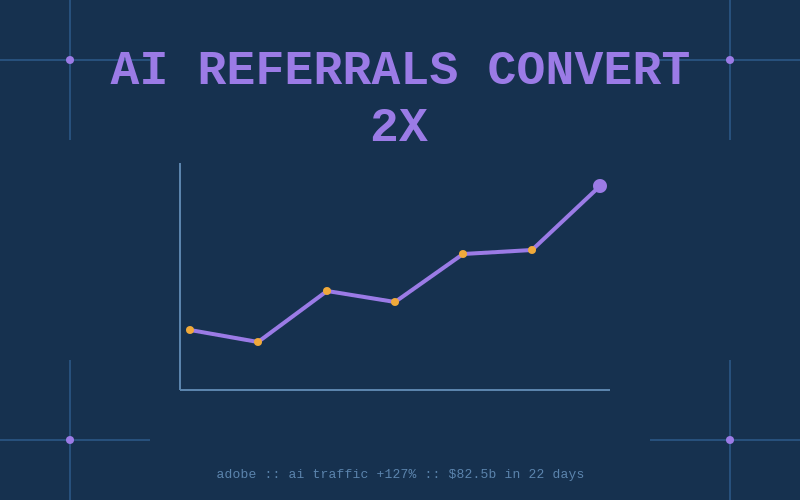
The quality side is the part nobody priced in last year. In August, Digital Commerce 360 reported Adobe's finding that AI referrals had out-converted non-AI referrals for eleven straight months, generating 53% more revenue per visit. By September the gap hit 83%, the largest of 2026. A year earlier the relationship ran the other way: an AI-referred visit was worth less than half a regular one.
The mechanism is mundane. An agent does the comparing before the click: prices, specs, sizing quirks, review summaries. The human who then lands on your product page has already read three alternatives and picked yours, like a friend who scanned every menu in the neighborhood and walked straight to your door, while a search visitor is still on the corner deciding where to eat.
Agents browse, humans pay
Salesforce's survey finds 31% of consumers have tried a personal agent such as Meta's Muse or OpenAI's Dots, but only 8% have let one complete a purchase. Meanwhile 73% are not ready to hand an agent their card details, even though 74% say they trust the recommendations AI gives them. Adobe's own survey of 1,000 US consumers lands nearby: 81% say AI improved their online shopping, and 27% use it more during sales events than at other times.
Retailer-side agents are spreading anyway. Salesforce predicts one in three retail sites will have a shopper agent live by Cyber Week. Among shoppers, 39% have already used one, and those shoppers spend 8% more per order and put 23% more items in the basket. The agents do the homework and the wallet stays in the human's pocket, whether that is a trust problem or a ritual. Plan for both halves this week.
What to do before Cyber Monday
- Assume a fifth of your holiday traffic is not human (Salesforce: 20%). Price, stock, and shipping data should live somewhere an agent can read without rendering your JavaScript.
- Track AI referrals as their own channel. If your analytics folds them into direct traffic, you are averaging away your best-converting visitors.
- Price for a discount-heavy week. Adobe forecasts Cyber 5 discounts up to 30%, and Salesforce counts average discounts up 5% globally and 8% in the US, with selling prices down 2%.
- BNPL is the early payment story: $6.1 billion spent so far and a record $1.09 billion forecast for Cyber Monday alone.
- Keep agent checkout off the holiday roadmap. With 8% adoption and 73% refusal, agent-readable catalogs beat card-collecting agents this season.
Caveats
Both datasets are vendor-reported and neither is independently audited. Adobe measures its own network of a trillion visits and 100 million SKUs. Salesforce blends platform data with market assumptions across 1.5 trillion page views in 89 countries. The Salesforce Cyber Week totals and Adobe's per-day AI growth rates are forecasts; actuals land after Cyber Monday.
The two vendors also define their AI buckets differently. Adobe counts traffic where a shopper clicked an AI-shared link; Salesforce folds in agents and AI-driven recommendations. The numbers are not meant to reconcile, and each conversion figure is measured against that vendor's own baseline. Security vendors, for their part, spent November projecting agent traffic at up to 150 times last year's Cyber Week. One camp counts the requests, this one counts the receipts, and you probably want both before you rewire a store.
Key Takeaways
- Adobe counted $82.5 billion in US online spending for Nov 1-22, up 9.1% year over year, with AI-referred traffic up 127%.
- The value of an AI-referred visit inverted within a year: from under half a normal visit to 83% more by September, and Salesforce reports AI-referred shoppers convert twice as often.
- Salesforce expects $75.8 billion, 21% of global Cyber Week sales, to be AI-influenced, with 20% of holiday traffic nonhuman.
- Adoption is uneven: 31% of shoppers have tried a personal agent, 8% have let one buy, and 73% will not hand over card details.
- Retailer agents are becoming common, one in three sites by Cyber Week, with agent users spending 8% more per order.
- Builder priority this week: agent-readable product data and separate AI-referral analytics, ahead of agent checkout.
Sources: Chain Store Age, Nov 25, 2026, Digital Commerce 360, Nov 25, 2026, Digital Commerce 360, Nov 19, 2026, Salesforce Newsroom, Nov 19, 2026