Statista Gave Up 27 Million Search Users to Keep Its Data Away From AI Crawlers
On this page 7 sections
TL;DR
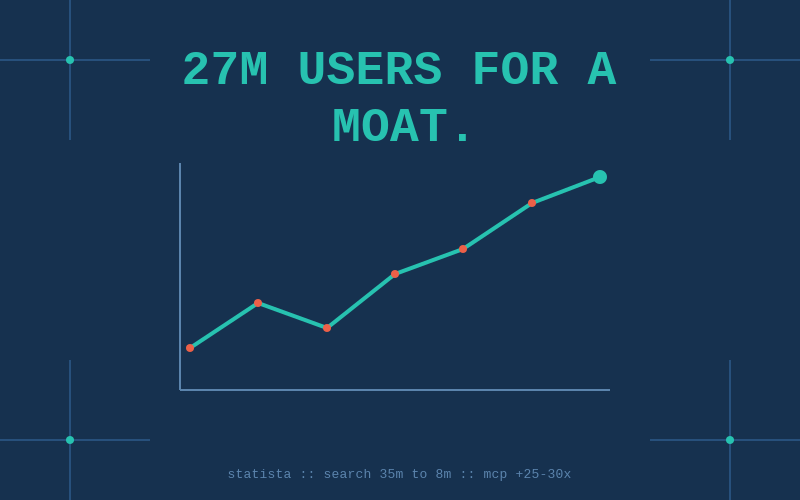
Statista put almost everything it publishes behind a registration wall that AI crawlers cannot get past, and CEO Marc Berg has now put numbers on what that cost: monthly users arriving from search fell from about 35 million to about 8 million. In exchange, the Hamburg statistics company kept its data out of chatbot answers and started selling it back into Claude, Copilot and ChatGPT through an API and an MCP server, under licenses customers carry to whichever assistant they use. Usage of that channel is growing 25 to 30 times year over year, from a base of 2 percent of customers, and Berg says the enterprise business is absorbing the loss.
A company that grew on free search
Two former consultants founded Statista in Hamburg in 2007, took no venture or private equity money, and grew it to about 160 million in revenue and almost 1,400 employees, Berg told TNW's Cristian Dina in an interview recorded at Web Summit in Lisbon and published on 26 November. Ströer, the publicly listed German media group, bought a majority stake in 2015 and, per Berg, still owns the company.
The growth engine was search. Statista let Google crawl proprietary statistics, showed each visitor one page for free, and asked for a sign-in on the way back. Conversion was almost nothing, about 0.01 percent of search traffic, but at 35 million monthly users the drip filled a lead pipeline. Over the past six years the company also turned aggregation into production: partnerships with about 11,000 data providers, a consumer panel built from more than three million interviews, and market models for over 1,000 industries. About 70 percent of what it sells is now proprietary.
The wall
AI crawlers read the same free pages Google did and carried the numbers into chatbot answers, with Statista credited as the source. The citation became a pricing problem: customers asked why they should pay Statista when a ChatGPT subscription costs about $19 a month.
Statista blocked the crawlers first, and the block did not hold. robots.txt is a note on the door asking guests to wipe their feet, and some guests walk past notes. So the company moved its data behind a registration wall. "It was a very hard decision for us to say this is not the value of the company, the value of the company is the data," Berg said.
Monthly search users fell to about 8 million. The lead pipeline dried up, and smaller customers with up to about 50 employees left because a chatbot answer was good enough for their slide decks. The enterprise business kept growing. "So we are willing to sacrifice all the traffic, or a large part of the traffic, in order to protect our data, and we have to find a different way to monetize it," Berg said.
Selling the data back through MCP
The AI companies noticed the wall. Berg says some of them came asking why one of their most cited sources had vanished, which has the energy of a burglar asking why the window got boarded up. Those conversations turned into cooperation talks, and a press release from November 2025 shows the direction of travel: 1M+ data points available in every popular AI assistant.
The result is Statista Connect, a REST API plus an MCP server that plugs the catalog into AI tools. The MCP server works with Claude, GPT, Gemini, open-weight models and private SLMs, and every answer carries a traceable source, per the product page, which also claims fewer hallucinations against a web-search baseline from Statista's own internal evaluation. Customers buy credits up front, and proprietary data costs more per credit than third-party data Statista only structures. The license travels: keep the Statista contract, bring it to whichever assistant you use.
Berg's example is a consultant building a chart on sneaker sales in Italy who pulls analyst-verified numbers into PowerPoint through Copilot, then has the same data generate a full market-entry deck with sizing. Usage of Connect is growing 25 to 30 times year over year. Two percent of existing customers have moved; of those holding a Connect license, 70 percent already use it.
What to steal if you own data
- A public page of proprietary data is a free API for anyone building an answer engine. Decide what you are giving away before someone ships a product on it.
robots.txtis a request; a registration wall is a policy. The wall stopped readers that ignored the block and turned scraping into a contract conversation.- Sell into the assistants instead of fighting them. The MCP server makes the assistant a distribution channel, and bring-your-own-license keeps you clear of individual platform deals.
- Price the exclusive tier higher. Credits that cost more for proprietary data keep margin on the part competitors cannot copy.
- Run Berg's moat test on your own catalog: "You have to have proprietary, high-quality and exclusive data that is fresh and can be traceable. And then you have a moat."
Caveats
- Every number here is Berg describing his own company, in one interview. None of it is audited, and the traffic figures have no third-party confirmation.
- Usage growth of 25 to 30 times starts from a small base: 2 percent of customers.
- The hallucination-reduction claim on the Connect page comes from Statista's own internal evaluation, not an independent benchmark.
- Berg's revenue figure, 160 million within 12 years, was given without a currency in the interview.
Key Takeaways
- Berg says monthly search users fell from about 35 million to about 8 million after Statista moved its data behind a registration wall that AI crawlers could not read.
- The old search funnel converted about 0.01 percent of traffic into leads; the wall still dried it up and cost Statista some customers with up to 50 employees.
- Statista Connect now sells the same data into Claude, Copilot and ChatGPT through a REST API and an MCP server, priced in credits, with proprietary data costing more.
- Connect usage is growing 25 to 30 times year over year; 2 percent of customers have moved, and 70 percent of Connect licensees already use it.
- AI companies that lost a top cited source came to negotiate, which turned scraping into licensing revenue.
- Berg's moat test: proprietary, high-quality, exclusive, fresh, traceable data.
Sources: TNW interview with Marc Berg, Nov 26, 2026, Statista Connect product page, Statista MCP page, Statista press release, Nov 20, 2025, Ströer press release, Dec 18, 2015